Fig. 1. Digital Horizons Infographic, Jeremy Swenson, 2025.
Minneapolis—
The rapid technological developments of 2024 have established a foundation for significant shifts in artificial intelligence (AI), cybersecurity, digital strategy, and cryptocurrency. Business executives, policy leaders, and tech enthusiasts must pay attention to these key learnings and trends as they navigate the opportunities and challenges of 2025 and beyond. Here are eight insights to keep in mind.
1. AI Alignment with Business Goals:
2024 underscored the importance of aligning AI initiatives with overarching business strategies. Companies that successfully integrated AI into their workflows—particularly in areas like customer service automation, predictive analytics, tech orchestration, and supply chain optimization—reported not only significant productivity gains but also enhanced customer satisfaction. For instance, AI-powered tools allowed firms to anticipate customer needs with remarkable accuracy, leading to a 35% improvement in retention rates. However, misalignment of AI projects often resulted in wasted resources, showcasing the need for thorough planning. To succeed in 2025, organizations must create cross-functional AI task forces and establish KPIs tailored to their unique business objectives.[1]
2. The Rise of Responsible AI:
As AI adoption grows, so does scrutiny over its ethical implications. 2024 saw regulatory frameworks such as the EU’s AI Act and similar policies in Asia gain traction, emphasizing transparency, accountability, and fairness in AI deployments. Companies that proactively implemented explainable AI models—capable of detailing how decisions are made—not only avoided legal risks but also gained consumer trust. Moreover, organizations adopting responsible AI practices observed better team morale, as employees felt more confident about using ethically sound tools. The NIST AI Risk Management Framework is a good start. Leaders in 2025 must view responsible AI as a strategic advantage, embedding ethical considerations into every stage of AI development.[2]
3. Cyber Resilience Becomes Non-Negotiable:
The escalation of sophisticated cyber threats—including AI-driven malware and deepfake fraud—led to a dramatic increase in cybersecurity investments. Many businesses adopted zero-trust models, ensuring that no user or device is trusted by default, even within corporate networks. Product owners must build products with a DevSecOps mindset and must think out misuse cases from many angles. Additionally, the integration of machine learning for anomaly detection enabled real-time identification of threats, reducing breach response times by over 50%. As the cost of cybercrime is projected to exceed $10 trillion globally by 2025, organizations must prioritize cyber resilience through advanced threat intelligence, employee training, and frequent vulnerability assessments. Cyber resilience is no longer a luxury but a fundamental pillar of operational stability.[3]
4. Quantum Readiness Emerges as a Critical Strategy:
Quantum computing made significant strides in 2024, with breakthroughs in error correction and hardware scalability bringing the technology closer to mainstream use. While practical quantum computers remain years away, their potential to break traditional encryption methods has already prompted a cybersecurity rethink. Forward-looking organizations have begun transitioning to quantum-safe cryptographic algorithms, ensuring that their sensitive data remains secure against future quantum attacks. Industries like finance and healthcare—where data sensitivity is paramount—are leading the charge. By adopting a proactive quantum readiness strategy, businesses can mitigate long-term risks and position themselves as leaders in a post-quantum era.[4]
5. The Blockchain Renaissance:
Blockchain technology continued to evolve beyond its cryptocurrency roots in 2024, finding innovative applications in sectors such as logistics, healthcare, and real estate. For example, blockchain’s immutable ledger capabilities enabled unprecedented transparency in supply chains, reducing fraud and enhancing consumer trust. Meanwhile, the tokenization of physical assets, such as real estate and fine art, democratized access to investment opportunities, attracting a broader range of participants. Organizations leveraging blockchain reported reduced operational costs and faster transaction times, proving that the technology’s value extends far beyond speculation. In 2025, businesses must explore blockchain’s potential as a tool for enhancing efficiency and fostering trust.[5]
6. Employee Upskilling for Digital Transformation:
The digital skills gap emerged as a critical bottleneck in 2024, prompting organizations to invest heavily in workforce development. Comprehensive upskilling programs focused on AI literacy, cybersecurity awareness, and digital strategy were launched across industries. Employees equipped with these skills demonstrated greater adaptability and productivity, enabling their organizations to better navigate technological disruptions. Additionally, companies that prioritized learning cultures saw higher retention rates, as employees valued the investment in their professional growth. As digital transformation accelerates, the ability to upskill and reskill the workforce will be a key differentiator for organizations aiming to remain competitive.[6]
7. Convergence of AI and IoT:
The integration of AI and the Internet of Things (IoT) reached new heights in 2024, driving advancements in smart factories, connected healthcare, and autonomous vehicles. AI-enabled IoT devices allowed businesses to predict equipment failures before they occurred, reducing downtime and maintenance costs by up to 20%. In healthcare, AI-powered wearable devices provided real-time insights into patient health, enabling early intervention and personalized treatment plans. The growing adoption of edge computing further enhanced the responsiveness of AI-IoT systems, enabling real-time decision-making at the device level. This convergence is set to redefine operational efficiency and customer experiences in 2025 and beyond.[7]
8. The Decentralized Finance (DeFi) Evolution:
Decentralized Finance (DeFi) continued to mature in 2024, overcoming early criticisms of security vulnerabilities and lack of regulation. Enhanced interoperability between DeFi platforms and traditional financial systems enabled seamless cross-border transactions, attracting institutional investors. Innovations such as decentralized insurance and automated compliance tools further bolstered confidence in the ecosystem. As traditional banks increasingly explore blockchain for settlement and lending services, the line between centralized and decentralized finance is beginning to blur. In 2025, DeFi’s scalability and innovation are poised to challenge the dominance of legacy financial institutions, creating new opportunities for both consumers and businesses.[8]
Looking Ahead:
The intersection of AI, cybersecurity, digital strategy, and cryptocurrency offers unprecedented opportunities for value creation. However, success will hinge on leaders’ ability to navigate complexity, embrace innovation, foster outstanding leadership, and prioritize ethical stewardship. As these trends continue to evolve, businesses must remain agile and forward-thinking.
About the Author:
Jeremy A. Swenson is a disruptive-thinking security entrepreneur, futurist/researcher, and seasoned senior management tech risk and digital strategy consultant. He is a frequent speaker, published writer, podcaster, and even does some pro bono consulting in these areas. He holds a certificate in Media Technology from Oxford University’s Media Policy Summer Institute, an MSST (Master of Science in Security Technologies) degree from the University of Minnesota’s Technological Leadership Institute, an MBA from Saint Mary’s University of Minnesota, and a BA in political science from the University of Wisconsin Eau Claire. He is an alum of the Federal Reserve Secure Payment Task Force, the Crystal, Robbinsdale, and New Hope Community Police Academy (MN), and the Minneapolis FBI Citizens Academy. You can follow him on LinkedIn and Twitter.
Footnotes:
Smith, J. (2024). “AI’s Business Integration Challenges.” Tech Review.
European Commission. (2024). “AI Act Regulatory Guidelines.” EU Tech Law Journal.
Cybersecurity Ventures. (2024). “The Cost of Cybercrime: Annual Report.”
Quantum Computing Report. (2024). “Quantum Progress and Cryptographic Implications.”
Blockchain Association. (2024). “The Blockchain Beyond Crypto Study.”
World Economic Forum. (2024). “The Future of Work: Digital Upskilling.”
IoT Analytics. (2024). “The AI-IoT Convergence Report.”
DeFi Pulse. (2024). “State of Decentralized Finance.”
Fig. 1. Screen Clip of the Link to Windows Application. Microsoft. Fair use Journalistic and AI created, 2025, Jeremy Swenson.
Minneapolis—
In today’s interconnected world, managing tasks across multiple devices has become second nature for many. The Link to Windows application takes this multitasking to the next level, creating a seamless bridge between Android smartphones and Windows PCs. It’s not just about convenience; it’s about enhancing productivity, ensuring security, and even adding a touch of fun to your digital life. Here’s a closer look at what the app offers, how it works, and why it’s worth integrating into your daily routine.
How It Works:
The Link to Windows app is like a personal assistant for your devices, synchronizing your Android smartphone with your Windows PC using a Microsoft account and a Wi-Fi connection.[1] Once paired, the app allows users to access essential phone functions directly from their computer. This includes:
Sending and receiving text messages.
Managing calls.
Accessing mobile apps right on the PC.
Viewing and transferring photos.
Mirroring notifications in real time.
Samsung and Surface Duo devices, the app is built-in, while others can easily download it from the Google Play Store. On the PC side, it integrates with Microsoft’s Phone Link app, pre-installed on Windows 10 and 11. The setup process is intuitive and guided, ensuring even beginners can start using the app with ease.
Key Benefits:
1. Security: Keeping Your Data Safe
Security is a cornerstone of the Link to Windows experience.
End-to-End Encryption ensures that messages and notifications are private and protected from prying eyes.
Granular Permissions empower users to decide exactly which features are shared between their devices, offering peace of mind.
For professionals, the app’s enterprise-friendly design makes it a great tool for IT-managed systems, maintaining compliance with corporate security standards.
Microsoft Account Integration leverages robust authentication protocols, including multi-factor authentication, to secure your data.
2. Convenience: Simplifying Multitasking
Imagine texting with the speed and ease of a full keyboard—that’s just one of the standout features of Link to Windows. Typing messages on your PC eliminates the frustration of small on-screen keyboards and lets you copy-paste content seamlessly between apps. Whether you’re drafting a quick response or multitasking during a meeting, this feature alone is a game-changer. Beyond texting, the app’s convenience extends to:
Unified Notifications: No more juggling devices; get all your alerts in one place and respond directly from your computer.
Drag-and-Drop File Transfers: Share photos, documents, and other files instantly between your phone and PC.
App Streaming: Run Android apps on your PC in a separate window, perfect for accessing mobile-only tools while working on a larger screen.
3. Fun: Enhancing Everyday Life
Link to Windows isn’t all about work—it’s also about fun and personalization.
Gaming Fans can play their favorite mobile games on a larger screen with keyboard and mouse controls for better precision.
Media Enthusiasts will love the ease of browsing photo galleries or streaming music directly from their phone to their PC.
Customization Options let you tailor notification styles and app layouts to match your workflow or personal aesthetic, making the experience uniquely yours.
Competitors in the Market:
While Link to Windows shines as a leader in device integration, it isn’t without competition. Apps like AirDroid and Pushbullet offer similar functionalities, such as file transfers, notifications, and messaging synchronization. However, these competitors often require premium subscriptions to unlock full features, whereas Link to Windows integrates seamlessly and cost-effectively with the Windows ecosystem.
Even Samsung recommends it as their own attempt at it failed: “The DeX for PC on Windows OS will end support from the One UI 7 version. We encourage customers to connect mobile phones and PCs through the Link to Windows feature.”[2]
Additionally, Apple users may point to the Apple Continuity suite, which offers exceptional integration between iOS devices and Macs. Though limited to Apple’s ecosystem, its smooth handoff capabilities, messaging sync, and call management rival those of Link to Windows. For those in mixed-device households, Link to Windows provides a more versatile alternative, particularly for Android-Windows users.
Why It’s Revolutionary:
The magic of Link to Windows lies in its ability to make your devices feel like extensions of one another. Instead of viewing your phone and PC as separate entities, the app integrates them into a single ecosystem. For instance, you can answer a text message on your PC, drag a photo into a PowerPoint slide, and then pick up a call—all without ever touching your phone. This unified experience is not just convenient; it’s empowering.
Room for Improvement:
While the app is a stellar achievement, it does have some room for growth:
The initial pairing process can be slightly clunky for non-tech-savvy users.
Not all features, such as app streaming, are available on every Android device, which can limit its appeal.
Apple users are left out, as there’s no comparable integration for iOS devices, making it a missed opportunity for cross-platform connectivity.
Final Verdict:
The Link to Windows app represents a new era in device integration. It’s a must-have for Android users who rely on Windows PCs, offering unparalleled security, convenience, and even an element of fun. From the ease of sending texts with a full keyboard to the joy of playing mobile games on a larger screen, the app transforms everyday tasks into streamlined experiences.
About the Author:
Jeremy A. Swenson is a disruptive-thinking security entrepreneur, futurist/researcher, and seasoned senior management tech risk and digital strategy consultant. He is a frequent speaker, published writer, podcaster, and even does some pro bono consulting in these areas. He holds a certificate in Media Technology from Oxford University’s Media Policy Summer Institute, an MSST (Master of Science in Security Technologies) degree from the University of Minnesota’s Technological Leadership Institute, an MBA from Saint Mary’s University of Minnesota, and a BA in political science from the University of Wisconsin Eau Claire. He is an alum of the Federal Reserve Secure Payment Task Force, the Crystal, Robbinsdale, and New Hope Community Police Academy (MN), and the Minneapolis FBI Citizens Academy. You can follow him on LinkedIn and Twitter.
Fig. 1. Zero Trust Components to Orchestration AI Mashup; Microsoft, 09/17/21; and Swenson, Jeremy, 03/29/24.
1. The Zero-Trust Security Model Becomes More Orchestrated via Artificial Intelligence (AI):
The zero-trust model represents a paradigm shift in cybersecurity, advocating for the premise that no user or system, irrespective of their position within the corporate network, should be automatically trusted. This approach entails stringent enforcement of access controls and continual verification processes to validate the legitimacy of users and devices. By adopting a need-to-know-only access philosophy, often referred to as the principle of least privilege, organizations operate under the assumption of compromise, necessitating robust security measures at every level.
Implementing a zero-trust framework involves a comprehensive overhaul of traditional security practices. It entails the adoption of single sign-on functionalities at the individual device level and the enhancement of multifactor authentication protocols. Additionally, it requires the implementation of advanced role-based access controls (RBAC), fortified network firewalls, and the formulation of refined need-to-know policies. Effective application whitelisting and blacklisting mechanisms, along with regular group membership reviews, play pivotal roles in bolstering security posture. Moreover, deploying state-of-the-art privileged access management (PAM) tools, such as CyberArk for password check out and vaulting, enables organizations to enhance toxic combination monitoring and reporting capabilities.
App-to-app orchestration refers to the process of coordinating and managing interactions between different applications within a software ecosystem to achieve specific business objectives or workflows. It involves the seamless integration and synchronization of multiple applications to automate complex tasks or processes, facilitating efficient data flow and communication between them. Moreover, it aims to streamline and optimize various operational workflows by orchestrating interactions between disparate applications in a cohesive manner. This orchestration process typically involves defining the sequence of actions, dependencies, and data exchanges required to execute a particular task or workflow across multiple applications.
However, while the concept of zero-trust offers a compelling vision for fortifying cybersecurity, its effective implementation relies on selecting and integrating the right technological components seamlessly within the existing infrastructure stack. This necessitates careful consideration to ensure that these components complement rather than undermine the orchestration of security measures. Nonetheless, there is optimism that the rapid development and deployment of AI-based custom middleware can mitigate potential complexities inherent in orchestrating zero-trust capabilities. Through automation and orchestration, these technologies aim to streamline security operations, ensuring that the pursuit of heightened security does not inadvertently introduce operational bottlenecks or obscure visibility through complexity.
2. Artificial Intelligence (AI) Powered Threat Detection Has Improved Analytics:
The utilization of artificial intelligence (AI) is on the rise to bolster threat detection capabilities. Through machine learning algorithms, extensive datasets are scrutinized to discern patterns suggestive of potential security risks. This facilitates swifter and more precise identification of malicious activities. Enhanced with refined machine learning algorithms, security information and event management (SIEM) systems are adept at pinpointing anomalies in network traffic, application logs, and data flow, thereby expediting the identification of potential security incidents for organizations.
There will be reduced false positives which has been a sustained issue in the past with large overconfident companies repeatedly wasting millions of dollars per year fine tuning useless data security lakes that mostly produce garbage anomaly detection reports [1], [2]. Literally the kind good artificial intelligence (AI) laughs at – we are getting there. All the while, the technology vendors try to solve this via better SIEM functionality for an increased price at present. Yet we expect prices to drop really low as the automation matures.
With enhanced natural language processing (NLP) methodologies, artificial intelligence (AI) systems possess the capability to analyze unstructured data originating from various sources such as social media feeds, images, videos, and news articles. This proficiency enables organizations to compile valuable threat intelligence, staying abreast of indicators of compromise (IOCs) and emerging attack strategies. Notable vendors offering such services include Dark Trace, IBM, CrowdStrike, and numerous startups poised to enter the market. The landscape presents ample opportunities for innovation, necessitating the abandonment of past biases. Young, innovative minds well-versed in web 3.0 technologies hold significant value in this domain. Consequently, in the future, more companies are likely to opt for building their tailored threat detection tools, leveraging advancements in AI platform technology, rather than purchasing pre-existing solutions.
Artificial intelligence (AI) isn’t just confined to threat detection; it’s increasingly playing a pivotal role in automating response actions within cybersecurity operations. This encompasses a range of tasks, including the automatic isolation of compromised systems, the blocking of malicious internet protocol (IP) addresses, the adjustment of firewall configurations, and the coordination of responses to cyber incidents—all achieved with greater efficiency and cost-effectiveness. By harnessing AI-driven algorithms, security orchestration, automation, and response (SOAR) platforms empower organizations to analyze and address security incidents swiftly and intelligently.
SOAR platforms capitalize on AI capabilities to streamline incident response processes, enabling security teams to automate repetitive tasks and promptly react to evolving threats. These platforms leverage AI not only to detect anomalies but also to craft tailored responses, thereby enhancing the overall resilience of cybersecurity infrastructures. Leading examples of such platforms include Microsoft Sentinel, Rapid7 InsightConnect, and FortiSOAR, each exemplifying the fusion of AI-driven automation with comprehensive security orchestration capabilities.
Microsoft Sentinel, for instance, utilizes AI algorithms to sift through vast volumes of security data, identifying potential threats and anomalies in real-time. It then orchestrates response actions, such as isolating compromised systems or blocking suspicious IP addresses, with precision and speed. Similarly, Rapid7 InsightConnect integrates AI-driven automation to streamline incident response workflows, enabling security teams to mitigate risks more effectively. FortiSOAR, on the other hand, offers a comprehensive suite of AI-powered tools for incident analysis, response automation, and threat intelligence correlation, empowering organizations to proactively defend against cyber threats. Basically, AI tools will help SOAR tools mature so security operations centers (SOCs) can catch the low hanging fruit; thus, they will have more time for analysis of more complex threats. These AI tools will employ the observe, orient, decide, act (OODA) Loop methodology [3]. This will allow them to stay up to date, customized, and informed of many zero-day exploits. At the same time, threat actors will constantly try to avert this with the same AI but with no governance.
With the escalating migration of organizations to cloud environments, safeguarding the security of cloud assets emerges as a paramount concern. While industry giants like Microsoft, Oracle, and Amazon Web Services (AWS) dominate this landscape with their comprehensive cloud offerings, numerous large organizations opt to establish and maintain their own cloud infrastructures to retain greater control over their data and operations. In response to the evolving security landscape, the adoption of cloud security posture management (CSPM) tools has become imperative for organizations seeking to effectively manage and fortify their cloud environments.
CSPM tools play a pivotal role in enhancing the security posture of cloud infrastructures by facilitating continuous monitoring of configurations and swiftly identifying any misconfigurations that could potentially expose vulnerabilities. These tools operate by autonomously assessing cloud configurations against established security best practices, ensuring adherence to stringent compliance standards. Key facets of their functionality include the automatic identification of unnecessary open ports and the verification of proper encryption configurations, thereby mitigating the risk of unauthorized access and data breaches. “Keeping data safe in the cloud requires a layered defense that gives organizations clear visibility into the state of their data. This includes enabling organizations to monitor how each storage bucket is configured across all their storage services to ensure their data is not inadvertently exposed to unauthorized applications or users” [4]. This has considerations at both the cloud user and provider level especially considering artificial intelligence (AI) applications can be built and run inside the cloud for a variety of reasons. Importantly, these build designs often use approved plug ins from different vendors making it all the more complex.
Furthermore, CSPM solutions enable organizations to proactively address security gaps and bolster their resilience against emerging threats in the dynamic cloud landscape. By providing real-time insights into the security status of cloud assets, these tools empower security teams to swiftly remediate vulnerabilities and enforce robust security controls. Additionally, CSPM platforms facilitate comprehensive compliance management by generating detailed reports and audit trails, facilitating adherence to regulatory requirements and industry standards.
In essence, as organizations navigate the complexities of cloud adoption and seek to safeguard their digital assets, CSPM tools serve as indispensable allies in fortifying cloud security postures. By offering automated monitoring, proactive threat detection, and compliance management capabilities, these solutions empower organizations to embrace the transformative potential of cloud technologies while effectively mitigating associated security risks.
About the Author:
Jeremy Swenson is a disruptive-thinking security entrepreneur, futurist / researcher, and senior management tech risk consultant. He is a frequent speaker, published writer, podcaster, and even does some pro bono consulting in these areas. He holds an MBA from St. Mary’s University of MN, an MSST (Master of Science in Security Technologies) degree from the University of Minnesota, and a BA in political science from the University of Wisconsin Eau Claire. He is an alum of the Federal Reserve Secure Payment Task Force, the Crystal, Robbinsdale and New Hope Citizens Police Academy, and the Minneapolis FBI Citizens Academy.
Use the free DHS developed CSET (Cybersecurity Evaluation Tool) to assess your security posture – High, Med, or Low. CSET is downloadable here.
Educate Employees About Cyber Threats and Hold Them Accountable:
Educate your employees about online threats and how to protect your business’s data, including safe use of social networking sites. Depending on the nature of your business, employees might be introducing competitors to sensitive details about your firm’s internal business.
Employees should be informed about how to post online in a way that does not reveal any trade secrets to the public or competing businesses.
Use games with training and hold everyone accountable to security policies and procedures.
This needs to be embedded in the culture of your company.
Protect Against Viruses, Spyware, and Other Malicious Code:
Make sure each of your business’s computers are equipped with antivirus software and antispyware and updated regularly. Such software is readily available online from a variety of vendors. All software vendors regularly provide patches and updates to their products to correct security problems and improve functionality. Configure all software to install updates automatically. Especially watch freeware which contains malvertising.
Secure Your Networks:
Safeguard your Internet connection by using a firewall and encrypting information. If you have a Wi-Fi network, make sure it is secure and hidden. To hide your Wi-Fi network, set up your wireless access point or router so it does not broadcast the network name, known as the Service Set Identifier (SSID).
Have a secure strong password to protect access to the router (xeeityyg18695845%&*&RELxu78IGO) — example.
Lastly, use a VPN (virtual private network).
Control Physical Access to Computers and Network Components:
Prevent access or use of business computers by unauthorized individuals. Laptops can be particularly easy targets for theft or can be lost, so lock them up when unattended. Make sure a separate user account is created for each employee and require strong passwords.
Administrative privileges should only be given to trusted IT staff and key personnel.
Create A Mobile Device Protection Plan:
Require users to password-protect their devices, encrypt their data, and install security apps to prevent criminals from stealing information while the phone is on public networks.
Use a containerization application to separate personal data from company data.
Be sure to set reporting procedures for lost or stolen equipment.
Protect All Pages on Your Public-Facing Webpages, Not Just the Checkout and Sign-Up Pages:
Make sure submission forms can block spam and can block code execution (cross-side scripting attacks).
Establish Security Practices and Policies to Protect Sensitive Information:
Establish policies on how employees should handle and protect personally identifiable information and other sensitive data. Clearly outline the consequences of violating your business’s cybersecurity policies and who is accountable.
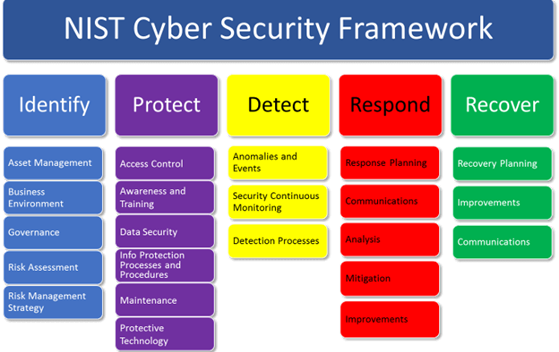
Base Your Security Strategy Significantly on the NIST Cybersecurity Framework 1.1: Identify, Detect Defend, Respond, and Recover:
The NIST Cybersecurity Framework Small Business Resources are linked here.
Fig. 2. NIST Cyber Security Framework Sub Tasks, NIST, 2022:
Require Employees to Use Strong Passwords and to Change Them Often:
Consider implementing multifactor authentication that requires additional information beyond a password to gain entry. Check with your vendors that handle sensitive data, especially financial institutions, to see if they offer multifactor authentication for your account. Smart card plus passcode for example.
Employ Best Practices on Payment Cards:
Work with your banks or card processors to ensure the most trusted and validated tools and anti-fraud services are being used. You may also have additional security obligations related to agreements with your bank or processor. Isolate payment systems from other, less secure programs and do not use the same computer to process payments and surf the Internet.
Outsource some or all of it and know where your risk responsibility ends.
Make Backup Copies of Important Business Data and Use Encryption When Possible:
Regularly backup the data on all computers. Critical data includes word processing documents, electronic spreadsheets, databases, financial files, human resources files, and accounts receivable/payable files. Backup data automatically if possible, or at least weekly, and store the copies either offsite or on the cloud.
Having all key files backed up via the 3-2-1 rule — three copies of files in two different media forms with one offsite — thus reducing ransomware attack damage.
Make Sure Your Vendors Have the Required Security Compliance Attestations and Insurance:
SOC 2, PCI, and HIPAA for example.
Cyber/data breach insurance should be separate from general business liability, and you should know the exclusions and sub-limits.
Use A Password Management Tool and Strong Passwords:
Another way to stay safe is by setting passwords that are longer, complex, and thus hard to guess. Additionally, they can be stored and encrypted for safekeeping using a well-regarded password vault and management tool. This tool can also help you to set strong passwords and can auto-fill them with each login — if you select that option. Yet using just the password vaulting tool is all that is recommended. Doing these two things makes it difficult for hackers to steal passwords or access your accounts.
Use Only Whitelisted Sites Not Blacklisted Ones or Ones Found Via the Dark Web:
Use only approved whitelisted platforms and sites that do not expose you to data leakages or intrusion on your privacy. Whitelisting is the practice of explicitly allowing some identified websites access to a particular privilege, service, or access. Backlisting is blocking certain sites or privileges. If a site does not assure your privacy, do not even sign up let alone participate.
Mimic Your Likely Threats with a Threat Modeling Methodology that works for your Industry:
Every year I like to research and commentate on the most impactful security technology and business happenings from the prior year. This year is unique since the pandemic and mass resignation/gig economy continues to be a large part of the catalyst for most of these trends. All these trends are likely to significantly impact small businesses, government, education, high tech, and large enterprise in big and small ways.
The pandemic continues to be a big part of the catalyst for digital transformation in tech automation, identity and access management (IAM), big data, collaboration tools, artificial intelligence (AI), and increasingly the supply chain. Disinformation efforts morphed and grew last year challenging data and culture. This requires us to put more attention on knowing and monitoring our own social media baselines. We no longer have the same office due to mass work from home (WFH) and the mass resignation/gig economy. This infers increased automated zero-trust policies and tools for IAM with less physical badge access required. The security perimeter is now more defined by data analytics than physical/digital boundaries.
The importance of supply chain cyber security was elevated by the Biden Administration’s Executive Order 1407 in response to hacks including SolarWinds and Colonial Pipeline. Education and awareness around the review and removal of non-essential mobile apps grows as a top priority as mobile apps multiply. All the while, data breaches, and ransomware reach an all-time high while costing more to mitigate.
1) Disinformation Efforts Accelerate Challenging Data and Culture:
Disinformation has not slowed down any in 2021 due to sustained advancements in communications technologies, the growth of large social media networks, and the “appification” of everything thereby increasing the ease and capability of disinformation. Disinformation is defined as incorrect information intended to mislead or disrupt, especially propaganda issued by a government organization to a rival power or the media. For example, governments creating digital hate mobs to smear key activists or journalists, suppress dissent, undermine political opponents, spread lies, and control public opinion (Shelly Banjo; Bloomberg, 05/18/2019).
Today’s disinformation war is largely digital via platforms like Facebook, Twitter, Instagram, Reddit, WhatsApp, Yelp, Tik-tok, SMS text messages, and many other lesser-known apps. Yet even state-sponsored and private news organizations are increasingly the weapon of choice, creating a false sense of validity. Undeniably, the battlefield is wherever many followers reside.
Bots and botnets are often behind the spread of disinformation, complicating efforts to trace and stop it. Further complicating this phenomenon is the number of app-to-app permissions. For example, the CNN and Twitter apps having permission to post to Facebook and then Facebook having permission to post to WordPress and then WordPress posting to Reddit, or any combination like this. Not only does this make it hard to identify the chain of custody and original source, but it also weakens privacy and security due to the many authentication permissions involved. The copied data is duplicated at each of these layers which is an additional consideration.
We all know that false news spreads faster than real news most of the time, largely because it is sensationalized. Since most disinformation draws in viewers which drives clicks and ad revenues; it is a money-making machine. If you can significantly control what’s trending in the news and/or social media, it impacts how many people will believe it. This in turn impacts how many people will act on that belief, good or bad. This is exacerbated when combined with human bias or irrational emotion. For example, in late 2021 there were many cases of fake COVID-19 vaccines being offered in response to human fear (FDA; 09/28/2021). This negatively impacts culture by setting a misguided example of what is acceptable.
There were several widely reported cases of political disinformation in 2021 including misleading texts, e-mails, mailers, Facebook censorship, and robocalls designed to confuse American voters amid the already stressful pandemic. Like a narcissist’s triangulation trap, these disinformation bursts riled political opponents on both sides in all states creating miscommunication, ad hominin attacks, and even derailed careers with impacts into the future (PBS; The Hinkley Report, 11/24/20 and Daniel Funke; USA Today, 12/23/21).
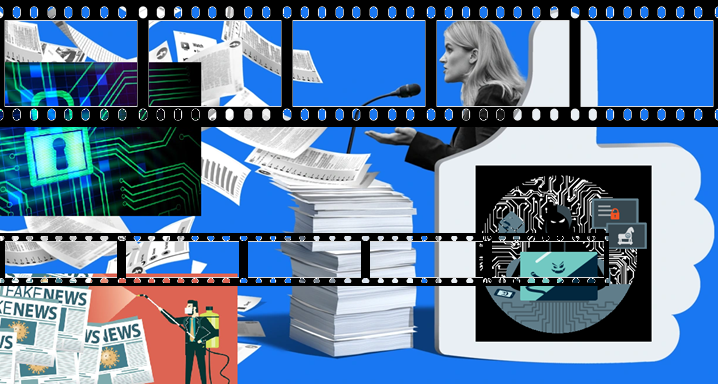
Facebook is significantly involved in disinformation as one recent study stated, “Globally, Facebook made the wrong decision for 83 percent of those ads that had not been declared as political by their advertisers and that Facebook or the researchers deemed political. Facebook both overcounted and undercounted political ads in this group” (New York University; Cybersecurity For Democracy, 2021). Of course, Facebook disinformation whistleblower Frances Haugen who testified before Congress in 2021 is only more evidence of these and related Facebook failings. Specifically that “Facebook executives, including CEO Mark Zuckerberg, misstated and omitted key details about what was known about Facebook and Instagram’s ability to cause harm” (Bobby Allyn; NPR, 10/05/21).
Fig. 2. Facebook Gaps in Ad Transparency (IMEC-DistriNet KU Leuven and NYU Cyber Security for Democracy, 2021).
With the help of Facebook’s misinformation, huge swaths of confused voters and activists aligned more with speculation and emotion/hype than unbiased facts, and/or project themselves as fake commentators. This dirtied the data in terms of the election process and only begs the question – which parts of the election information process are broken? This normalizes petty policy fights, emotional reasoning, lack of unbiased intellectualism – negatively impacting western culture. All to the threat actor’s delight. Increased public to private partnerships, more educational rigor, and enhanced privacy protections for election and voter data are needed to combat this disinformation.
2) Identity and Access Management (IAM) Scrutiny Drives Zero Trust Orchestration:
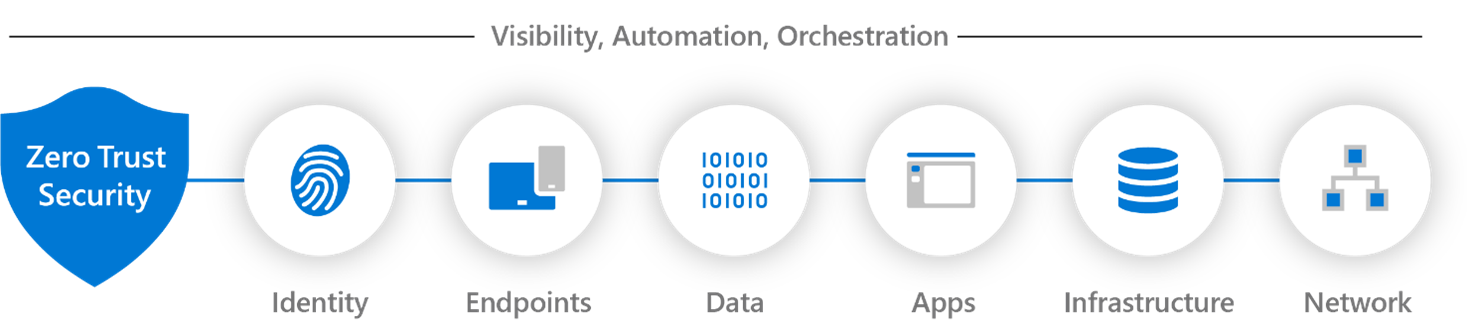
The pandemic and mass resignation/gig economy has pushed most organizations to amass work from home (WFH) posture. Generally, this improves productivity making it likely to become the new norm. Albeit with new rules and controls. To support this, 51% of business leaders started speeding up the deployment of zero trust capabilities in 2020 (Andrew Conway; Microsoft, 08/19/20) and there is no evidence to suggest this is slowing down in the next year but rather it is likely increasing to support zero trust orchestration. Orchestration is enhanced automation between partner zero trust applications and data, while leaving next to no blind spots. This reduces risk and increases visibility and infrastructure control in an agile way. The quantified benefit of deploying mature zero trust capabilities including orchestration is on average $ 1.76 million dollars less in breach response costs when compared to an organization who has not rolled out zero trust capabilities (IBM Security, Cost of A Data Breach Report, 2021).
Fig. 3. Zero Trust Components to Orchestration (Microsoft, 09/17/21).
Zero trust moves organizations to a need-to-know-only access mindset with inherent deny rules, all the while assuming you are compromised. This infers single sign-on at the personal device level and improved multifactor authentication. It also infers better role-based access controls (RBAC), firewalled networks, improved need-to-know policies, effective whitelisting and blacking listing of apps, group membership reviews, and state of the art PAM (privileged access management) tools for the next year. In the future more of this is likely to better automate and orchestrate (Fig. 3.) zero trust abilities so that one part does not hinder another part via complexity fog.
3) Security Perimeter is Now More Defined by Data Analytics than Physical/Digital Boundaries:
This increased WFH posture blurs the security perimeter physically and digitally. New IP addresses, internet volume, routing, geolocation, and virtual machines (VMs) exacerbate this blur. This raises the criticality of good data analytics and dashboarding to define the digital boundaries in real-time. Therefore, prior audits, security controls, and policies may be ineffective. For instance, empty corporate offices are the physical byproduct of mass WFH, requiring organizations to set default disable for badge access. Extra security in or near server rooms is also required. The pandemic has also made vendor interactions more digital, so digital vendor connection points should be reduced and monitored in real-time, and the related exception policies should be re-evaluated.
New data lakes and machine learning informed patterns can better define security perimeter baselines. One example of this includes knowing what percent of your remote workforce is on what internet providers and what type? For example, Google fiber, Comcast cable, CenturyLink DSL, ATT 5G, etc. There are only certain modems that can go with each of these networks and that leaves a data trail. Of course, it could be any type of router. What type of device do they connect with MAC, Apple, VM, or other, and if it is healthy can all be determined in relationship to security perimeter analytics.
4) Supply Chain Risk and Attacks Increase Prompting Government Action:
Every organization has a supply chain big or small. There are even subcomponents of the supply chain that can be hard to see like third/fourth-party vendors. A supply chain attack works by targeting a third/fourth party with access to an organization’s systems instead of hacking their networks directly.
In 2021 cybercriminals focused their surveillance on key components of the supply chain including hacking DNS servers, switches, routers, VPN concentrators and services, and other supply chain connected components at the vendor level. Of note was the massive Colonial Gas Pipeline hack that spiked fuel prices this last summer. This was caused by one compromised VPN account informed by a leaked password from the dark web (Turton, William; and Mehrotra, Kartikay; Bloomberg, 06/04/21). The SolarWinds hack was another supply chain-originated attack in that they got into SolarWinds IT management product Orien which in turn got them into the networks of most of the customers of that product (Lily Hay Newman; Wired, 12/19/21). The research consensus unsurprisingly ties this attack to Russian affiliated threat actors and there is no evidence contracting that.
In response to these and related attacks the U.S. Presidential Administration issued Executive Order 14017, the heart of which requires those who manufacture and distribute software a new awareness of their supply chain to include what is in their products, even open-source software (White House; 05/12/21). This in addition to more spending on CISA hiring and public relations efforts for vulnerabilities and NIST framework conformance. Time will tell what this order delivers as it is dependent on what private sector players do.
5) Data Breaches Have Greatly Increased in Number and Cost:
The pandemic has continued to be a part of the catalyst for increased lawlessness including fraud, ransomware, data theft, and other types of profitable hacking. Cybercriminals are more aggressively taking advantage of geopolitical conflict and legal standing gaps. For example, almost all hacking operations are in countries that do not have friendly geopolitical relations with the United States or its allies – and all their many proxy hops would stay consistent with this. These proxy hops are how they hide their true location and identity.
Moreover, with local police departments extremely overworked and understaffed with their number one priority being responding to the huge uptick in violent crime in most major cities, white-collar cybercrimes remain a low priority. Additionally, local police departments have few cyber response capabilities depending on the size of their precinct. Often, they must sheepishly defer to the FBI, CISA, and the Secret Service, or their delegates for help. Yet not unsurprisingly, there is a backlog for that as well with preference going to large companies of national concern that fall clearly into one of the 16 critical infrastructures. That is if turf fights and bureaucratic roadblocks don’t make things worse. Thus, many mid and small-sized businesses are left in the cold to fend for themselves which often results in them paying ransomware, and then being a victim a second time all the while their insurance carrier drops them.
Further complicating this is lack of clarity on data breach and business interruption insurance coverage and terms. Keep in mind most general business liability insurance policies and terms were drafted before hacking was invented so they are by default behind the technology. Most often general liability business insurance covers bodily injuries and property damage resulting from your products, services, or operations. Please see my related article 10 Things IT Executives Must Know About Cyber Insurance to understand incident response and to reduce the risk of inadequate coverage and/or claims denials.
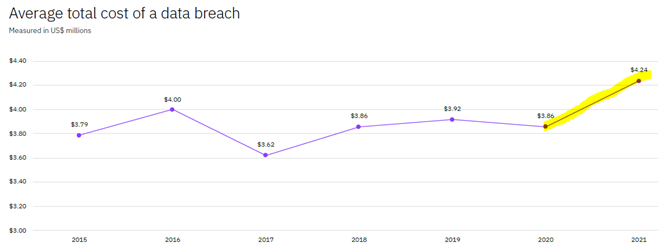
According to the Identity Theft Resource Center (ITRC)’s 2021Q3 Data Breach Report, there was a 17% year-over increase as of 09/30/21. This means that by the time they finish their Q4 2021 report it’s likely to be above a 30% year-over-year increase. Breaches are also more costly for organizations suffering them according to the IBM Security Cost of Data Breach Report (Fig 5).
Fig 5. Cost of A Data Breach Increases 2020 to 2021 (IBM Security, 2021).
From 2020 to 2021 the average cost of a data breach in U.S. dollars rose to $4.24 million from $3.86 million. This is almost a 10% increase at 9.1%. In contrast, the preceding 4 years were relatively flat (Fig 5). The pandemic and policing conundrum is a considerable part of this uptick.
Lastly, this is a lot of money for an organization to spend on a breach. Yet this amount could be higher when you factor in other long-term consequence costs such as increased risk of a second breach, brand damage, and/or delayed regulatory penalties that were below the surface – all of which differs by industry. In sum, it is cheaper and more risk prudent to spend even $4.24 million or a relative percentage at your organization on preventative zero trust capabilities than to deal with the cluster of a data breach.
Take-Aways:
COVID-19 remains a catalyst for digital transformation in tech automation, IAM, big data, collaboration tools, and AI. We no longer have the same office and thus less badge access is needed. The growth and acceptability of mass WFH combined with the mass resignation/gig economy remind employers that great pay and culture alone are not enough to keep top talent. Signing bonuses and personalized treatment are likely needed. Single sign-on (SSO) will expand to personal devices and smartphones/watches. Geolocation-based authentication is here to stay with double biometrics likely. The security perimeter is now more defined by data analytics than physical/digital boundaries, and we should dashboard this with machine learning and AI tools.
Education and awareness around the review and removal of non-essential mobile apps is a top priority. Especially for mobile devices used separately or jointly for work purposes. This requires a better understanding of geolocation, QR code scanning, couponing, digital signage, in-text ads, micropayments, Bluetooth, geofencing, e-readers, HTML5, etc. A bring your own device (BYOD) policy needs to be written, followed, and updated often informed by need-to-know and role-based access (RBAC) principles. Organizations should consider forming a mobile ecosystem security committee to make sure this unique risk is not overlooked or overly merged with traditional web/IT risk. Mapping the mobile ecosystem components in detail is a must.
IT and security professionals need to realize that alleviating disinformation is about security before politics. We should not be afraid to talk about it because if we are then our organizations will stay weak and insecure and we will be plied by the same political bias that we fear confronting. As security professionals, we are patriots and defenders of wherever we live and work. We need to know what our social media baseline is across platforms. More social media training is needed as many security professionals still think it is mostly an external marketing thing. Public-to-private partnerships need to improve and app to app permissions need to be scrutinized. Enhanced privacy protections for election and voter data are needed. Everyone does not need to be a journalist, but everyone can have the common sense to identify malware-inspired fake news. We must report undue bias in big tech from an IT, compliance, media, and a security perspective.
Cloud infra will continue to grow fast creating perimeter and compliance complexity/fog.Organizations should preconfigure cloud-scale options and spend more on cloud-trained staff. They should also make sure that they are selecting more than two or three cloud providers, all separate from one another. This helps staff get cross-trained on different cloud platforms and add-ons. It also mitigates risk and makes vendors bid more competitively.
The increase in number and cost of data breaches was in part attributed to vulnerabilities in supply chains in a few national data breach incidents in 2021. Part of this was addressed in President Biden’s Executive Order 1407 on supply chain security. This reminds us to replace outdated routers, switches, repeaters, controllers, and to patch them immediately. It also reminds us to separate and limit network vendor access points to strictly what is needed and for a limited time window. Last but not least, we must have up-to-date thorough business interruption / cyber insurance with detailed knowledge of what it requires for incident response with breach vendors pre-selected.
About the Author:
Jeremy Swenson is a disruptive thinking security entrepreneur, futurist/researcher, and senior management tech risk consultant. Over 17 years he has held progressive roles at many banks, insurance companies, retailers, healthcare orgs, and even governments including being a member of the Federal Reserve Secure Payment Task Force. Organizations relish in his ability to bridge gaps and flesh out hidden risk management solutions while at the same time improving processes. He is a frequent speaker, published writer, podcaster, and even does some pro bono consulting in these areas. As a futurist, his writings on digital currency, the Target data breach, and Google combining Google + video chat with Google Hangouts video chat have been validated by many. He holds an MBA from St. Mary’s University of MN, a MSST (Master of Science in Security Technologies) degree from the University of Minnesota, and a BA in political science from the University of Wisconsin Eau Claire.
1) We knew there would come another well-positioned company who makes a pair of smart glasses like Google Glass and that it will derive more competition and innovation. Microsoft raised their hand right away with their HoloLens glasses which are hologram based, slightly “gamified”, and seemingly better than Google Glass largely because they tied it in with known Windows functionality (broader offerings). See a video of this cool new technology here:
2) It is a fact that on average people now access more of their e-mail via mobile devices more often than on a traditional computer. This has forced websites, news makers, and companies to design their web offerings in a mobile compatible design so when you go to the web on a computer the sites are often overly mobile in their design aspects and sometimes look goofy and the buttons and frames are too big. CNN.com is a good example of a web-site that went too far with their mobile design so if you access it from a normal computer it looks more like a kids play web-site with big buttons and frames optimized for touch with little info presented. Yet their prior design was better especially if you want to read more on one screen view.
(Old vs. New CNN.com, respectively) There is no doubt that mobile will continue to grow and will be used on smaller devices like watches, ear buds, pacemakers, and contact lenses. Web design has shifted so fast to mobile that sometimes good web design and user experience is forgotten about for non-mobile users or business users who on average spend much more time on those same sites than mobile users. Thus a better balance of the two design types is needed, and an app is a separate project all together yet still needed. I also think Microsoft will take more mobile market share away from Android and Apple since they have learned a lot from their Windows 8 release and are quickly working to release Windows 10 as a better touch based mobility optimized O.S. that many are excited to try.
3) There will be more data breaches but many of them will be supported by the Western Governments who in effect devalue security standards by corroborating with large companies to quarry vast amounts of metadata all in the name of security. Sadly we know Governments have abused this power in the past and will continue to do so thus the private sector needs to collaborate and inspire innovation in this space for better security and transparency so the masses may have security and corrupt Governments can be exposed.
As it stands now hackers are a few steps ahead of antivirus makers and they are constantly tweaking their viruses so they can’t be detected. The newest types of viruses are suspected to be created by the Equation Group, one of the most sophisticated hacking groups ever known. These new viruses hide in your hard drives firmware and are undetectable. Antivirus maker Kaspersky commented on this in their Q&A doc on the Equation Group by stating, “We were able to recover two HDD firmware reprogramming modules from the EQUATIONDRUG and GRAYFISH platforms. The EQUATIONDRUG HDD firmware reprogramming module has version 3.0.1 while the GRAYFISH reprogramming module has version 4.2.0. These were compiled in 2010 and 2013, respectively, if we are to trust the PE timestamps” (http://25zbkz3k00wn2tp5092n6di7b5k.wpengine.netdna-cdn.com/files/2015/02/Equation_group_questions_and_answers.pdf).
Kaspersky went on to further speculate that there were clues that the U.S. N.S.A. was involved in the latest hard drive firmware virus and even suggested they had the cooperation of major hard drive makers like Western Digital, Seagate, Samsung, and Toshiba in order to get the code needed to write the virus. Any reasonable technologist would likely agree with this. Yet this decreases innovation and free competition and you know big money likely traded hands to make these deals happen. How can a big company now trust paying a technology company for security or services when they are just going to give it away to supposed governments here or elsewhere? More importantly, if one government has the ability to get into a tech companies data, then other more ill-intentioned governments and organizations can quickly learn how to do that as well and that is the real threat.
If you want to hire me to speak at your next event or consult for your company on these and related topics please contact me.
In the holiday shopping rush of December 2013 Target (TGT), the 1,778 store middle market retailer, had one of the biggest data breaches in American business history. The breach apparently affected more than 70-100 million customers over 40 million cards (varying estimates exist) across all U.S. stores but excluded Target.com and stores in Canada. The general consensus is that a HVAC contractor for Target, Fazio Mechanical Services, who had access to Target’s networks got their own networks hacked via an e-mail phishing attack, normally an elementary attack method; yet that attack installed malware that then got onto Target’s network and installed more malware that copied personal data from Target’s payment processing terminals when it was in the “working memory area” or “cache” of the software/system – that is before it gets encrypted to be sent to the bank to be authorized. This is part of the reason why it was not detected so fast and yes these hackers were smart.
Yet Target also did a bad job separating their networks and servers while they were trying to save money by having less networks and broader access for those who needed them. Yet I don’t see why an HVAC contractor would need to be so close to the networks that work the registers. This is simply poor design. I am sure the HVAC company could have done their job without access to the Target network. Let’s not hope they just wanted to upload HVAC reports and browse the network.
According to a recent Business Week article, “Target had a team of security specialists in Bangalore to monitor its computers around the clock. If Bangalore noticed anything suspicious, Target’s security operations center in Minneapolis would be notified. On Saturday, Nov. 30, the hackers had set their traps and had just one thing to do before starting the attack: plan the data’s escape route. As they uploaded exfiltration malware to move the stolen credit card numbers—first to staging points spread around the U.S. to cover their tracks, then into their computers in Russia—FireEye spotted them. Bangalore got an alert and flagged the security team in Minneapolis.” (http://www.businessweek.com/articles/2014-03-13/target-missed-alarms-in-epic-hack-of-credit-card-data) Yet Target did not take this alert seriously but why? Fear of change, ego, poor leadership, and too much bureaucracy got in the way of the costly software’s effectiveness. At the time of the breach FireEye was a new software tool for Target’s technology group and what I know about new technology is that people delay embracing and learning new systems of out of fear that those systems will be buggy or not as good as the old ones. I understand this very well having worked part time in the P.C. dept. at Best Buy for more than 3.7 years representing Intel and related software makers Microsoft, Symantec, Trend Micro, and Adobe. When Windows 8 came out all kinds of people were doubting it not because it was bad but because it was more work to get to know, and if they saw something really different about it, they were inclined to think it was a bug when in fact it was a useful design feature they didn’t yet understand. The same bias can be applied to Apple computers. People falsely think that they are immune from viruses because Apple designs them that way. What a joke. Apple computers are only as secure as their understanding of the latest virus. Yes it is true the Apple operating system is not targeted as much for viruses but it is also not used as much and it is hardly used by large companies and governments.
Moving on, the CIO really needs to get behind any major software change like this, and if Target’s former CIO Beth Jacob was really behind FireEye she probably would have done something about the alerts they were giving her. You would think as CIO she would want to immediately act and reduce any risk. What was she doing at the time, giving some speech about how she was such a great leader in the industry while some high buck corporate partner pays for her three-course lunch? Clearly, her eye was not on the ball or even on Target (no pun intended), and she had a big enough ego to think she was smart enough and had put the right people on her team to take care of this. Yet what an epic fail. It is also likely that there were people some layers below Jacob that tried to inform others to the alert but I am sure their voice of concern and reason got squashed by Jacob’s massive ego, after all you can’t doubt a CIO – right? I highly doubt everyone in Target’s IT security team was going to ignore these alerts but it is too many layers of bureaucracy that got in the way of Target’s safety. Target is better off with a more open style of bureaucracy where concerns can be heard at all levels and tools and processes are shared for innovative solutioning – Google’s culture is a good example of this.
Target has also grossly underestimated the costs associated with the data breach to keep their stock price up but of course they would never say it like that, however I am not alone in thinking Target’s $147 million figure is too low. According to one analyst, “costs would rise even more over time. “I don’t see how they’re getting out of this for under a billion, over time,” he said, adding, “$150 million in a quarter seems almost like a bargain.” (http://www.nytimes.com/2014/08/06/business/target-puts-data-breach-costs-at-148-million.html?_r=0)
Those who have the stolen data are likely outside of the U.S. and when and if they use the data to commit fraud the ability of a U.S. corporation or court to go after them is diminished, timely, and costly. Moreover, since the U.S is the midst of negative geo-politics with parts of Europe, particularly Russia where some sources have traced the hack, those who have the data are likely to be bold in how they use it and that’s where the cost to Target will add up. The other areas where the costs will grow is in Target’s own internal policy and procedure changes as well as the growth of their IT security staff and tools, but most importantly their investment in training must grow. At present Target has over more than 90 lawsuits against them regarding the breach and that number is likely to grow so the costs here are going to be huge overall.
Lastly, I am not all negative on the Twin Cities’ favorite corporate hometown hero as I shop at Target often, have the REDCard, have been to their diversity events, and I have also seen a lot of concerts and sporting events at both Target Field and the Target Center. However, the mere fact that Target has the money and lobbying power to get their name in the community does not mean they are a true leader in the community. As the data security community increases consumer awareness retailers like Target will continue to be challenged to innovate and that’s better for all people.





 1) We knew there would come another well-positioned company who makes a pair of smart glasses like Google Glass and that it will derive more competition and innovation. Microsoft raised their hand right away with their HoloLens glasses which are hologram based, slightly “gamified”, and seemingly better than Google Glass largely because they tied it in with known Windows functionality (broader offerings). See a video of this cool new technology here:
 There is no doubt that mobile will continue to grow and will be used on smaller devices like watches, ear buds, pacemakers, and contact lenses. Web design has shifted so fast to mobile that sometimes good web design and user experience is forgotten about for non-mobile users or business users who on average spend much more time on those same sites than mobile users. Thus a better balance of the two design types is needed, and an app is a separate project all together yet still needed. I also think Microsoft will take more mobile market share away from Android and Apple since they have learned a lot from their Windows 8 release and are quickly working to release Windows 10 as a better touch based mobility optimized O.S. that many are excited to try.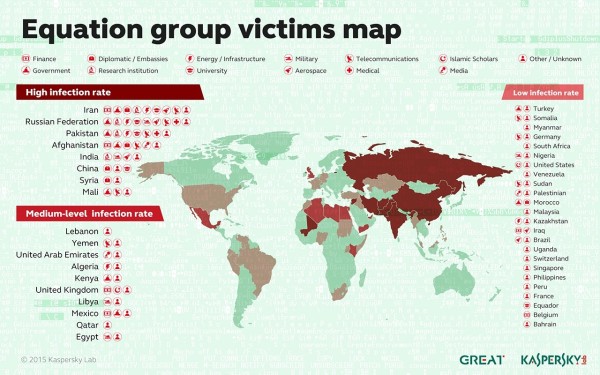
 The general consensus is that a HVAC contractor for Target, Fazio Mechanical Services, who had access to Target’s networks got their own networks hacked via an e-mail phishing attack, normally an elementary attack method; yet that attack installed malware that then got onto Target’s network and installed more malware that copied personal data from Target’s payment processing terminals when it was in the “working memory area” or “cache” of the software/system – that is before it gets encrypted to be sent to the bank to be authorized. This is part of the reason why it was not detected so fast and yes these hackers were smart.
 Yet Target did not take this alert seriously but why? Fear of change, ego, poor leadership, and too much bureaucracy got in the way of the costly software’s effectiveness. At the time of the breach FireEye was a new software tool for Target’s technology group and what I know about new technology is that people delay embracing and learning new systems of out of fear that those systems will be buggy or not as good as the old ones. I understand this very well having worked part time in the P.C. dept. at Best Buy for more than 3.7 years representing Intel and related software makers Microsoft, Symantec, Trend Micro, and Adobe. When Windows 8 came out all kinds of people were doubting it not because it was bad but because it was more work to get to know, and if they saw something really different about it, they were inclined to think it was a bug when in fact it was a useful design feature they didn’t yet understand. The same bias can be applied to Apple computers. People falsely think that they are immune from viruses because Apple designs them that way. What a joke. Apple computers are only as secure as their understanding of the latest virus. Yes it is true the Apple operating system is not targeted as much for viruses but it is also not used as much and it is hardly used by large companies and governments.
 Abstract Forward Consulting