
By Jeremy Swenson
Thirty-one. That is how many unaddressed safety-and-soundness supervisory warnings Silicon Valley Bank was sitting on when it collapsed in March 2023—roughly triple the number carried by comparable banks. The warnings existed. Examiners had written them down. Committees had reviewed them. And the bank failed anyway, in 36 hours, taking $209 billion in assets down with it.[1]
This figure isn’t really just about Silicon Valley Bank; it’s a broader story about how governance can falter right when it was meant to prevent failure. Across modern sectors like finance, healthcare, insurance, and tech—especially under heavy regulation—the structure is quite similar: a First Line managing risks, a Third Line (Internal Audit) independently evaluating effectiveness, and a Second Line acting as an oversight layer to challenge and ensure risk remains within boundaries before issues arise.
The uncomfortable pattern across nearly every major governance failure of the last fifteen years is not that the second line was absent. It was there, busy, and documented—and it still didn’t work.
That is the uncomfortable pattern across nearly every major governance failure of the last fifteen years: the second line of defense (2LOD) was rarely absent. It was there, it was busy, and it was thoroughly documented. JPMorgan’s Chief Investment Office had risk managers. Credit Suisse’s Prime Services division had a dedicated risk team. Wells Fargo had a corporate risk function, a legal department, and an audit group that all reviewed the Community Bank. Danske Bank’s Estonian branch had internal audit and a chief risk officer. In each case, the paperwork existed. The risk did not go away.
This raises the question at the center of this piece, and one that boards, regulators, and chief risk officers are increasingly asking out loud: is the modern second line of defense actually reducing risk—or is it primarily producing evidence that governance activities occurred? The two are not the same thing, and the gap between them is where some of the costliest failures in recent corporate history have lived.
What the Second Line Is Supposed to Do
The three-lines model that underpins risk governance at virtually every large regulated institution was formalized by the Institute of Internal Auditors in 2013 and substantially updated in 2020. The first line is operational management—the traders, lenders, engineers, and business unit leaders who own risk because they create it in the course of doing their jobs. The third line is internal audit, an independent function that reports to the board and periodically tests whether the first two lines are actually working. The second line sits in the middle: risk management, compliance, information security, and similar functions that provide, in the Institute’s own language, “complementary expertise, support, monitoring, and challenge” to the business.[2]
In U.S. banking specifically, this structure is not just best practice—it is regulatory expectation with teeth. The Office of the Comptroller of the Currency’s (OCC) 2014 heightened standards for large national banks explicitly require an independent risk management function, organizationally and financially separate from the business lines it oversees. The Federal Reserve’s 2011 guidance on model risk management, SR 11-7, assigns the second line an independent validation role specifically because business lines have an inherent incentive to trust their own models.[3]
Notably, when the Institute of Internal Auditors rewrote its guidance in 2020, it deliberately dropped the word “defense” from the model’s name, worried that the martial framing had encouraged organizations to treat risk management as purely defensive—blocking and reviewing—rather than as a function that helps an organization take the right risks well. That single word change is a useful preview of this piece’s argument: a second line built entirely around defense metrics—how many reviews were completed, how many policies exist, how many attestations were signed—can satisfy every requirement on paper while missing the actual point.[4]
Where the Model Breaks Down
Strip away the acronyms, and the recurring failure modes of the second line reduce to a short, uncomfortable list. Each one, on its own, sounds like a minor process gap. Together, and when combined with real money and real institutions, they have produced some of the largest corporate governance failures on record.
Documentation Instead of Risk Reduction
The clearest symptom is a second line that measures itself by volume: reviews completed, policies published, attestations collected, meetings held. Every one of those activities can be running at full capacity while the underlying risk grows untouched, because none of them require anyone to verify that a control actually works—only that someone said it does.
Self-Attestation Over Independent Verification
Much of traditional second-line practice depends on the first line telling the second line the truth: attestations, self-assessments, and point-in-time control tests that sample a narrow window and assume it represents the whole. When Danske Bank’s Estonian branch was later examined, the bank’s own lawyers conceded that “major deficiencies in controls and governance made it possible to use Danske Bank’s branch in Estonia for criminal activities such as money laundering,” and that internal reporting simply never reached the people positioned to stop it.[5]
Individual Exceptions Over Systemic Patterns
Second lines are often organized to catch one broken control at a time—a missed reconciliation, a late report, an expired certificate—rather than to notice that dozens of small, individually explainable exceptions are actually one large, systemic problem wearing different clothes.
Compliance Treated as a Proxy for Safety
Perhaps the most persistent conflation in second-line practice is the assumption that a control environment which satisfies a regulation is therefore a control environment that manages the underlying risk. The two frequently travel together. They are not the same claim, and treating them as interchangeable is exactly how organizations end up technically compliant and substantively exposed at once.
A Challenge Function That Doesn’t Actually Challenge
Effective second-line challenge requires two things that are hard to combine: enough independence to say no to a profitable business line, and enough technical and commercial fluency to know when “no” is actually warranted. Many second lines have one without the other—independent enough to be disliked, but not fluent enough in the actual business to be heeded, or so embedded in the business that independence quietly erodes.
Struggling to Govern What It Doesn’t Understand
Every one of the weaknesses above compounds sharply the moment the underlying risk is technical: artificial intelligence models, cloud migrations, third-party data pipelines, or novel cyber threats. A second line built to review loan files and sales scripts is not automatically equipped to evaluate a machine learning model’s training data lineage or a cloud vendor’s shared-responsibility boundary—and regulators are now saying so explicitly. NIST’s AI Risk Management Framework (RMF) and the broader push toward AI-specific governance exist precisely because traditional control catalogs were not written with adaptive, probabilistic systems in mind.[6]
Five Failures, One Pattern
These are not abstractions. They are the documented findings of regulators, board-appointed investigators, and congressional committees—and read together, they describe the same failure recurring in different industries, different countries, and different decades.
1. JPMorgan’s “London Whale” (2012)—When Risk Managers Don’t Know What the Business Is Doing
In 2012, JPMorgan Chase’s Chief Investment Office lost more than $6.2 billion on a series of synthetic credit derivative trades that came to be known as the “London Whale.” The U.S. Senate Permanent Subcommittee on Investigations spent nine months and reviewed more than 90,000 documents before concluding that the unit had mismarked its trading book to hide losses, disregarded multiple indicators of increasing risk, manipulated its own risk models, and evaded regulatory oversight.[7]
The Subcommittee’s report found that JPMorgan’s firm-wide risk managers—the second line—“knew little about” the trading strategy and had no role in approving the positions that produced the loss, even as the bank’s own public statements insisted the trades were consistent with firm-wide risk management. This was a second line that existed on the org chart and was functionally absent from the transaction that mattered most.[8]
2. Wells Fargo’s Sales Practices Scandal (2011–2016)—When Egos and Tenure Silence the Second Line
Between 2011 and 2016, Wells Fargo employees opened millions of unauthorized accounts to meet aggressive sales quotas, ultimately leading to the termination of roughly 5,300 employees and $185 million in regulatory penalties. When the bank’s independent directors released their own 110-page investigation in 2017, the findings went well beyond a rogue sales culture.[9]
The report found that Carrie Tolstedt, the long-tenured head of the Community Bank, and other Community Bank leaders “resisted and impeded scrutiny or oversight from corporate risk management and the Board,” and “minimized the scale and nature of problems” when they were forced to report them. Then-CEO John Stumpf, the report found, relied on “the Bank’s decades of success” and was “too slow to investigate or critically challenge” the sales model—a textbook description of tenure-driven bias, where years of past success become evidence against present-day concerns rather than a reason to look harder.[10]
Just as tellingly, the report found that Wells Fargo’s control functions were structurally weakened by internal politics: risk, legal, HR, and audit were “decentralized” and had “parallel units” embedded inside the Community Bank itself, reporting up through business-aligned structures that deferred to the business rather than challenging it. Audit reviewed the relevant controls and largely found them effective—but, the report notes pointedly, “it did not view its role to include analyzing more broadly the root cause of the improper conduct.” That is the governance-activity trap in a single sentence: the review happened, the box was checked, and the actual problem sailed through untouched.[11]
3. Credit Suisse and Archegos (2021)—When the Second Line Is Afraid to Say No
In March 2021, the collapse of Archegos Capital Management, a lightly regulated family office, cost Credit Suisse $5.5 billion—more than any other bank exposed to the same client. The board-commissioned investigation by Paul, Weiss found no fraud and no missing risk architecture. The controls existed. What failed was the willingness to use them.[12]
The investigation found a “persistent failure” to manage and remediate known risks connected to Archegos, and, more specifically, that Credit Suisse’s risk managers had intended to demand additional margin from Archegos to reflect its mounting credit risk—but were prevented from doing so because the business “deemed” it not to be in the bank’s commercial interest to upset the relationship. One outside review summarized the underlying dynamic bluntly: this was “a business more scared of losing a client than addressing the risks that client was bringing to the bank.” The report also found the Prime Services risk team itself was understaffed, had failed to replace departing senior risk staff, and lacked leadership experience—the second line, quite literally, hollowed out from within.[13]
4. Danske Bank Estonia (2007–2018)—When the Second Line Covers Its Own Mistakes
Danske Bank’s Estonian branch moved an estimated $230 billion in suspicious transactions, much of it linked to Russia, between 2007 and 2015—one of the largest money-laundering cases in European history. It might never have come to light if not for Howard Wilkinson, a British trader who filed four internal whistleblower reports to the bank’s audit unit and Copenhagen management between 2013 and 2014.[14]
Wilkinson later testified before the Danish and European Parliaments that the bank had “deliberately ignored” his warnings and that an Estonia branch executive told him the bank was “not the police.” An internal Danske audit team eventually validated the substance of his concerns, yet the bank still failed to take meaningful action until the money-laundering scandal became public in 2018—four years later. As Wilkinson departed the bank, he was reportedly presented with a nondisclosure agreement. This is the sharpest version of the pattern this piece was asked to examine directly: not a second line that failed to notice a problem, but one that noticed, confirmed it internally, and chose containment over correction—protecting the institution’s narrative rather than fixing the underlying failure.[15]
5. Silicon Valley Bank (2023)—When Periodic Reviews Can’t Keep Up With Real-Time Risk
SVB failed in 36 hours following a bank run, but the vulnerabilities behind it built for years. The Federal Reserve’s own review, led by Vice Chair for Supervision Michael Barr, is remarkable for how directly a regulator indicted its own supervisory process: SVB’s board and management “failed to manage their risks,” Federal Reserve supervisors “did not fully appreciate the extent of the vulnerabilities” as the bank grew, and—critically—even when supervisors did identify problems, they “did not take sufficient steps to ensure that Silicon Valley Bank fixed those problems quickly enough.”[16]
The report also found that SVB itself had changed its own risk-management assumptions specifically to reduce how its interest rate risk was measured, rather than managing the underlying exposure—a second-line control quietly redefined until it stopped producing uncomfortable answers. Barr’s report is also a rare admission that periodic, point-in-time supervisory cycles are structurally too slow for a risk that can move at deposit-run speed; a regulator reaching the same conclusion this piece reaches about the second line more broadly.[17]
What Regulators Learned—And Where Their Own Findings Converge
The most useful evidence that this is a systemic problem, not a string of unrelated scandals, comes from the regulators themselves. On April 28, 2023, the Federal Reserve and the Federal Deposit Insurance Corporation (FDIC) each released their own self-critical report on the same weekend of bank failures—an unusually candid coincidence that let the two reports be read side by side.
The Fed’s report on SVB, discussed above, found that supervisors identified real vulnerabilities but did not escalate forcefully enough once they had. The FDIC’s own report on Signature Bank reached a strikingly similar structural conclusion through a completely separate investigation: the bank’s failure was rooted in poor management, but the report also found that FDIC examiners had downgraded Signature’s liquidity rating as early as 2017 while its overall composite rating stayed at a healthy “2-Satisfactory” for six more years—a gap between what examiners were seeing and what the supervisory rating actually communicated.[18]
The U.S. Government Accountability Office (GAO) took a further step by reviewing both agencies together rather than separately. It concluded that this supports the main argument of this piece concerning federal banking regulation: the Federal Reserve and FDIC “identified numerous concerns at the banks as early as 2018, but did not issue enforcement actions.” Additionally, the GAO pointed out that the Federal Reserve’s “procedures for moving from a lower-level concern to an enforcement action often weren’t clear or specific.” This indicates that a regulator, assessing itself, independently recognizes the same core idea discussed here: identifying a risk is not the same as forcing a change. An institution can recognize risks on a large scale for years without reliably enforcing change.[19]
Read together with the NIST AI Risk Management Framework’s push for governance built around measurable, continuous risk assessment rather than static control catalogs, and the IIA’s 2020 shift away from purely defensive framing, a consistent regulatory direction emerges across otherwise unrelated bodies: less faith in point-in-time review, more emphasis on forcing identified risk into actual remediation, and explicit skepticism that documentation volume is a reliable proxy for safety. None of these bodies coordinated with each other. They arrived at overlapping conclusions anyway, because they were all looking at the same underlying failure pattern from different angles.[20],[21]
Figure 1. Most second-line functions do not lack activity—they sit in the high-activity, low-reduction quadrant, producing evidence of governance without changing risk outcomes.

The Part Nobody Puts in the Org Chart: Tenure, Ego, and Internal Turf Wars
Every case above shares a dynamic that rarely appears in a governance framework diagram but shows up in nearly every post-mortem: the people closest to a mistake are often the ones best positioned to prevent its discovery, and organizational tenure tends to make that worse rather than better.
Long-tenured leaders accumulate something more dangerous than complacency—they accumulate authorship. A risk model, a sales program, a client relationship built over a decade is not just a business asset to the person who built it; it is proof of their own judgment. Wells Fargo’s Board Report describes exactly this pattern in Carrie Tolstedt, who had run the Community Bank for years and treated challenges to the sales model as challenges to her track record, not as useful information. John Stumpf’s decades at the company produced the same effect at the top: reliance on “decades of success” became a reason to discount new evidence rather than investigate it.[22]
Ego compounds this in a specific and predictable way inside the second line itself: once a risk function has signed off on something—approved a model, cleared a client, blessed a control—reversing that judgment later means admitting the earlier review was wrong. The Credit Suisse-Archegos investigation found that risk staff who wanted to tighten margin requirements were overruled by colleagues managing the client relationship, who prioritized the commercial relationship over the escalation. That is not a hypothetical about incentives; it is a documented instance of one part of the organization protecting a prior decision instead of correcting course.[23]
The most direct evidence of internal fighting to cover mistakes is Danske Bank. Wilkinson’s own account describes a bank that did not simply fail to notice a problem—it received internal confirmation that the problem was real, from its own audit function, and chose a non-disclosure agreement and years of silence over disclosure and remediation. That is not a control gap. It is a second line, or the executives who supervise it, actively managing the appearance of the problem rather than the problem itself—the containment instinct that shows up whenever an admission of error threatens a career, a bonus cycle, or a carefully maintained reputation.[24]
A second line that cannot survive telling the truth about its own prior mistakes will eventually stop looking for them.
None of this requires malice to be dangerous. Most of the people in these stories were not villains; they were professionals whose incentives, tenure, and self-image quietly bent the direction of ambiguous judgment calls toward “this is probably fine.” A modern second line has to be designed with the explicit assumption that this bending will happen—through rotation of long-tenured reviewers, external validation of internally cleared decisions, and protected channels for escalation that do not depend on the goodwill of the person whose earlier judgment is being questioned.
Governance Activity Is Not the Same as Risk Reduction
Every case study mentioned earlier successfully passed a compliance test before turning into a scandal. This is the key point repeatedly emphasized here: governance that merely shows evidence of compliance is different from governance that genuinely reduces risk. An organization can generate a lot of documentation proving compliance but still fall short in actually altering risk outcomes.
Evidence-of-compliance governance is legible, defensible in an exam, and relatively cheap to produce: a signed attestation, a completed checklist, a policy that has been “reviewed and approved.” Outcome-based governance is harder and more expensive: independently tested controls, risk metrics tied to actual loss experience, escalation paths that get used even when the news is bad. The first kind of governance protects the organization in an audit. The second kind protects the organization in a crisis. Wells Fargo, Credit Suisse, and Danske Bank all had abundant supplies of the first and a critical shortage of the second.
Figure 2. Modernizing the second line means shifting the underlying operating model, not just increasing the volume of existing activity.
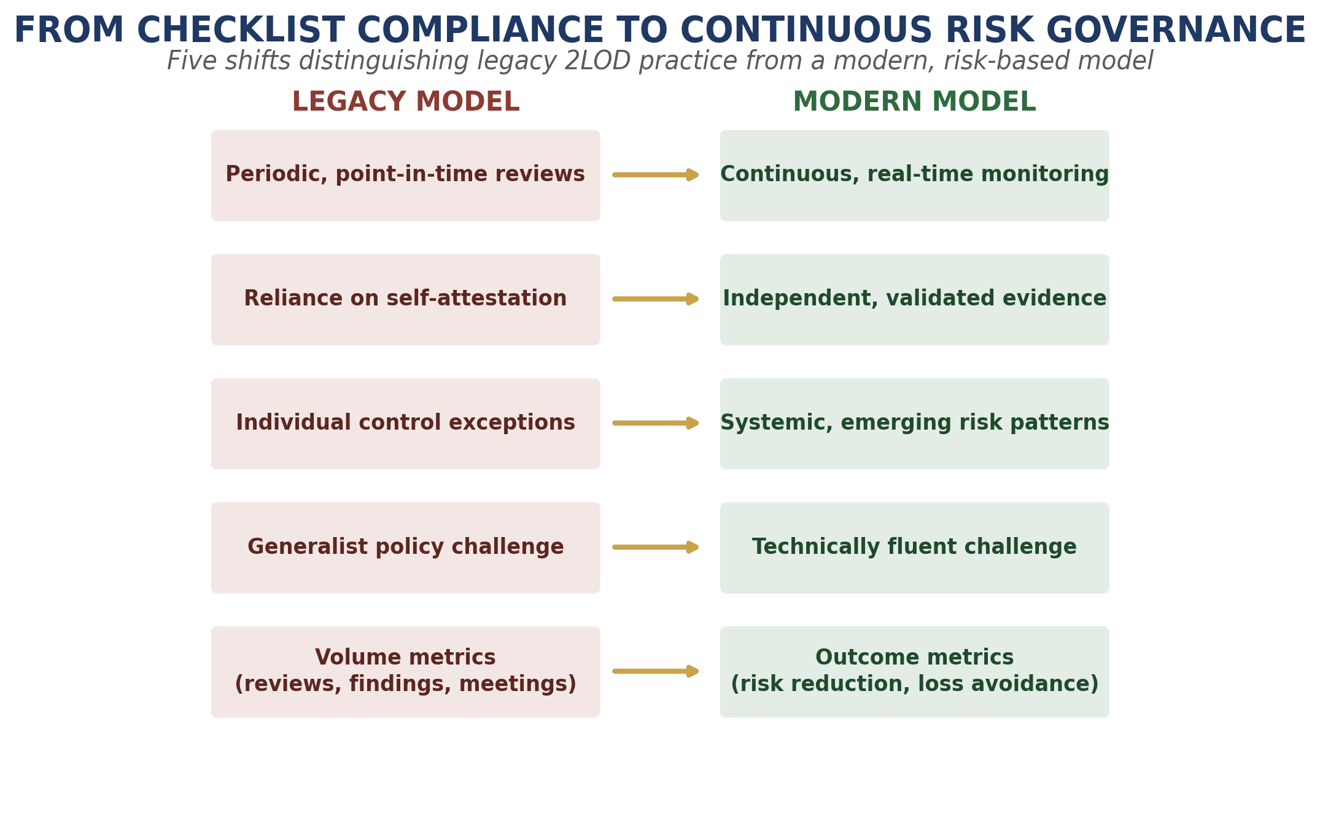
What a Modern Second Line Actually Looks Like
None of this argues for a weaker second line—every case study here shows the cost of that. It argues for a fundamentally different operating model, one that a growing body of regulatory guidance and industry practice is already pointing toward.
Risk-Based, Not Checklist-Based
Oversight intensity should scale with actual risk and complexity, not with how many items happen to be on a standard control list. A stable, well-understood process and a novel AI model deployed into a regulated decision workflow should never receive the same depth of review simply because both appear as line items on the same checklist.
Continuous Monitoring, Not Periodic Snapshots
The Barr report on SVB is itself an argument for this shift: point-in-time exams cannot keep pace with risks—interest rate exposure, deposit concentration, model drift—that can move materially between review cycles. Where technology allows it, continuous, automated monitoring should replace calendar-driven review as the default, with periodic deep-dives reserved for the risks continuous monitoring cannot yet see.
Evidence Over Attestation
Self-reported control effectiveness should be treated as a starting hypothesis, not a conclusion. Independent data validation—sampling actual transactions, actual model outputs, actual system logs—is more expensive than collecting a signature, and it is the only version of assurance that would have caught what self-attestation missed at Danske Bank.
Genuine Business and Technology Fluency
A second line cannot challenge what it does not understand. This means recruiting and developing risk professionals with real technical depth—in derivatives, in cloud architecture, in machine learning—rather than treating the second line as a generalist compliance career track. JPMorgan’s risk managers not knowing what the CIO’s synthetic credit portfolio actually did is the clearest cautionary tale on this point.
Escalation That Survives Internal Politics
Escalation paths need to be structurally protected from the relationship dynamics that killed escalation at Credit Suisse and Danske Bank—which means routing serious concerns to a level of the organization with no commercial stake in the outcome, and protecting the people who raise them, not just on paper but in how the organization actually treats them afterward.
Outcome-Based Metrics
A second line’s effectiveness should be measured by risk events avoided, losses prevented, and issues resolved before they compound—not by the number of reviews completed, policies published, or meetings held. Volume metrics are easy to game and easy to satisfy without changing anything; outcome metrics are harder to fake.
Real Oversight of AI, Cloud, and Third Parties
Emerging-technology governance needs its own competency track within the second line, built around frameworks purpose-designed for these risks—NIST’s AI Risk Management Framework, cloud shared-responsibility models, and structured third-party risk programs—rather than an attempt to stretch legacy control catalogs over technology they were never built to evaluate.[25]
Clear Accountability Between the First and Second Lines
Wells Fargo’s decentralized risk structure, with control functions embedded inside and reporting up through the business they were meant to oversee, shows what happens when the line between “owns the risk” and “challenges the risk” blurs. Modern governance requires those roles to remain organizationally and, where possible, financially distinct—precisely what the OCC’s heightened standards were written to enforce.[26]
Constructive Challenge, Not a Permanent Bottleneck
None of the above is a case for more friction everywhere. A second line that slows every decision equally will be resented, routed around, and eventually ignored—which is its own form of failure. The goal is targeted friction: fast, low-touch review for well-understood, lower-risk activity, and genuinely rigorous, well-resourced challenge concentrated on the decisions that could actually sink the institution.
Conclusion: Measuring the Right Thing
Return to Silicon Valley Bank’s 31 unaddressed supervisory warnings. Every one of them was, in a narrow sense, evidence that governance was happening: someone had identified a risk, written it down, and tracked it. And every one of them failed to change what actually happened to the bank. That is the second line’s central modern challenge, in miniature.
None of this is solvable by better metrics alone. Every case study in this piece also involved someone for whom the honest answer was personally expensive—a bonus, a reputation, a decade of authorship over a program now under question. A second line rebuilt around outcome-based measurement but layered on top of the same career incentives that rewarded Carrie Tolstedt’s silence and cost Howard Wilkinson his job will simply produce more sophisticated versions of the same evasions. The measurement has to change. So does the price of telling the truth.
It is also worth taking seriously what the regulators’ own convergence implies about where this is heading. The Federal Reserve, the FDIC, the GAO, NIST, and the IIA did not coordinate their findings—they arrived at the same conclusion independently, from different mandates, within the same few years. Convergence without coordination is usually a sign that a standard is hardening, not that a moment is passing. Institutions that treat this argument as a post-SVB overreaction, rather than the new baseline expectation, are likely to be rereading their own supervisory letters in a few years and wondering how they missed it.
The stakes of getting this right are also rising, not leveling off. Every failure examined here involved a risk that a sufficiently empowered reviewer could, in principle, still understand—a trading book, a sales incentive, a margin call. The AI models now moving into underwriting, claims, and credit decisions will not extend that same courtesy; their behavior can shift with a single retraining cycle in ways no annual attestation was ever built to catch. A second line that could not reliably catch a mismarked trading book will not reliably catch a model that has quietly drifted—not without first becoming the kind of second line this piece has been describing.
The organizations in this piece did not fail because nobody was watching. They failed because watching, on its own, was mistaken for managing. A modern second line has to be judged by a harder, more honest standard than whether the reviews got done: whether the risks that mattered actually got smaller. Everything else—the frameworks, the dashboards, the attestations—is only useful to the extent it serves that one outcome. Where it doesn’t, it is not governance. It is just paperwork with better branding.
Endnotes
[1] Board of Governors of the Federal Reserve System, Review of the Federal Reserve’s Supervision and Regulation of Silicon Valley Bank (Washington, DC: Federal Reserve, April 28, 2023), https://www.federalreserve.gov/publications/files/svb-review-20230428.pdf; “Fed’s Barr: ‘Weaknesses in Supervision and Regulation Must Be Fixed,’” American Banker, April 28, 2023, https://www.americanbanker.com/news/feds-barr-weaknesses-in-supervision-and-regulation-must-be-fixed.
[2] The Institute of Internal Auditors, The IIA’s Three Lines Model: An Update of the Three Lines of Defense (Lake Mary, FL: IIA, July 2020), https://www.theiia.org/globalassets/documents/resources/the-iias-three-lines-model-an-update-of-the-three-lines-of-defense-july-2020/three-lines-model-updated-english.pdf.
[3] Office of the Comptroller of the Currency, OCC Guidelines Establishing Heightened Standards for Certain Large Insured National Banks, Insured Federal Savings Associations, and Insured Federal Branches, 12 C.F.R. Part 30, Appendix D (2014); Board of Governors of the Federal Reserve System, “Supervisory Guidance on Model Risk Management,” SR Letter 11-7 (Washington, DC: Federal Reserve, April 4, 2011).
[4] “IIA Unveils New Three Lines Model,” Radical Compliance, July 22, 2020, https://www.radicalcompliance.com/2020/07/22/iia-unveils-new-three-lines-model/.
[5] “Howard Wilkinson,” Kohn, Kohn & Colapinto Whistleblower Case Archive, accessed August 2026, https://kkc.com/whistleblower-case-archive/howard-wilkinson/.
[6] National Institute of Standards and Technology, Artificial Intelligence Risk Management Framework (AI RMF 1.0) (Gaithersburg, MD: U.S. Department of Commerce, January 26, 2023), https://doi.org/10.6028/NIST.AI.100-1.
[7] U.S. Senate Permanent Subcommittee on Investigations, Committee on Homeland Security and Governmental Affairs, JPMorgan Chase Whale Trades: A Case History of Derivatives Risks and Abuses (Washington, DC: U.S. Senate, March 15, 2013), https://www.hsgac.senate.gov/subcommittees/investigations/library/files/report-jpmorgan-chase-whale-trades-a-case-history-of-derivatives-risks-and-abuses-march-15-2013/.
[8] JP Morgan Chase Whale Trades: A Case History of Derivatives Risks and Abuses, summarized in Demos, https://www.demos.org/research/jp-morgan-chase-whale-trades-case-history-derivatives-risks-and-abuses.
[9] Independent Directors of the Board of Wells Fargo & Company, Sales Practices Investigation Report (San Francisco: Wells Fargo & Company, April 10, 2017), https://lowellmilkeninstitute.law.ucla.edu/wp-content/uploads/2018/01/WF-Board-Report.pdf.
[10] Wells Fargo Newsroom, “Wells Fargo Board Releases Findings of Independent Investigation of Retail Banking Sales Practices and Related Matters,” press release, April 10, 2017, https://newsroom.wf.com/news-releases/news-details/2017/Wells-Fargo-Board-Releases-Findings-of-Independent-Investigation-of-Retail-Banking-Sales-Practices-and-Related-Matters/default.aspx.
[11] “Summary of the Report of the Independent Directors of Wells Fargo & Company into Sales Practices,” Lexology, October 11, 2017, https://www.lexology.com/library/detail.aspx?g=9b82dbcc-146d-4921-847c-526ccbf505a2; Brad S. Karp, Roberto J. Gonzalez, and Vikas Desai, “Lessons Learned from the Wells Fargo Sales Practices Investigation Report,” Harvard Law School Forum on Corporate Governance, April 22, 2017, https://corpgov.law.harvard.edu/2017/04/22/lessons-learned-from-the-wells-fargo-sales-practices-investigation-report/.
[12] Credit Suisse Group AG, Report of the Special Committee of the Board of Directors of Credit Suisse Group Regarding Archegos Capital Management, prepared by Paul, Weiss, Rifkind, Wharton & Garrison LLP (July 29, 2021), as reported in “Credit Suisse Publishes Independent Review of Archegos Losses,” Paul, Weiss news release, July 29, 2021, https://www.paulweiss.com/practices/litigation/internal-investigations/news/credit-suisse-publishes-independent-review-of-archegos-losses.
[13] “Unpacking the Report on Credit Suisse’s Archegos Disaster,” Euromoney, July 29, 2021, https://www.euromoney.com/article/28usrfe6tdwq9fkpayosg/capital-markets/unpacking-the-report-on-credit-suisses-archegos-disaster/; “Credit Suisse and the Archegos Collapse – Lessons in Risk Management and Governance for All,” BDO, February 21, 2025, https://www.bdo.co.uk/en-gb/insights/industries/financial-services/credit-suisse-and-the-archegos-collapse-lessons-in-risk-management-and-governance.
[14] “Whistleblower in Danish Banking Scandal: Bank Ignored Me,” Associated Press via Seattle Times, November 19, 2018, https://www.seattletimes.com/business/whistleblower-in-danish-banking-scandal-bank-ignored-me/; “Danske Bank Money Laundering Scandal – Tip of the Icebergs,” National Law Review, accessed August 2026, https://natlawreview.com/article/danske-bank-money-laundering-scandal-tip-icebergs.
[15] “Howard Wilkinson,” Kohn, Kohn & Colapinto Whistleblower Case Archive, accessed August 2026, https://kkc.com/whistleblower-case-archive/howard-wilkinson/; “Thanks to Danske Bank Whistleblower, SEC Sets Aside $178 Million for Harmed Investors,” Whistleblower Blog, April 4, 2023, https://whistleblowersblog.org/corporate-whistleblowers/sec-whistleblowers/thanks-to-danske-bank-whistleblower-sec-sets-aside-178-million-for-harmed-investors/.
[16] Board of Governors of the Federal Reserve System, Review of the Federal Reserve’s Supervision and Regulation of Silicon Valley Bank, i-iii; “Federal Reserve Board Announces the Results from the Review of the Supervision and Regulation of Silicon Valley Bank,” press release, April 28, 2023, https://www.federalreserve.gov/newsevents/pressreleases/bcreg20230428a.htm.
[17] Board of Governors of the Federal Reserve System, Review of the Federal Reserve’s Supervision and Regulation of Silicon Valley Bank, 3.
[18] Federal Deposit Insurance Corporation, FDIC’s Supervision of Signature Bank (Washington, DC: FDIC, April 28, 2023), https://www.fdic.gov/news/press-releases/2023/pr23033a.pdf; “FDIC Signature Bank Report Summary,” prepared for the U.S. House Committee on Financial Services, May 2, 2023, https://financialservices.house.gov/uploadedfiles/2023.05.02_-_fdic_signature_bank_report_summary_final.pdf.
[19] U.S. Government Accountability Office, Bank Supervision: More Timely Escalation of Supervisory Action Needed, GAO-24-106974 (Washington, DC: GAO, 2024), https://www.gao.gov/products/gao-24-106974.
[20] National Institute of Standards and Technology, Artificial Intelligence Risk Management Framework (AI RMF 1.0) (Gaithersburg, MD: U.S. Department of Commerce, January 26, 2023), https://doi.org/10.6028/NIST.AI.100-1.
[21] The Institute of Internal Auditors, The IIA’s Three Lines Model: An Update of the Three Lines of Defense (Lake Mary, FL: IIA, July 2020), https://www.theiia.org/globalassets/documents/resources/the-iias-three-lines-model-an-update-of-the-three-lines-of-defense-july-2020/three-lines-model-updated-english.pdf.
[22] Independent Directors of the Board of Wells Fargo & Company, Sales Practices Investigation Report.
[23] “Credit Suisse and the Archegos Collapse,” BDO; “Unpacking the Report on Credit Suisse’s Archegos Disaster,” Euromoney.
[24] “Whistleblower in Danish Banking Scandal: Bank Ignored Me,” Seattle Times; “Howard Wilkinson,” Kohn, Kohn & Colapinto.
[25] National Institute of Standards and Technology, Artificial Intelligence Risk Management Framework (AI RMF 1.0).
[26] Office of the Comptroller of the Currency, OCC Guidelines Establishing Heightened Standards, 12 C.F.R. Part 30, Appendix D; Independent Directors of the Board of Wells Fargo & Company, Sales Practices Investigation Report.

 Abstract Forward Consulting