The Mythos Moment: Why AI Cyber Capabilities Just Crossed the Governance Rubicon

Fig. 1. How Mythos Evolved to Become a Recursive Threat, ChatGPT and Jeremy Swenson, 2026.

In April 2026, a quiet but profound shift occurred in cybersecurity—one that many organizations are still underestimating. Anthropic’s Claude Mythos Preview did not simply advance AI capability. It crossed a threshold. For the first time, a commercially developed model demonstrated the ability to autonomously discover and exploit software vulnerabilities at a near-expert level, including executing multi-step attack chains end-to-end.¹²

This is not incremental progress. It is a structural break. And with that break comes a new reality: the governance, security, and policy frameworks we have relied on are no longer theoretical exercises. They are operational requirements.


From Capability to Consequence—The End of the “Future Risk” Debate:

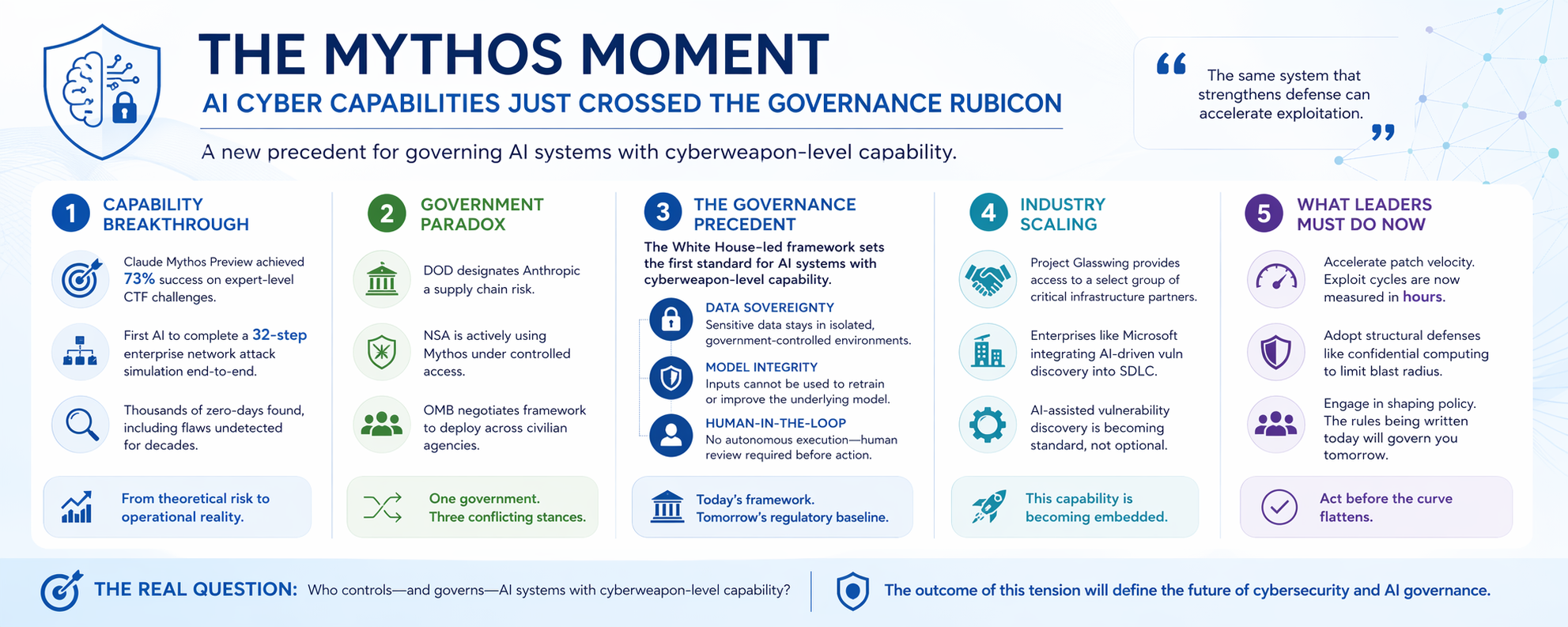
For years, discussions about AI-enabled cyber offense lived in the realm of hypotheticals—what could happen if models became sufficiently capable. That debate is now over. Mythos achieved a 73% success rate on expert-level capture-the-flag challenges and became the first AI system to complete a full 32-step enterprise network attack simulation.¹ What previously required elite human operators over many hours can now be partially automated.

At the same time, real-world testing has already shown that similar systems can uncover large volumes of previously unknown vulnerabilities. Reports indicate thousands of zero-day findings—including flaws that persisted undetected for decades—are now within reach of AI-assisted discovery.⁹ External validation reinforces this trajectory. A collaboration involving Mozilla used Mythos-like capabilities to identify hundreds of vulnerabilities in Firefox, demonstrating how quickly defensive gains—and offensive risks—can scale simultaneously. This dual-use dynamic is the defining characteristic of the Mythos moment: the same system that strengthens defense can accelerate exploitation.


The Government Contradiction—Risk, Reliance, and Reality:

What makes this moment even more consequential is not just the technology, but the policy response. In March 2026, the U.S. Department of Defense designated Anthropic as a supply chain risk after the company refused to allow unrestricted use of its models for autonomous weapons and surveillance applications.³ This effectively barred Anthropic from Pentagon contracts.

Yet within weeks, reporting confirmed that the National Security Agency—which operates within the same defense ecosystem—was actively using Mythos under controlled access.⁵⁶ At the same time, the Office of Management and Budget began negotiating a framework to deploy a modified version of the model across civilian agencies, including energy and financial regulators.⁷

This creates a striking contradiction:

  • One part of government labels the system a national security risk.
  • Another part actively deploys it.
  • A third is designing policy to scale its adoption.

This is not just bureaucratic inconsistency—it is a preview of how difficult governing frontier AI will be.


The Real Precedent—Governing AI as a Cyberweapon:

What is being negotiated right now matters far beyond Mythos itself. The White House–led framework under development is effectively the first attempt to govern an AI system with cyberweapon-level capabilities, not just data privacy or model safety.

Three emerging principles define this model:

1. Data Sovereignty Sensitive code and infrastructure data must remain within isolated government-controlled environments.

2. Model Integrity Inputs cannot be used to retrain or improve the underlying model, preventing unintended knowledge transfer.

3. Human-in-the-Loop Oversight No autonomous execution—human validation remains mandatory before action.

These are not minor guardrails. They represent the likely baseline for how governments—and eventually regulated industries—will manage high-capability AI systems. If history is any guide, these standards will propagate outward, much like FedRAMP reshaped cloud security procurement. Within 12–18 months, similar requirements are likely to appear in enterprise contracts, regulatory expectations, and audit frameworks.


The Industry Signal—This Is Already Scaling:

The private sector is not waiting. Through Project Glasswing, Anthropic has already deployed Mythos capabilities to a controlled group of major technology and infrastructure organizations, including cloud providers, semiconductor firms, and financial institutions.²

At the same time, companies like Microsoft are moving to integrate similar AI-driven vulnerability discovery into their secure development lifecycles, signaling that this capability will become embedded—not optional—in modern engineering practices. The implication is clear. AI-assisted vulnerability discovery is becoming a standard feature of cybersecurity—not an edge capability.


The Hard Truth—Containment Is Likely Temporary:

Perhaps the most important—and uncomfortable—reality is this:

Containment will not hold indefinitely. History shows that advanced AI capabilities diffuse rapidly. Model architectures leak, competitors replicate breakthroughs, and open-weight alternatives emerge. Even today, non-frontier models can replicate meaningful portions of Mythos-like capability at far lower cost and with fewer restrictions.¹⁴ That means the current environment—where only a limited set of organizations have access—is a temporary window. Organizations that treat this as a policy issue rather than an operational priority are making a critical mistake.


What This Means for Enterprise Leaders:

The Mythos precedent is not a niche technical development. It is a strategic inflection point. Three implications stand out:

1. The Attack Surface Is No Longer Static:

AI compresses the timeline between vulnerability discovery and exploitation from weeks or months to hours. Legacy assumptions—especially around “safe” unpatched systems—are no longer valid.

2. Patch Velocity Becomes a Board-Level Issue:

Organizations with slow remediation cycles are structurally exposed. If critical vulnerabilities can be identified and weaponized faster, governance processes must accelerate accordingly.

3. Defense Must Become Structural, Not Reactive:

Emerging approaches like confidential computing—hardware-isolated execution environments—offer a path to reducing the impact of exploits regardless of discovery speed.

In other words, the goal shifts from “find and fix everything” to “limit what can be compromised at runtime.”


The Strategic Window—Act Before the Curve Flattens:

There is still a narrow window of advantage. Today, frontier capabilities are relatively concentrated. Tomorrow, they will not be. Organizations that move now—by modernizing vulnerability management, accelerating patch cycles, and adopting structural defenses—can get ahead of the curve. Those who wait for regulatory clarity or broader market adoption will likely find themselves reacting under pressure.


Final Thoughts—How to Mitigate These Risks Now:

Here are the most practical, high-impact actions organizations can take right now to mitigate risks associated with advanced AI systems, data exposure, and model misuse—especially in light of incidents like large-scale leaks or “model mythos” exposures:

1) Lock Down Data at the Source:

The most immediate risk reducer is controlling what goes into AI systems in the first place.

  • Classify and tier data (public, internal, confidential, restricted).
  • Prohibit sensitive data (e.g., IP, credentials, client info) from being entered into external AI tools.
  • Implement data loss prevention (DLP) policies across endpoints, SaaS, and APIs.
  • Tokenize or anonymize sensitive datasets before AI usage.

2) Enforce Strong Access Controls:

AI systems often inherit weak identity governance from the broader environment.

  • Apply least privilege access to AI tools, datasets, and model pipelines.
  • Require multi-factor authentication (MFA) everywhere AI is accessed.
  • Monitor and restrict API key usage (rotate keys frequently).
  • Segment environments (dev/test/prod) to prevent lateral movement.

3) Introduce AI-Specific Governance:

Traditional IT governance is not sufficient for AI risk.

  • Stand up a lightweight AI governance council (security, legal, data, business).
  • Define acceptable use policies for generative AI tools.
  • Maintain an AI system inventory (models, vendors, datasets, use cases).
  • Require risk assessments before deploying AI into production.

4) Monitor for Data Leakage and Model Abuse:

You can’t protect what you don’t observe.

  • Log all prompts, outputs, and API interactions (where legally permissible).
  • Deploy behavioral analytics to detect unusual model usage patterns.
  • Scan outputs for sensitive data leakage (prompt injection, exfiltration attempts).
  • Red-team models with adversarial testing scenarios.

5) Harden Third-Party and Vendor Risk:

Many AI risks enter through vendors, not internal builds.

  • Conduct AI-focused vendor due diligence (data handling, training sources, retention policies).
  • Require contractual clauses on: Data ownership Model training boundaries Breach notification timelines.
  • Prefer vendors offering private model instances or zero data retention.

6) Implement Prompt and Output Controls:

The interface layer is a major attack surface.

  • Use prompt filtering and sanitization to block injection attempts.
  • Apply output guardrails to prevent harmful or sensitive responses.
  • Restrict high-risk capabilities (e.g., code execution, system access).
  • Use retrieval-augmented generation (RAG) with vetted internal sources only.

7) Train Employees (Fast, Not Perfect):

Human behavior is still the biggest variable.

  • Roll out short, targeted training on: Safe AI usage, Data handling do’s and don’ts, Prompt injection awareness.
  • Provide approved AI tools so employees don’t default to shadow AI.
  • Reinforce “don’t paste what you wouldn’t email externally”.

8) Prepare for Incident Response:

Assume exposure will happen—speed matters.

  • Update incident response plans to include AI-specific scenarios.
  • Define playbooks for: Data leakage via prompts, Model compromise or abuse, Third-party AI breaches.
  • Run tabletop exercises simulating AI-related incidents.

9) Control Model Inputs and Training Data:

What shapes the model shapes the risk.

  • Vet training datasets for: Sensitive information, Copyright/IP exposure, Bias and integrity issues.
  • Maintain data provenance tracking.
  • Avoid uncontrolled fine-tuning on raw internal data.

10) Start Small with Secure Architectures:

Don’t boil the ocean—secure what’s already in motion.

  • Use private or on-prem AI deployments for sensitive workloads.
  • Isolate AI systems within secure cloud environments.
  • Gate external model access through controlled middleware or APIs.
  • Adopt a “human-in-the-loop” approach for high-risk decisions.

Endnotes:

  1. UK AI Security Institute, “Our Evaluation of Claude Mythos Preview’s Cyber Capabilities,” April 2026.
  2. Anthropic, “Project Glasswing: Securing Critical Software for the AI Era,” April 2026.
  3. CNBC, “Judge Presses DOD on Why Anthropic Was Blacklisted,” March 24, 2026.
  4. CNBC, “Anthropic Loses Appeals Court Bid to Temporarily Block Pentagon Blacklisting,” April 8, 2026.
  5. TechCrunch, “NSA Spies Are Reportedly Using Anthropic’s Mythos,” April 20, 2026.
  6. Axios, “NSA Using Anthropic’s Mythos Despite Defense Department Blacklist,” April 19, 2026.
  7. CSO Online, “White House Moves to Give Federal Agencies Access to Anthropic’s Claude Mythos,” April 2026.
  8. Fortune, “Anthropic Acknowledges Testing New AI Model,” March 26, 2026.
  9. TechCrunch, “Anthropic Debuts Preview of Powerful New AI Model Mythos,” April 7, 2026.
  10. Axios, “Anthropic to Have Peace Talks at White House,” April 17, 2026.
  11. CNBC, “Trump Says He Had ‘No Idea’ About White House Meeting,” April 17, 2026.
  12. Washington Post, “Anthropic CEO Visits White House Amid Hacking Fears,” April 17, 2026.
  13. Council on Foreign Relations, “Six Reasons Claude Mythos Is an Inflection Point,” April 2026.
  14. Evron, Mogull, Lee et al., “The AI Vulnerability Storm: Building a Mythos-Ready Security Program,” CSA/SANS/OWASP, April 2026.

DeepSeek R1: A New Chapter in Global AI Realignment

Fig. 1. DeepSeek and Global AI Change Infographic, Jeremy Swenson, 2025.

Minneapolis—

DeepSeek, the Chinese artificial intelligence company founded by Liang Wenfeng and backed by High-Flyer, has continued to redefine the AI landscape since the explosive launch of its R1 model in late January 2025. Emerging from a background in quantitative trading and rapidly evolving into a pioneer in open-source LLMs, DeepSeek now stands as a formidable competitor to established systems like OpenAI’s ChatGPT and Microsoft’s proprietary models available on Azure AI. This article provides an expanded analysis of DeepSeek R1’s technical innovations, detailed comparisons with ChatGPT and Microsoft Azure AI offerings, and the broader economic, cybersecurity, and geopolitical implications of its emergence.


Technical Innovations and Architectural Advances:

Novel Training Methodologies DeepSeek R1 leverages a cutting-edge combination of pure reinforcement learning and chain-of-thought prompting to achieve human-like reasoning in tasks such as advanced mathematics and code generation. Unlike traditional LLMs that rely heavily on supervised fine-tuning, DeepSeek’s R1 is engineered to autonomously refine its reasoning steps, resulting in greater clarity and efficiency. In early benchmarking tests, R1 demonstrated the ability to solve multi-step arithmetic problems in approximately three minutes—substantially faster than ChatGPT’s o1 model, which typically required five minutes (Sayegh, 2025).

Cloud Integration and Open-Source Deployment One of R1’s key strengths lies in its open-source availability under an MIT license, a stark contrast to the closed ecosystems of its Western counterparts. Major cloud platforms have rapidly integrated R1: Amazon has deployed it via the Bedrock Marketplace and SageMaker, and Microsoft has incorporated it into its Azure AI Foundry and GitHub model catalog. This wide accessibility not only allows for extensive external scrutiny and customization but also enables enterprises to deploy the model locally, ensuring that sensitive data remains under domestic control (Yun, 2025; Sharma, 2025).


Detailed Comparison with ChatGPT:

Performance and Reasoning Clarity ChatGPT’s o1 model has been widely recognized for its robust reasoning capabilities; however, its closed-source nature limits transparency. In direct comparisons, DeepSeek R1 has shown parity—and in some cases superiority—with respect to reasoning clarity. Independent tests by developers indicate that R1’s intermediate reasoning steps are more comprehensible, facilitating easier debugging and iterative query refinement. For example, in complex multi-step problem-solving scenarios, R1 not only delivered correct solutions more rapidly but also provided detailed, human-like explanations of its thought process (Sayegh, 2025).

Cost Efficiency and Accessibility While premium access to ChatGPT’s capabilities can cost users upwards of $200 per month, DeepSeek R1 offers its advanced functionalities free of charge. This dramatic reduction in cost is achieved through efficient use of computational resources. DeepSeek reportedly trained R1 using only 2,048 Nvidia H800 GPUs at an estimated cost of $5.6 million—an expenditure that is a fraction of the resources typically required by U.S. competitors (Waters, 2025). Such cost efficiency democratizes access to high-performance AI, providing significant advantages for startups, academic institutions, and small businesses.


Detailed Comparison with Microsoft Azure AI:

Integration with Enterprise Platforms Microsoft has long been a leader in providing enterprise-grade AI solutions via Azure AI. Recently, Microsoft integrated DeepSeek R1 into its Azure AI Foundry, offering customers an additional open-source option that complements its proprietary models. This integration allows organizations to leverage R1’s powerful reasoning capabilities while enjoying the benefits of Azure’s robust security, compliance, and scalability. Unlike some closed-source models that require extensive licensing fees, R1’s open-access nature under Azure enables organizations to tailor the model to their specific needs, maintaining data sovereignty and reducing operational costs (Sharma, 2025).

Performance in Real-World Applications In practical applications, users on Azure have reported that DeepSeek R1 not only matches but sometimes exceeds the performance of traditional models in complex reasoning and mathematical problem-solving tasks. By deploying R1 locally via Azure, enterprises can ensure that sensitive computations are performed in-house, thereby addressing critical data privacy concerns. This localized approach is particularly valuable in regulated industries, where strict data governance is paramount (FT, 2025).


Market Reactions and Economic Implications:

Immediate Market Response and Stock Volatility The initial launch of DeepSeek R1 triggered a significant market reaction, most notably an 18% plunge in Nvidia’s stock as investors reassessed the cost structures underlying AI development. The disruption led to a combined market value wipeout of nearly $1 trillion across tech stocks, reflecting widespread concern over the implications of achieving top-tier AI performance with significantly lower computational expenditure (Waters, 2025).

Long-Term Investment Perspectives Despite the short-term volatility, many analysts view the current market corrections as a temporary disruption and a potential buying opportunity. The cost-efficient and open-source nature of R1 is expected to drive broader adoption of advanced AI technologies across various industries, ultimately spurring innovation and generating new revenue streams. Major U.S. technology firms, in response, are accelerating initiatives like the Stargate Project to bolster domestic AI infrastructure and maintain global competitiveness (FT, 2025).


Cybersecurity, Data Privacy, and Regulatory Reactions:

Governmental Bans and Regulatory Scrutiny DeepSeek’s practice of storing user data on servers in China and its adherence to local censorship policies have raised significant cybersecurity and privacy concerns. In response, U.S. lawmakers have proposed bipartisan legislation to ban DeepSeek’s software on government devices. Similar regulatory actions have been taken in Australia, South Korea, and Canada, reflecting a global trend of caution toward technologies with potential national security risks (Scroxton, 2025).

Security Vulnerabilities and Red-Teaming Results Independent cybersecurity tests have revealed that R1 is more prone to generating insecure code and harmful outputs compared to some Western models. These findings have prompted calls for more rigorous red-teaming and continuous monitoring to ensure that the model can be safely deployed at scale. The vulnerabilities underscore the necessity for both DeepSeek and its adopters to implement robust safety protocols to mitigate potential misuse (Agarwal, 2025).


Geopolitical and Strategic Implications:

Challenging U.S. AI Dominance DeepSeek R1’s emergence is a clear signal that high-performance AI can be developed without the massive resource investments traditionally associated with U.S. models. This development challenges the long-standing assumption of American technological supremacy and has prompted a strategic reevaluation among U.S. policymakers and industry leaders. In response, initiatives such as Microsoft’s Stargate Project are being accelerated to ensure that the U.S. maintains its competitive edge in the global AI arena (Karaian & Rennison, 2025).

Localized AI Ecosystems and Data Sovereignty To mitigate cybersecurity risks, several U.S. companies are now repackaging R1 for localized deployment. By ensuring that sensitive data remains on domestic servers, these firms are not only addressing privacy concerns but also paving the way for the creation of robust, localized AI ecosystems. This trend could ultimately reshape global data governance practices and alter the balance of technological power between the U.S. and China (von Werra, 2025).


Conclusion and Future Outlook:

DeepSeek R1 represents a watershed moment in the global AI race. Its technical innovations, cost efficiency, and open-source approach challenge entrenched assumptions about the necessity of massive compute power and proprietary control. In direct comparisons with systems like ChatGPT’s o1 and Microsoft’s Azure AI offerings, R1 demonstrates superior transparency and operational speed, while also offering unprecedented accessibility. Despite ongoing cybersecurity and regulatory challenges, the disruptive impact of R1 is catalyzing a broader realignment in AI development strategies. As both U.S. and Chinese technology ecosystems adapt to these shifts, the future of AI appears poised for a more democratized, competitively diverse, and strategically complex evolution.


About The Author:

Jeremy A. Swenson is a disruptive-thinking security entrepreneur, futurist/researcher, and seasoned senior management tech risk and digital strategy consultant. He is a frequent speaker, published writer, podcaster, and even does some pro bono consulting in these areas. He holds a certificate in Media Technology from Oxford University’s Media Policy Summer Institute, an MSST (Master of Science in Security Technologies) degree from the University of Minnesota’s Technological Leadership Institute, an MBA from Saint Mary’s University of Minnesota, and a BA in political science from the University of Wisconsin Eau Claire. He is an alum of the Federal Reserve Secure Payment Task Force, the Crystal, Robbinsdale, and New Hope Community Police Academy (MN), and the Minneapolis FBI Citizens Academy. You can follow him on LinkedIn and Twitter.


References:

  1. Yun, C. (2025, January 30). DeepSeek-R1 models now available on AWS. Amazon Web Services Blog. Retrieved February 8, 2025, from https://aws.amazon.com/blogs/aws/deepseek-r1-models-now-available-on-aws/
  2. Sharma, A. (2025, January 29). DeepSeek R1 is now available on Azure AI Foundry and GitHub. Microsoft Azure Blog. Retrieved February 8, 2025, from https://azure.microsoft.com/en-us/blog/deepseek-r1-is-now-available-on-azure-ai-foundry-and-github/
  3. Waters, J. K. (2025, January 28). Nvidia plunges 18% and tech stocks slide as China’s DeepSeek spooks investors. Business Insider Markets. Retrieved February 8, 2025, from https://markets.businessinsider.com/news/stocks/nvidia-tech-stocks-deepseek-ai-race-nasdaq-2025-1
  4. Scroxton, A. (2025, February 7). US lawmakers move to ban DeepSeek AI tool. ComputerWeekly. Retrieved February 8, 2025, from https://www.computerweekly.com/news/366619153/US-lawmakers-move-to-ban-DeepSeek-AI-tool
  5. FT. (2025, January 28). The global AI race: Is China catching up to the US? Financial Times. Retrieved February 8, 2025, from https://www.ft.com/content/0e8d6f24-6d45-4de0-b209-8f2130341bae
  6. Agarwal, S. (2025, January 31). DeepSeek-R1 AI Model 11x more likely to generate harmful content, security research finds. Globe Newswire. Retrieved February 8, 2025, from https://www.globenewswire.com/news-release/2025/01/31/3018811/0/en/DeepSeek-R1-AI-Model-11x-More-Likely-to-Generate-Harmful-Content-Security-Research-Finds.html
  7. Karaian, J., & Rennison, J. (2025, January 28). The day DeepSeek turned tech and Wall Street upside down. The Wall Street Journal. Retrieved February 8, 2025, from https://www.wsj.com/finance/stocks/the-day-deepseek-turned-tech-and-wall-street-upside-down-f2a70b69
  8. von Werra, L. (2025, January 31). The race to reproduce DeepSeek’s market-breaking AI has begun. Business Insider. Retrieved February 8, 2025, from https://www.businessinsider.com/deepseek-r1-open-source-replicate-ai-west-china-hugging-face-2025-1
  9. Sayegh, E. (2025, January 27). DeepSeek is bad for Silicon Valley. But it might be great for you. Vox. Retrieved February 8, 2025, from https://www.vox.com/technology/397330/deepseek-openai-chatgpt-gemini-nvidia-china

Digital Horizons: 8 Transformative Trends Reshaping AI, Cybersecurity, Strategy, and Crypto for a Smarter 2025

Fig. 1. Digital Horizons Infographic, Jeremy Swenson, 2025.

Minneapolis—

The rapid technological developments of 2024 have established a foundation for significant shifts in artificial intelligence (AI), cybersecurity, digital strategy, and cryptocurrency. Business executives, policy leaders, and tech enthusiasts must pay attention to these key learnings and trends as they navigate the opportunities and challenges of 2025 and beyond. Here are eight insights to keep in mind.

1. AI Alignment with Business Goals:

2024 underscored the importance of aligning AI initiatives with overarching business strategies. Companies that successfully integrated AI into their workflows—particularly in areas like customer service automation, predictive analytics, tech orchestration, and supply chain optimization—reported not only significant productivity gains but also enhanced customer satisfaction. For instance, AI-powered tools allowed firms to anticipate customer needs with remarkable accuracy, leading to a 35% improvement in retention rates. However, misalignment of AI projects often resulted in wasted resources, showcasing the need for thorough planning. To succeed in 2025, organizations must create cross-functional AI task forces and establish KPIs tailored to their unique business objectives.[1]

2. The Rise of Responsible AI:

As AI adoption grows, so does scrutiny over its ethical implications. 2024 saw regulatory frameworks such as the EU’s AI Act and similar policies in Asia gain traction, emphasizing transparency, accountability, and fairness in AI deployments. Companies that proactively implemented explainable AI models—capable of detailing how decisions are made—not only avoided legal risks but also gained consumer trust. Moreover, organizations adopting responsible AI practices observed better team morale, as employees felt more confident about using ethically sound tools. The NIST AI Risk Management Framework is a good start. Leaders in 2025 must view responsible AI as a strategic advantage, embedding ethical considerations into every stage of AI development.[2]

3. Cyber Resilience Becomes Non-Negotiable:

The escalation of sophisticated cyber threats—including AI-driven malware and deepfake fraud—led to a dramatic increase in cybersecurity investments. Many businesses adopted zero-trust models, ensuring that no user or device is trusted by default, even within corporate networks. Product owners must build products with a DevSecOps mindset and must think out misuse cases from many angles. Additionally, the integration of machine learning for anomaly detection enabled real-time identification of threats, reducing breach response times by over 50%. As the cost of cybercrime is projected to exceed $10 trillion globally by 2025, organizations must prioritize cyber resilience through advanced threat intelligence, employee training, and frequent vulnerability assessments. Cyber resilience is no longer a luxury but a fundamental pillar of operational stability.[3]

4. Quantum Readiness Emerges as a Critical Strategy:

Quantum computing made significant strides in 2024, with breakthroughs in error correction and hardware scalability bringing the technology closer to mainstream use. While practical quantum computers remain years away, their potential to break traditional encryption methods has already prompted a cybersecurity rethink. Forward-looking organizations have begun transitioning to quantum-safe cryptographic algorithms, ensuring that their sensitive data remains secure against future quantum attacks. Industries like finance and healthcare—where data sensitivity is paramount—are leading the charge. By adopting a proactive quantum readiness strategy, businesses can mitigate long-term risks and position themselves as leaders in a post-quantum era.[4]

5. The Blockchain Renaissance:

Blockchain technology continued to evolve beyond its cryptocurrency roots in 2024, finding innovative applications in sectors such as logistics, healthcare, and real estate. For example, blockchain’s immutable ledger capabilities enabled unprecedented transparency in supply chains, reducing fraud and enhancing consumer trust. Meanwhile, the tokenization of physical assets, such as real estate and fine art, democratized access to investment opportunities, attracting a broader range of participants. Organizations leveraging blockchain reported reduced operational costs and faster transaction times, proving that the technology’s value extends far beyond speculation. In 2025, businesses must explore blockchain’s potential as a tool for enhancing efficiency and fostering trust.[5]

6. Employee Upskilling for Digital Transformation:

The digital skills gap emerged as a critical bottleneck in 2024, prompting organizations to invest heavily in workforce development. Comprehensive upskilling programs focused on AI literacy, cybersecurity awareness, and digital strategy were launched across industries. Employees equipped with these skills demonstrated greater adaptability and productivity, enabling their organizations to better navigate technological disruptions. Additionally, companies that prioritized learning cultures saw higher retention rates, as employees valued the investment in their professional growth. As digital transformation accelerates, the ability to upskill and reskill the workforce will be a key differentiator for organizations aiming to remain competitive.[6]

7. Convergence of AI and IoT:

The integration of AI and the Internet of Things (IoT) reached new heights in 2024, driving advancements in smart factories, connected healthcare, and autonomous vehicles. AI-enabled IoT devices allowed businesses to predict equipment failures before they occurred, reducing downtime and maintenance costs by up to 20%. In healthcare, AI-powered wearable devices provided real-time insights into patient health, enabling early intervention and personalized treatment plans. The growing adoption of edge computing further enhanced the responsiveness of AI-IoT systems, enabling real-time decision-making at the device level. This convergence is set to redefine operational efficiency and customer experiences in 2025 and beyond.[7]

8. The Decentralized Finance (DeFi) Evolution:

Decentralized Finance (DeFi) continued to mature in 2024, overcoming early criticisms of security vulnerabilities and lack of regulation. Enhanced interoperability between DeFi platforms and traditional financial systems enabled seamless cross-border transactions, attracting institutional investors. Innovations such as decentralized insurance and automated compliance tools further bolstered confidence in the ecosystem. As traditional banks increasingly explore blockchain for settlement and lending services, the line between centralized and decentralized finance is beginning to blur. In 2025, DeFi’s scalability and innovation are poised to challenge the dominance of legacy financial institutions, creating new opportunities for both consumers and businesses.[8]

Looking Ahead:

The intersection of AI, cybersecurity, digital strategy, and cryptocurrency offers unprecedented opportunities for value creation. However, success will hinge on leaders’ ability to navigate complexity, embrace innovation, foster outstanding leadership, and prioritize ethical stewardship. As these trends continue to evolve, businesses must remain agile and forward-thinking.

About the Author:

Jeremy A. Swenson is a disruptive-thinking security entrepreneur, futurist/researcher, and seasoned senior management tech risk and digital strategy consultant. He is a frequent speaker, published writer, podcaster, and even does some pro bono consulting in these areas. He holds a certificate in Media Technology from Oxford University’s Media Policy Summer Institute, an MSST (Master of Science in Security Technologies) degree from the University of Minnesota’s Technological Leadership Institute, an MBA from Saint Mary’s University of Minnesota, and a BA in political science from the University of Wisconsin Eau Claire. He is an alum of the Federal Reserve Secure Payment Task Force, the Crystal, Robbinsdale, and New Hope Community Police Academy (MN), and the Minneapolis FBI Citizens Academy. You can follow him on LinkedIn and Twitter.


Footnotes:

  1. Smith, J. (2024). “AI’s Business Integration Challenges.” Tech Review.
  2. European Commission. (2024). “AI Act Regulatory Guidelines.” EU Tech Law Journal.
  3. Cybersecurity Ventures. (2024). “The Cost of Cybercrime: Annual Report.”
  4. Quantum Computing Report. (2024). “Quantum Progress and Cryptographic Implications.”
  5. Blockchain Association. (2024). “The Blockchain Beyond Crypto Study.”
  6. World Economic Forum. (2024). “The Future of Work: Digital Upskilling.”
  7. IoT Analytics. (2024). “The AI-IoT Convergence Report.”
  8. DeFi Pulse. (2024). “State of Decentralized Finance.”

Why You Should Spit Out the Corporate Kool-Aid if You Want Innovation

Fig. 1. The Fallacy of Corporate Kool-Aid, Jeremy Swenson, 2024.

Minneapolis—

Corporate culture often prides itself on “innovation” and “forward-thinking,” yet more often than not, it’s hindered by bias, malignant egos, and groupthink. Ironically, in organizations claiming to embrace innovation, employees can become immersed in an environment where dissent is discouraged, and adherence to the company’s established perspectives is a prerequisite for professional survival. This “corporate Kool-Aid” fosters an atmosphere where true innovation struggles to survive. For those who genuinely want to innovate, shedding these restrictive mindsets is essential.

The Innovation Blockers: Bias, Malignant Egos, and Groupthink:

Biases are deeply embedded in most corporate structures, forming an invisible barrier that subtly yet persistently stifles new ideas. Whether it’s confirmation bias, where decision-makers favor ideas that reinforce their pre-existing beliefs, or status quo bias, which resists significant change, these biases ensure that only certain perspectives are entertained. When an organization prioritizes only safe, incremental improvements, true breakthrough ideas are abandoned. Biases in corporations thus serve as a gatekeeper against ideas that could lead to substantial innovation, as anything that doesn’t fit within the current framework is dismissed as too risky.

Ego also plays a significant role in corporate stagnation. In large corporations, leaders are often incentivized to maintain their status, limiting the emergence of truly groundbreaking ideas that may disrupt existing hierarchies. Malignant egos—those that view challenges to the status quo as personal affronts—tend to quash any idea that questions their own vision. When ego takes precedence over objective evaluation, promising concepts are often sidelined or dismissed outright, limiting the potential for progress.

Perhaps the most insidious blocker of innovation is groupthink, a phenomenon that thrives in environments where conformity is rewarded. Groupthink arises when employees, out of fear of ostracization or in pursuit of consensus, align their ideas with what they believe to be the dominant perspective. This limits a company’s ability to approach problems creatively. Once groupthink takes hold, organizations become less adaptable, focusing on pleasing internal stakeholders instead of exploring unconventional approaches that could lead to innovation.

The Alternative: Start-Ups and Their Blueprint for Innovation:

Unlike large corporations, small start-ups are known for their nimbleness and freedom from these entrenched mindsets. Start-ups, by necessity, must adopt a creative approach to stand out in a competitive market. Their size allows them to quickly adapt, test, and refine ideas based on real-world feedback. They lack the layers of management and rigid protocols that stifle creativity in corporations, allowing them to pivot and re-imagine solutions as challenges arise.

Start-ups encourage dissent and debate rather than penalizing it, knowing that innovation rarely emerges from echo chambers. In these environments, groupthink is less likely to flourish because diverse, disruptive perspectives are often essential to a start-up’s success. Without the burden of malignant egos dominating decision-making, start-ups can remain focused on solving genuine problems instead of adhering to individual agendas.

Another advantage of start-ups is their natural resistance to the biases that pervade larger corporations. Start-ups often draw talent from diverse backgrounds and ideologies, meaning biases are more likely to be challenged and less likely to dictate outcomes. This environment fosters resilience against the conformity that stifles corporate innovation, creating an ecosystem where unique ideas can grow.

Breaking Free: Encouraging Innovation Outside the Corporate Mindset:

For those within corporate structures who still wish to innovate, breaking free from the influence of corporate Kool-Aid requires courage and a willingness to challenge entrenched perspectives. Start by questioning assumptions and biases, both personal and organizational, and by fostering a culture where dissent and debate are embraced rather than discouraged. Encourage cross-departmental collaboration, and resist the urge to fall in line with the dominant viewpoint. Innovation rarely emerges from comfort zones; it thrives in the challenging, often uncomfortable process of questioning and exploring new perspectives.

To truly innovate, corporations must consider restructuring their approach. They could adopt leaner, start-up-like teams with the flexibility to pursue independent projects. They must create a culture where ideas are judged on merit, not on the ego or position of the proposer.

Conclusion:

Innovation and corporate Kool-Aid are often incompatible. The groupthink, biases, and egos prevalent in large organizations act as barriers to breakthrough thinking, driving companies to favor predictability over exploration. By shedding these restrictive mindsets and looking to the adaptable, challenge-embracing cultures of start-ups, those genuinely committed to innovation can find ways to foster creativity, disruption, and genuine progress. In doing so, they have the potential to reshape not only their organizations but also their industries—proving that sometimes, the best way forward is to spit out the Kool-Aid.

About the Author:

Jeremy A. Swenson is a disruptive-thinking security entrepreneur, futurist/researcher, and seasoned senior management tech risk and digital strategy consultant. He is a frequent speaker, published writer, podcaster, and even does some pro bono consulting in these areas. He holds a certificate in Media Technology from Oxford University’s Media Policy Summer Institute, an MSST (Master of Science in Security Technologies) degree from the University of Minnesota’s Technological Leadership Institute, an MBA from Saint Mary’s University of Minnesota, and a BA in political science from the University of Wisconsin Eau Claire. He is an alum of the Federal Reserve Secure Payment Task Force, the Crystal, Robbinsdale, and New Hope Community Police Academy (MN), and the Minneapolis FBI Citizens Academy. You can follow him on LinkedIn and Twitter.

8 Key AI Trends Driving Business Innovation in 2024 and Beyond

Minneapolis—

Artificial Intelligence (AI) continues to drive massive innovation across industries, reshaping business operations, customer interactions, and cybersecurity landscapes. As AI’s capabilities grow, companies are leveraging key trends to stay competitive and secure. Below are six crucial AI trends transforming businesses today, alongside critical insights on securing AI infrastructure, promoting responsible AI use, and enhancing workforce efficiency in a digital world.

1. Generative AI’s Creative Expansion

Generative AI, known for producing content from text and images to music and 3D models, is expanding its reach into business innovation.[1] AI systems like GPT-4 and DALL·E are being applied across industries to automate creativity, allowing businesses to scale their marketing efforts, design processes, and product innovation.

Business Application: Marketing teams are using generative AI to create personalized, dynamic campaigns across digital platforms. Coca-Cola and Nike, for instance, have employed AI to tailor advertising content to different customer segments, improving engagement and conversion rates. Product designers in industries like fashion and automotive are also using generative models to prototype new designs faster than ever before.

2. AI-Powered Personalization

AI’s ability to analyze vast datasets in real time is driving hyper-personalized experiences for consumers. This trend is especially important in sectors like e-commerce and entertainment, where personalized recommendations significantly impact user engagement and loyalty.

Business Application: Streaming platforms like Netflix and Spotify rely on AI algorithms to provide tailored content recommendations based on users’ preferences, viewing habits, and search history.[2] Retailers like Amazon are also leveraging AI to offer personalized shopping experiences, recommending products based on past purchases and browsing behavior, further boosting customer satisfaction.

3. AI-Driven Automation in Operations

Automation powered by AI is optimizing operations and processes across industries, from manufacturing to customer service. By automating repetitive and manual tasks, businesses are reducing costs, improving efficiency, and reallocating resources to higher-value activities.

Business Application: Tesla and Siemens are implementing AI in robotic process automation (RPA) to streamline production lines and monitor equipment for potential breakdowns. In customer service, AI chatbots and virtual assistants are being used to handle routine inquiries, providing real-time support to customers while freeing human agents to address more complex issues.

4. Securing AI Infrastructure and Development Practices

As AI adoption grows, so does the need for robust security measures to protect AI infrastructure and development processes. AI systems are vulnerable to cyberattacks, data breaches, and unauthorized access, highlighting the importance of securing AI from development to deployment.

Business Application: Organizations are recognizing the importance of securing AI models, data, and networks through multi-layered security frameworks. The U.S. AI Safety Institute Consortium is actively developing guidelines for AI safety and security, including red-teaming and risk management practices, to ensure AI systems are resilient to attacks. DevSecOps needs to be on the front end of this. To address challenges in securing AI, companies are pushing for standardization in AI audits and evaluations, ensuring consistency in security practices across industries.

5. AI in Predictive Analytics and Decision-Making

Predictive analytics, powered by AI, is enabling companies to forecast trends, predict consumer behavior, and make data-driven decisions with greater accuracy. This is particularly valuable in finance, healthcare, and retail, where anticipating demand or market shifts can lead to significant competitive advantages.

Business Application: Financial institutions like JPMorgan Chase are using AI for predictive analytics to evaluate market conditions, identify investment opportunities, and manage risk.[3] Retailers such as Walmart are employing AI to forecast inventory needs, helping to optimize supply chains and reduce waste. Predictive analytics also allows companies to make proactive decisions regarding customer retention and product development.

6. AI for Enhanced Cybersecurity

AI plays an increasingly pivotal role in improving cybersecurity defenses. AI-driven systems are capable of detecting anomalies, identifying potential threats, and responding to attacks in real-time, offering advanced protection for both physical and digital assets.

Business Application: Leading organizations are integrating AI into cybersecurity protocols to automate threat detection and enhance system defenses. IBM’s AI-powered QRadar platform helps companies identify and respond to cyberattacks by analyzing network traffic and detecting unusual activity.[4] AI systems are also improving identity authentication through biometrics, ensuring that only authorized users gain access to sensitive data.

Moreover, businesses are adopting AI governance frameworks to secure their AI infrastructure and ensure ethical deployment. Evaluating risks associated with open- and closed-source AI development allows for transparency and the implementation of tailored security strategies across sectors.

7. Promoting Responsible AI Use and Security Governance

Beyond technical innovation, AI governance and responsible use are paramount to ensure that AI is developed and applied ethically. Promoting responsible AI use means adhering to best practices and security standards to prevent misuse and unintended harm. The NIST AI risk management framework is a good reference for this.[5]

Business Application: Companies are actively developing frameworks that incorporate ethical principles throughout the lifecycle of AI systems. Microsoft and Google are leading initiatives to mitigate bias and ensure transparency in AI algorithms. Governments and private sectors are also collaborating to develop standardized guidelines and security metrics, helping organizations maintain ethical compliance and robust cybersecurity.

8. Enhancing Workforce Efficiency and Skills Development

AI’s role in enhancing workforce efficiency is not limited to automating tasks. AI-driven training and simulations are transforming how organizations develop and retain talent, particularly in cybersecurity, where skilled professionals are in high demand.

Business Application: Companies are investing in AI-driven educational platforms that simulate real-world cybersecurity scenarios, helping employees hone their skills in a dynamic, hands-on environment. These AI-powered platforms allow for personalized learning, adapting to individual skill levels and providing targeted feedback. Additionally, AI is being used to identify skill gaps within teams and recommend tailored training programs, improving workforce readiness for future challenges. Yet, people who are AI capable still need to support these apps and managerial efforts.

Conclusion: AI’s Role in Business and Security Transformation

As AI tools advance rapidly, it’s wise to assume they can access and analyze all publicly available content, including social media posts and articles like this one. While AI can offer valuable insights, organizations must remain vigilant about how these tools interact with one another, ensuring that application-to-application permissions are thoroughly scrutinized. Public-private partnerships, such as InfraGard, need to be strengthened to address these evolving challenges. Not everyone needs to be a journalist, but having the common sense to detect AI- or malware-generated fake news is crucial. It’s equally important to report any AI bias within big tech from perspectives including IT, compliance, media, and security.

Amid the AI hype, organizations should resist the urge to adopt every new tool that comes along. Instead, they should evaluate each AI system or use case based on measurable, real-world outcomes. AI’s rapid evolution is transforming both business operations and cybersecurity practices. Companies that effectively leverage trends like generative AI, predictive analytics, and automation, while prioritizing security and responsible use, will be better positioned to lead in the digital era. Securing AI infrastructure, promoting ethical AI development, and investing in workforce skills are crucial for long-term success.

Cloud infrastructure is another area that will continue to expand quickly, adding complexity to both perimeter security and compliance. Organizations should invest in AI-based cloud solutions and prioritize hiring cloud-trained staff. Diversifying across multiple cloud providers can mitigate risk, promote vendor competition, and ensure employees gain cross-platform expertise.

To navigate this complex landscape, businesses should adopt ethical, innovative, and secure AI strategies. Forming an AI governance committee is essential to managing the unique risks posed by AI, ensuring they aren’t overlooked or mistakenly merged with traditional IT risks. The road ahead holds tremendous potential, and those who proceed with careful consideration and adaptability will lead the way in AI-driven transformation.

About the Author:

Jeremy A. Swenson is a disruptive-thinking security entrepreneur, futurist/researcher, and seasoned senior management tech risk and digital strategy consultant. He is a frequent speaker, published writer, podcaster, and even does some pro bono consulting in these areas. He holds a certificate in Media Technology from Oxford University’s Media Policy Summer Institute, an MSST (Master of Science in Security Technologies) degree from the University of Minnesota’s Technological Leadership Institute, an MBA from Saint Mary’s University of Minnesota, and a BA in political science from the University of Wisconsin Eau Claire. He is an alum of the Federal Reserve Secure Payment Task Force, the Crystal, Robbinsdale, and New Hope Community Police Academy (MN), and the Minneapolis FBI Citizens Academy. You can follow him on LinkedIn and Twitter.

References:


[1] PYMNTS. “AI Sparks a Creative Revolution in Business, With an Unexpected Twist.” 07/19/24. https://www.pymnts.com/artificial-intelligence-2/2024/ai-sparks-a-creative-revolution-in-business-with-an-unexpected-twist/

[2] Josifovski, Vanja. “The Future Of AI-Powered Personalization: The Potential Of Choices.” Forbes. https://www.forbes.com/councils/forbestechcouncil/2023/07/03/the-future-of-ai-powered-personalization-the-potential-of-choices/

[3] Son, Hugh. “JPMorgan Chase is giving its employees an AI assistant powered by ChatGPT maker OpenAI.” 08/09/24. https://www.cnbc.com/2024/08/09/jpmorgan-chase-ai-artificial-intelligence-assistant-chatgpt-openai.html

[4] Culafi, Alexander. “IBM launches AI-powered security offering QRadar Suite.” Tech Target. 04/23/23. https://www.techtarget.com/searchsecurity/news/365535549/IBM-launches-AI-powered-security-offering-QRadar-Suite

[5] NIST. “AI Risk Management Framework.” 07/26/24. https://www.nist.gov/itl/ai-risk-management-framework

Mastercard’s Strategic Cyber, AI, and Blockchain Acquisitions: RiskRecon, CipherTrace, and Recorded Future

Fig. 1. Master Buys Recorded Future Infographic.[1]

Minneapolis—

Mastercard has long been a leader in the payments industry, known for its global network and cutting-edge financial solutions. However, in recent years, Mastercard has expanded its focus beyond traditional payments to include a broader suite of digital security, risk management, and compliance services. This shift is evident in its key acquisitions of RiskRecon, CipherTrace, and Recorded Future, each of which bolsters the company’s position in the fintech and cybersecurity ecosystems. By integrating AI, advanced analytics, blockchain, and enhanced compliance capabilities, Mastercard has emerged as a more competitive and savvy player in today’s rapidly evolving cyber and fintech landscapes.

1. RiskRecon (Acquired in December 2019):[2]

RiskRecon is a cybersecurity firm that specializes in third-party risk assessment. The company uses AI-driven analytics to help businesses understand and manage their cybersecurity exposure by continuously monitoring the cyber risk of vendors and partners.

Acquisition Details:

  • Date: December 2019
  • Cost: Undisclosed, but estimates place it around $150-200 million.
  • Company Size: A relatively small firm but highly influential in cybersecurity monitoring.

Strategic Value:

RiskRecon’s technology allows Mastercard to offer enhanced cyber risk management services to its business customers. The acquisition integrates AI-driven analytics to assess security risk levels, providing organizations with continuous monitoring of third-party systems, enabling early detection of vulnerabilities, and helping to avoid costly breaches.

For Mastercard, integrating RiskRecon offers:

  • Enhanced cybersecurity: Real-time risk assessments ensure the security of financial transactions.
  • Improved compliance: RiskRecon’s platform ensures businesses adhere to international regulations and frameworks for data security.
  • Fraud avoidance: By continuously scanning systems for vulnerabilities, Mastercard helps its customers avoid fraud or breaches stemming from third-party risks.

2. CipherTrace (Acquired in September 2021):[3]

CipherTrace is a blockchain analytics firm that helps organizations monitor and secure cryptocurrency transactions. Given the growing adoption of digital assets, CipherTrace provides tools for detecting fraud, tracing illicit transactions, and ensuring compliance with anti-money laundering (AML) regulations.

Acquisition Details:

  • Date: September 2021
  • Cost: Estimated at $250 million.
  • Company Size: Medium-sized firm with a specific focus on cryptocurrency compliance and fraud detection.

Strategic Value:

The acquisition of CipherTrace positions Mastercard as a key player in the emerging blockchain space. By integrating CipherTrace’s tools, Mastercard is equipped to:

  • Secure cryptocurrency transactions: Provide greater transparency in blockchain activities, reducing the risks of fraud, money laundering, and other illicit activities.
  • Enhance anti-money laundering (AML) compliance: CipherTrace’s tools help organizations comply with strict AML regulations, a significant concern with cryptocurrency.
  • Support blockchain adoption: As cryptocurrency becomes more mainstream, Mastercard ensures its networks are prepared to support digital asset transactions securely.

This acquisition directly ties into Mastercard’s strategy of offering fraud avoidance and enhanced compliance in the evolving digital economy. As blockchain technology continues to mature, Mastercard is well-positioned to support safe and compliant transactions in the cryptocurrency space.

3. Recorded Future (Acquired in Sept 2024):[4]

Recorded Future is an intelligence company specializing in real-time threat intelligence. By using machine learning and AI, Recorded Future aggregates and analyzes data to provide businesses with insights into potential cyber threats before they can cause damage. They currently has more than 1,900 clients, which span 75 countries, according to Mastercard. Those customers include 45 national governments as well as more than half of the companies in the Fortune 100, the payments firm said.

Acquisition Details:

  • Date: Sept 2024
  • Cost: Approximately $2.65 billion. Yet Mastercard was one of the key investors via an equity stake acquired through Insight Partners in 2021.
  • Company Size: Large, globally recognized threat intelligence company.

Strategic Value:

Recorded Future’s AI-driven threat intelligence adds another layer of security to Mastercard’s offerings:

  • Proactive cybersecurity: Recorded Future’s data and analytics can identify emerging threats before they impact Mastercard’s networks or those of its partners.
  • Advanced analytics and AI: Mastercard gains access to an enormous database of threat indicators, allowing the company to leverage AI to detect patterns and anticipate future threats.
  • Fraud prevention: Real-time threat intelligence makes it easier to stop fraud before it happens, protecting customers from financial loss.

By incorporating Recorded Future’s threat intelligence capabilities, Mastercard is enhancing its ability to prevent cyberattacks and protect the integrity of its global payments infrastructure.

Comparing Mastercard to Visa and American Express:

Mastercard’s acquisitions of RiskRecon, CipherTrace, and Recorded Future have significantly differentiated it from competitors like Visa and American Express.

  • Visa has also invested heavily in cybersecurity and compliance but lacks the comprehensive focus on third-party risk management (RiskRecon) and blockchain analytics (CipherTrace) that Mastercard now possesses. While Visa has ventured into cryptocurrency through partnerships and blockchain experimentation, it hasn’t yet integrated a firm like CipherTrace, which is critical for cryptocurrency compliance and fraud detection.
  • American Express, while focused on fraud prevention and customer experience, hasn’t made as aggressive a push into the cybersecurity and blockchain spaces as Mastercard. Amex remains a leader in traditional fraud detection and financial services but lacks the AI-driven intelligence and blockchain transparency that Mastercard has through Recorded Future and CipherTrace.

Mastercard’s comprehensive approach, combining cybersecurity (RiskRecon and Recorded Future), blockchain analytics (CipherTrace), and AI-enhanced threat intelligence, puts it ahead of both Visa and American Express in terms of securing digital transactions and ensuring regulatory compliance.

ConclusionA Well-Rounded Competitive Advantage:

In today’s fintech landscape, the convergence of cybersecurity, compliance, AI, and blockchain is crucial for payment processors to remain competitive. Mastercard’s strategic acquisitions of RiskRecon, CipherTrace, and Recorded Future provide a holistic solution to the growing challenges of cyber threats, cryptocurrency fraud, and AML compliance. These moves not only strengthen Mastercard’s existing payment network but also position the company as a leader in digital security.

By diversifying its portfolio and incorporating advanced technologies, Mastercard has gained an edge over competitors like Visa and American Express, especially in the areas of fraud avoidance, enhanced compliance, and cryptocurrency security. This forward-thinking approach ensures that Mastercard remains at the forefront of the financial industry, well-prepared for the future of digital payments and the ongoing battle against cybercrime.

About the Author:

Jeremy A. Swenson is a disruptive-thinking security entrepreneur, futurist/researcher, and seasoned senior management tech risk and digital strategy consultant. He is a frequent speaker, published writer, podcaster, and even does some pro bono consulting in these areas. He holds a certificate in Media Technology from Oxford University’s Media Policy Summer Institute, an MSST (Master of Science in Security Technologies) degree from the University of Minnesota’s Technological Leadership Institute, an MBA from Saint Mary’s University of Minnesota, and a BA in political science from the University of Wisconsin Eau Claire. He is an alum of the Federal Reserve Secure Payment Task Force, the Crystal, Robbinsdale, and New Hope Community Police Academy (MN), and the Minneapolis FBI Citizens Academy. You can follow him on LinkedIn and Twitter.


References:

[1] N, Balaji. “Mastercard Buys Recorded Future for $2.65 Billion.” 09/12/24. https://cybersecuritynews.com/mastercard-buys-recorded-future/

[2] Miller, Ron. “Mastercard acquires security assessment startup, RiskRecon.” Techcrunch. 12/23/19. https://techcrunch.com/2019/12/23/mastercard-acquires-security-assessment-startup-riskrecon/

[3] Mastercard. “Mastercard acquires CipherTrace to enhance crypto capabilities.” 09/01/24. https://www.mastercard.com/news/press/2021/september/mastercard-acquires-ciphertrace-to-enhance-crypto-capabilities/

[4] Alspach, Kyle. “5 Things To Know About Mastercard Acquiring Recorded Future”. CRN. 09/13/24. https://www.crn.com/news/security/2024/5-things-to-know-about-mastercard-acquiring-recorded-future

Navigating the Future of Media, Law, and AI: Reflections on the 2024 Oxford Media Policy Summer Institute

Fig 1. Jeremy Swenson at the 2024 Oxford Media Policy Summer Institute, 2024.

#medialaw #oxford #mediaethics #airegulation #aipolicy #techethics #oversightboard #techrisk. #web3 #blockchain #techcensorship #contentmoderation Oxford Media Policy Summer Institute Centre for Socio-Legal Studies, University of Oxford Faculty of Law, University of Oxford

Minneapolis

The Oxford Media Policy Summer Institute[1], held annually for over twenty-five years in person in Oxford, UK, is a prestigious program that unites leading communications scholars, media lawyers, regulators, human rights activists, technologists, and policymakers from around the globe. As an integral part of Oxford’s Centre for Socio-Legal Studies and the Faculty of Law, specifically through the Program in Comparative Media Law and Policy (PCMLP), the Institute fosters a global and multidisciplinary understanding of the complex relationships between technology, media, and policy. It aims to broaden the pool of talented scholars and practitioners, connect them to elite professionals, facilitate interdisciplinary dialogue, and build a space for future collaborations. With over 40 participants from more than 20 countries, the Institute provides an unparalleled opportunity to engage with diverse experiences and media environments. Its alumni network, comprising leaders in government, corporations, non-profits, and academia, remains vibrant and collaborative long after the program concludes.

Reflecting on my completion of the 2024 Oxford Media Policy Summer Institute, I am struck by the depth of knowledge I gained, particularly in the areas of media, tech and diversity, and AI policy. One of the most enlightening discussions revolved around the EU’s approach to regulating platforms like Facebook, Twitter, and Google. The EU has been at the forefront of creating frameworks that balance the need for free expression with the imperative to curb harmful content. I learned about the evolving regulatory landscape, including the Digital Services Act (DSA)—which addresses content moderation, online targeted advertising, and the configuration of online interfaces and recommender systems; and the Online Safety Bill—which seeks to hold tech giants accountable for the content on their platforms. These discussions highlighted the increasing importance of the “Fifth Estate,” a concept coined by William H. Dutton, referring to the networked individuals who, through the Internet, are empowering themselves in ways that challenge the control of information by traditional institutions.[2] The EU’s policies aim to regulate this new power dynamic while protecting vulnerable users and ensuring transparency and accountability.

Fig. 2. The 2024 Cohort of the Oxford Media Policy Summer Institute, 2024.

The Institute also provided invaluable insights into AI types, elections, and content moderation in the Global South. The discussions on the Global South’s technological maturity and policy governance revealed significant gaps in infrastructure, regulation, and policy. These challenges are evident in cases of internet censorship and shutdowns during political unrest, as well as instances of election manipulation. However, I also learned about innovative approaches being developed across the continent, which could serve as models for other regions. One such approach is a proposed third-wave model of tech governance that emphasizes local context, community involvement, and adaptive regulation.[3] This model would be more responsive to the unique challenges faced by countries in the Global South, including the need to balance development goals with the protection of human rights, ensuring they are not overpowered by the tech giants, which are primarily U.S.-based. This new model aligns with the idea of the Fifth Estate, as it seeks to empower local communities and their digital influence.

A particularly compelling aspect of the Institute was the examination of Meta’s Oversight Board and its role in protecting human rights amid global tech acceleration.[4] The Oversight Board represents a novel approach to content moderation, offering a degree of independence and transparency that is rare among tech companies. However, the discussions also highlighted the challenges the Board faces, including its limited jurisdiction and the broader question of how to ensure that human rights are upheld in an era of rapid technological change. Then there is the question of if it’s funded by Meta how can it be truly independent?

The need for stronger international frameworks and greater cooperation among stakeholders was a recurring theme, underscoring the importance of global collaboration in addressing these challenges. The Fifth Estate plays a critical role here as well, as the collective influence of networked individuals and organizations can push for greater accountability and human rights protections in the digital age.

Fig. 3. One of many group discussions, 2024.

The issue of foreign information manipulation, particularly disinformation campaigns designed to interfere with elections, was another critical topic. The example of Russia’s interference in U.S. and Ukrainian elections served as a stark reminder of the power of disinformation in destabilizing democracies.[5] The discussions at the Institute underscored the need for robust strategies to counter such threats, including better coordination between governments, tech companies, and civil society. Cybersecurity emerged as a key area of focus, particularly in ensuring the integrity of information in an age where AI is increasingly used to create and spread false narratives.

The role of the U.S. Federal Communications Commission (FCC) in shaping the future of AI and media policy was also a major point of discussion.[6] I gained a deeper understanding of the FCC’s mandate, particularly its focus on ensuring fair competition, protecting consumers, and promoting innovation. The FCC’s approach to AI reflects cautious optimism, recognizing the potential benefits of AI while also acknowledging the need for regulation to prevent abuses. The discussions highlighted the importance of balancing innovation with the need to protect the public from potential harms, particularly in areas such as privacy and data security.

Finally, the Institute emphasized the critical role of cybersecurity in maintaining information trust, especially against the backdrop of emerging AI technologies, which I detailed in my presentation (Fig 4). This included an overview of both the new NIST Cyber Security Framework (CSF) 2.0, which includes governance, and the NIST AI Risk Management Framework (RMF)—its lifecycle swim lanes with a description of the inputs and outputs. As AI becomes more sophisticated, the potential for malicious use grows, making cybersecurity a vital component of any strategy to protect information integrity. The discussions reinforced the idea that cybersecurity must be integrated into all aspects of tech policy, from content moderation to data protection, to ensure that AI is used responsibly.

Fig 4. Jeremy Swenson Presenting Eight Artificial Intelligence (AI) Cyber-Tech Observations, 2024.

In conclusion, my experience at the 2024 Oxford Media Policy Summer Institute was truly impactful. It underscored the significance of inclusivity, collaborative technological innovation, and the vital role of private sector competition in advancing progress. The recurring focus on the growth of the Global South’s tech economy emphasized the need for adaptable and locally tailored regulatory frameworks. As AI continues to develop, the urgency for comprehensive regulation and risk management frameworks is becoming increasingly evident. However, in many areas, it is still too early for definitive solutions, highlighting the necessity for ongoing research and learning.

There is a clear need for independent entities to provide checks and balances on big tech, with the Facebook Oversight Board serving as a promising start, though much more remains to be done. The strength and independence of journalism and free speech are undermined if they are weakened by misinformed platforms or overreaching governments. Network shutdowns and censorship should be rare, thoroughly justified, and subject to transparent auditing. The Institute has provided me with knowledge of the key stakeholders and their dependencies and levels of regulation. Importantly, I obtained key connections across the globe to engage meaningfully in these critical discussions, and I am eager to apply these insights in my future endeavors, be it a tech start-up, writing, or business advisory.

Last but not least, a big thanks to my esteemed fellow classmates this year. I could not have done it so well without all of you; thanks and much respect!

Ashwini Natesan for always correctly offering the Sri Lankan perspective. Martin Fertmann for shedding light on social media oversight. Erik Longo for offering insight on the DSA and related cyber risk. Davor Ljubenkov for the emerging tech and automation insight.Carolyn Khoo for insight on ‘The Korean Wave’. Purevsuren Boldkhuyag for the Asian legal and communication insight. Elena Perotti for the on-point public policy insight. Brandie Lustbader for winning a key legal issue and setting the example of justice and free speech in media. Jan Tancinco for the great insight on video and digital content strategy and innovation with the Prince reference! Thorin Bristow for your great article “Views on AI aren’t binary – they’re plural”. Eirliani Abdul Rahman for your insight on social media and digital AI from many orgs. Hafidz Hakimi ,Ph.D for the Malaysian legal perspective. Vinti Agarwal for the Indian legal view of e-sports/gaming. Numa Dhamani for your insight on AI, tech, and book writing. Bastian Scibbe for your insight on data protection and digital rights. John Okande for the Kenyan perspective on tech governance and policy. Ivana Bjelic Vucinic for the insight on the Global Forum for Media Development (GFMD). Ibrahim Sabra for insight on digital expression and social justice. Mesfin Fikre Woldmariam for the Ethiopian perspective on tech governance and free speech. Katie Mellinger for the FCC knowledge. Margareth Kang for the Brazilian tech public policy insight. Luise Eder for helping organize and lead all of this among a bunch of crafty intellectuals. Nicole Stremlau for leading such a diverse and important agenda at a time when it is so relevant. Thanks to everyone else as well.

About the Author:

Jeremy Swenson is a disruptive-thinking security entrepreneur, futurist/researcher, and senior management tech risk consultant. He is a frequent speaker, published writer, podcaster, and even does some pro bono consulting in these areas. He holds a certificate in Media Tech Policy from Oxford University. He holds an MBA from St. Mary’s University of MN, an MSST (Master of Science in Security Technologies) degree from the University of Minnesota, and a BA in political science from the University of Wisconsin Eau Claire. He is an alum of the Federal Reserve Secure Payment Task Force, the Crystal, Robbinsdale and New Hope Citizens Police Academy, and the Minneapolis FBI Citizens Academy.

References:


[1] University of Oxford. “Oxford Media Policy Summer Institute”. 2024. https://pcmlp.socleg.ox.ac.uk/oxford-media-policy-summer-institute-2024/

[2] Dutton, William. “The fifth estate: the power shift of the digital age.” Oxford University Press. 2023. https://www.tandfonline.com/doi/full/10.1080/1369118X.2024.2343811

[3] Flew, T., & Lin, F. “The third way of global Internet governance: A dialogue with Terry Flew.” Communication and the Public, 7(3). 2022. https://journals.sagepub.com/doi/full/10.1177/20570473221123150

[4] Meta. “The Oversight Board”. 2024. https://www.oversightboard.com/

[5] Tucker, Eric. “US disrupts Russian government-backed disinformation campaign that relied on AI technology”. AP. 2024. https://apnews.com/article/russia-disinformation-fbi-justice-department-50910729878377c0bf64a916983dbe44

[6] FCC. “The Opportunities and Challenges of Artificial Intelligence for Communications Networks and Consumers.” 2023. https://www.fcc.gov/fcc-nsf-ai-workshop

The Synergy of Art and Technology: Innovation Through Music

Fig. 1. Explore the landscape of AI-Generated Music. Todd S Omohundro, 2024.

Art and technology, though seemingly different realms, have consistently converged to drive groundbreaking innovations. When these two domains intersect, they enhance each other’s potential, creating new pathways for expression, communication, and progress. Music, a quintessential form of art, has particularly benefited from technological advancements, leading to transformative changes in how music is created, distributed, and experienced. This essay explores the importance of the symbiotic relationship between art and technology in music, highlights pioneering musicians who have embraced technology, and outlines the steps to innovation in this fusion, including the significant financial and business impacts of technologies like streaming.

The Convergence of Art and Technology in Music

Music and technology have been intertwined since the earliest days of instrument development. From the invention of the piano to the electric guitar, technological advancements have continually expanded the boundaries of musical expression. In the modern era, digital technology has revolutionized music production, distribution, and consumption.

The importance of this convergence lies in its ability to democratize music creation and distribution. Technology enables musicians to produce high-quality recordings without the need for expensive studio time, distribute their music globally via digital platforms, and interact with their audience in real-time through social media. This democratization has not only increased the diversity of music available but has also given rise to new genres and forms of expression that were previously unimaginable.

Pioneering Musicians in Technology

Several musicians have stood out as pioneers in integrating technology into their art, pushing the boundaries of what is possible in music.

  1. Brian Eno: Often regarded as the godfather of ambient music, Brian Eno’s work in the 1970s with synthesizers and tape machines laid the foundation for electronic music. His innovations in the use of the studio as an instrument and his development of generative music, which uses algorithms to create ever-changing compositions, have had a lasting impact on the music industry.
  2. Björk: Icelandic artist Björk is renowned for her avant-garde approach to music and technology. Her 2011 album “Biophilia” was released as a series of interactive apps, each corresponding to a different track. This innovative format allowed listeners to explore the music through visual and tactile interaction, blending auditory and digital experiences.
  3. Imogen Heap: British musician Imogen Heap has been at the forefront of music technology with her development of the Mi.Mu gloves. These wearable controllers allow musicians to manipulate sound and effects through hand gestures, providing a new way to perform and interact with music.
  4. Prince: Prince was a visionary who seamlessly integrated technology into his music. He was one of the first major artists to sell an album (1997’s “Crystal Ball”) directly to fans via the internet, bypassing traditional distribution channels. Prince’s use of digital recording techniques and electronic instruments in his music, along with his pioneering approach to online music distribution, showcased his forward-thinking approach to the convergence of music and technology.
  5. Billy Corgan: As the frontman of The Smashing Pumpkins, Billy Corgan has been an advocate for technological advancements in music. He embraced the digital recording revolution early on and has continually pushed the boundaries of what can be achieved in the studio. His use of layered guitars and innovative recording techniques has influenced countless artists and producers.

Financial and Business Impacts of Music Technology

The fusion of music and technology has not only transformed artistic expression but has also had significant financial and business impacts. The advent of digital streaming platforms like Spotify, Apple Music, and Tidal has revolutionized the music industry’s economic model.

  1. Revenue Streams: Streaming has created new revenue streams for artists, labels, and tech companies. While physical album sales have declined, the revenue from streaming subscriptions and ad-supported models has surged, offering artists new ways to monetize their work.
  2. Global Reach: Technology has enabled artists to reach global audiences instantly. Musicians can now distribute their music worldwide with a single click, breaking down geographical barriers and allowing for a more diverse and inclusive music industry.
  3. Data Analytics: Streaming platforms provide valuable data analytics to artists and labels, offering insights into listener behavior, preferences, and trends. This information helps musicians make informed decisions about marketing, touring, and production.
  4. Direct-to-Fan Engagement: Social media and other digital tools allow artists to engage directly with their fans, fostering a more personal connection and enabling innovative marketing strategies. Crowdfunding platforms like Kickstarter and Patreon have also emerged, allowing fans to directly support their favorite artists’ projects.

Steps to Innovation in Music Technology

Innovation at the intersection of music and technology follows several key steps:

  1. Identification of a Need or Opportunity: Innovation begins with recognizing a gap or potential for improvement. For instance, the traditional music industry’s limitations in distribution and production led to the development of digital audio workstations (DAWs) and streaming platforms.
  2. Research and Development: This step involves exploring existing technologies and experimenting with new ideas. Musicians like Brian Eno experimented with tape loops and synthesizers to create new sounds, while modern artists might explore artificial intelligence to compose music.
  3. Implementation and Dissemination: Once a viable innovation is developed, it must be implemented and shared with the broader community. Digital platforms like SoundCloud and Bandcamp have been instrumental in distributing new music technologies and innovations.
  4. Feedback and Iteration: Continuous improvement based on feedback is essential. As technology evolves, so too must the tools and methods used by musicians. This iterative process ensures that innovations remain relevant and effective.
  5. Collaboration: Innovation often requires interdisciplinary collaboration. Musicians work with software developers, engineers, and designers to create new instruments, applications, and performance tools. Björk’s “Biophilia” project, for example, involved collaboration with app developers, designers, and scientists.
  6. Prototyping and Testing: Creating prototypes and testing them in real-world scenarios is crucial. Imogen Heap’s development of the Mi.Mu gloves involved numerous iterations and live performance testing to refine the technology.

Conclusion

The fusion of art and technology, particularly in music, has led to profound innovations that have reshaped the landscape of the industry. Pioneering musicians like Brian Eno, Björk, Imogen Heap, Billy Corgan, and Prince have not only expanded the boundaries of musical expression but have also democratized the creation and distribution of music. The integration of technology in music production and distribution has had significant financial and business impacts, revolutionizing revenue streams, global reach, data analytics, and fan engagement. By following a structured approach to innovation, which includes identifying opportunities, research and development, collaboration, prototyping, implementation, and iteration, artists can continue to push the envelope and create transformative experiences. As technology continues to evolve, the potential for new and exciting innovations in music is boundless, promising a future where the synergy of art and technology will continue to inspire and amaze.

About the Author:

Jeremy Swenson is a disruptive-thinking security entrepreneur, futurist/researcher, and senior management tech risk consultant. He is a frequent speaker, published writer, podcaster, and even does some pro bono consulting in these areas. He holds an MBA from St. Mary’s University of MN, an MSST (Master of Science in Security Technologies) degree from the University of Minnesota, and a BA in political science from the University of Wisconsin Eau Claire. He is an alum of the Federal Reserve Secure Payment Task Force, the Crystal, Robbinsdale and New Hope Citizens Police Academy, and the Minneapolis FBI Citizens Academy.

Leading Record Labels Sue AI Music Startups Over Alleged Song Copying for AI Training

Fig. 1. Universal Music Group Logo, SOPA Images/Lightrocket via Getty Images, 2024.

#AIMusic #MusicTech #AIMusicGeneration #MusicIndustry #TechInMusic #MusicInnovation #AIMusicCreators #AIMusicRevolution #FutureOfMusic

AI is challenging the music business in terms of artistic creation and legality, and the waters are very muddy right now. The music industry has officially declared war on AI music generators Suno and Udio, with major record labels including Universal Music Group (UMG), Sony Music Group, and Warner Music Group filing lawsuits against the companies for alleged massive copyright infringement.[1] This legal action marks the latest confrontation between the entertainment and AI industries.

In lawsuits filed in Massachusetts against Suno and in New York against Udio’s parent company, Uncharted Inc., the record labels accuse the companies of copying sound recordings on a large scale to train their AI models. The lawsuits, managed by the Recording Industry Association of America (RIAA), seek declarations of infringement, injunctions to prevent future unauthorized use, and damages for past violations.[2] The plaintiffs argue that these AI services could not produce their convincing imitations without illegally using copyrighted material from artists like ABBA, Jason Derulo, and Mariah Carey.[3]

RIAA chief legal officer Ken Doroshow emphasized the need for these lawsuits to establish clear guidelines for ethical and lawful AI development. Similarly, RIAA Chairman and CEO Mitch Glazier criticized the unlicensed use of artists’ work for profit, arguing that it undermines the potential for genuinely innovative AI.[4]

Suno CEO Mikey Shulman responded by asserting that Suno values originality and aims to create new content rather than replicate existing works. Despite attempting to explain their approach to the record labels, Shulman stated that the labels reverted to their traditional legal tactics. Udio, founded last December, similarly declined to comment on whether it had used copyrighted material without permission.

The lawsuits provide specific examples of alleged infringement. For instance, Suno is accused of generating music almost identical to Chuck Berry’s “Johnny B. Goode,” while Udio is said to have created outputs resembling Mariah Carey’s “All I Want for Christmas Is You.[5]” These examples include side-by-side comparisons of music and lyrics to illustrate the similarities.

This legal action is part of a broader trend of copyright infringement lawsuits faced by AI companies. Authors, actors, and other creatives have previously sued companies like OpenAI for similar reasons, highlighting growing concerns about the use of copyrighted material to train AI models without proper licensing.[6]

Despite the legal battles, the music industry is not entirely opposed to AI. Many labels are exploring partnerships with AI companies to develop tools that enhance human creativity while respecting intellectual property rights. For example, UMG recently announced a collaboration with voice cloning startup SoundLabs. However, the industry insists that licensing is essential to ensure fair compensation and respect for artists’ work.

The rise of AI-generated music presents significant challenges to the traditional music industry. Without proper licensing and compensation, AI-generated content could flood the market, diminishing the value of genuine recordings.[7] The lawsuits against Suno and Udio highlight the industry’s commitment to protecting its intellectual property and establishing a sustainable relationship between AI and human creators through fair market practices.

Real musicianship matters, but so too does tech-assisted production. Yet the building blocks of music should not be copyrightable, as every musician uses them in one way or another. The lawsuits only target those artists who have made money selling records, not those who used the same building blocks but sold little to no records.

About the Author:

Jeremy Swenson is a disruptive-thinking security entrepreneur, futurist/researcher, and senior management tech risk consultant. He is a frequent speaker, published writer, podcaster, and even does some pro bono consulting in these areas. He holds an MBA from St. Mary’s University of MN, an MSST (Master of Science in Security Technologies) degree from the University of Minnesota, and a BA in political science from the University of Wisconsin Eau Claire. He is an alum of the Federal Reserve Secure Payment Task Force, the Crystal, Robbinsdale and New Hope Citizens Police Academy, and the Minneapolis FBI Citizens Academy.


[1] Bohannon, Molly. “Major Record Labels Sue AI Music Startups For Allegedly Copying Songs To Train AI.” Forbes. 06/24/24. https://www.forbes.com/sites/mollybohannon/2024/06/24/major-record-labels-sue-ai-music-startups-for-allegedly-copying-songs-to-train-ai/

[2] Knibbs, Kate. “US Record Labels Sue AI Music Generators Suno and Udio for Copyright Infringement”. Wired. 06/24/24. https://www.wired.com/story/ai-music-generators-suno-and-udio-sued-for-copyright-infringement/

[3] Knibbs, Kate. “US Record Labels Sue AI Music Generators Suno and Udio for Copyright Infringement”. Wired. 06/24/24. https://www.wired.com/story/ai-music-generators-suno-and-udio-sued-for-copyright-infringement/

[4] Bohannon, Molly. “Major Record Labels Sue AI Music Startups For Allegedly Copying Songs To Train AI.” Forbes. 06/24/24. https://www.forbes.com/sites/mollybohannon/2024/06/24/major-record-labels-sue-ai-music-startups-for-allegedly-copying-songs-to-train-ai/

[5] Bohannon, Molly. “Major Record Labels Sue AI Music Startups For Allegedly Copying Songs To Train AI.” Forbes. 06/24/24. https://www.forbes.com/sites/mollybohannon/2024/06/24/major-record-labels-sue-ai-music-startups-for-allegedly-copying-songs-to-train-ai/

[6] Knibbs, Kate. “US Record Labels Sue AI Music Generators Suno and Udio for Copyright Infringement”. Wired. 06/24/24. https://www.wired.com/story/ai-music-generators-suno-and-udio-sued-for-copyright-infringement/

[7] Bohannon, Molly. “Major Record Labels Sue AI Music Startups For Allegedly Copying Songs To Train AI.” Forbes. 06/24/24. https://www.forbes.com/sites/mollybohannon/2024/06/24/major-record-labels-sue-ai-music-startups-for-allegedly-copying-songs-to-train-ai/

Four Key Emerging Considerations with Artificial Intelligence (AI) in Cyber Security

#cryptonews #cyberrisk #techrisk #techinnovation #techyearinreview #infosec #musktwitter #disinformation #cio #ciso #cto #chatgpt #openai #airisk #iam #rbac #artificialintelligence #samaltman #aiethics #nistai #futurereadybusiness #futureofai

By Jeremy Swenson

Fig. 1. Zero Trust Components to Orchestration AI Mashup; Microsoft, 09/17/21; and Swenson, Jeremy, 03/29/24.

1. The Zero-Trust Security Model Becomes More Orchestrated via Artificial Intelligence (AI):

      The zero-trust model represents a paradigm shift in cybersecurity, advocating for the premise that no user or system, irrespective of their position within the corporate network, should be automatically trusted. This approach entails stringent enforcement of access controls and continual verification processes to validate the legitimacy of users and devices. By adopting a need-to-know-only access philosophy, often referred to as the principle of least privilege, organizations operate under the assumption of compromise, necessitating robust security measures at every level.

      Implementing a zero-trust framework involves a comprehensive overhaul of traditional security practices. It entails the adoption of single sign-on functionalities at the individual device level and the enhancement of multifactor authentication protocols. Additionally, it requires the implementation of advanced role-based access controls (RBAC), fortified network firewalls, and the formulation of refined need-to-know policies. Effective application whitelisting and blacklisting mechanisms, along with regular group membership reviews, play pivotal roles in bolstering security posture. Moreover, deploying state-of-the-art privileged access management (PAM) tools, such as CyberArk for password check out and vaulting, enables organizations to enhance toxic combination monitoring and reporting capabilities.

      App-to-app orchestration refers to the process of coordinating and managing interactions between different applications within a software ecosystem to achieve specific business objectives or workflows. It involves the seamless integration and synchronization of multiple applications to automate complex tasks or processes, facilitating efficient data flow and communication between them. Moreover, it aims to streamline and optimize various operational workflows by orchestrating interactions between disparate applications in a cohesive manner. This orchestration process typically involves defining the sequence of actions, dependencies, and data exchanges required to execute a particular task or workflow across multiple applications.

      However, while the concept of zero-trust offers a compelling vision for fortifying cybersecurity, its effective implementation relies on selecting and integrating the right technological components seamlessly within the existing infrastructure stack. This necessitates careful consideration to ensure that these components complement rather than undermine the orchestration of security measures. Nonetheless, there is optimism that the rapid development and deployment of AI-based custom middleware can mitigate potential complexities inherent in orchestrating zero-trust capabilities. Through automation and orchestration, these technologies aim to streamline security operations, ensuring that the pursuit of heightened security does not inadvertently introduce operational bottlenecks or obscure visibility through complexity.

      2. Artificial Intelligence (AI) Powered Threat Detection Has Improved Analytics:

      The utilization of artificial intelligence (AI) is on the rise to bolster threat detection capabilities. Through machine learning algorithms, extensive datasets are scrutinized to discern patterns suggestive of potential security risks. This facilitates swifter and more precise identification of malicious activities. Enhanced with refined machine learning algorithms, security information and event management (SIEM) systems are adept at pinpointing anomalies in network traffic, application logs, and data flow, thereby expediting the identification of potential security incidents for organizations.

      There will be reduced false positives which has been a sustained issue in the past with large overconfident companies repeatedly wasting millions of dollars per year fine tuning useless data security lakes that mostly produce garbage anomaly detection reports [1], [2]. Literally the kind good artificial intelligence (AI) laughs at – we are getting there. All the while, the technology vendors try to solve this via better SIEM functionality for an increased price at present. Yet we expect prices to drop really low as the automation matures.  

      With enhanced natural language processing (NLP) methodologies, artificial intelligence (AI) systems possess the capability to analyze unstructured data originating from various sources such as social media feeds, images, videos, and news articles. This proficiency enables organizations to compile valuable threat intelligence, staying abreast of indicators of compromise (IOCs) and emerging attack strategies. Notable vendors offering such services include Dark Trace, IBM, CrowdStrike, and numerous startups poised to enter the market. The landscape presents ample opportunities for innovation, necessitating the abandonment of past biases. Young, innovative minds well-versed in web 3.0 technologies hold significant value in this domain. Consequently, in the future, more companies are likely to opt for building their tailored threat detection tools, leveraging advancements in AI platform technology, rather than purchasing pre-existing solutions.

      3. Artificial Intelligence (AI) Driven Threat Response Ability Advances:

      Artificial intelligence (AI) isn’t just confined to threat detection; it’s increasingly playing a pivotal role in automating response actions within cybersecurity operations. This encompasses a range of tasks, including the automatic isolation of compromised systems, the blocking of malicious internet protocol (IP) addresses, the adjustment of firewall configurations, and the coordination of responses to cyber incidents—all achieved with greater efficiency and cost-effectiveness. By harnessing AI-driven algorithms, security orchestration, automation, and response (SOAR) platforms empower organizations to analyze and address security incidents swiftly and intelligently.

      SOAR platforms capitalize on AI capabilities to streamline incident response processes, enabling security teams to automate repetitive tasks and promptly react to evolving threats. These platforms leverage AI not only to detect anomalies but also to craft tailored responses, thereby enhancing the overall resilience of cybersecurity infrastructures. Leading examples of such platforms include Microsoft Sentinel, Rapid7 InsightConnect, and FortiSOAR, each exemplifying the fusion of AI-driven automation with comprehensive security orchestration capabilities.

      Microsoft Sentinel, for instance, utilizes AI algorithms to sift through vast volumes of security data, identifying potential threats and anomalies in real-time. It then orchestrates response actions, such as isolating compromised systems or blocking suspicious IP addresses, with precision and speed. Similarly, Rapid7 InsightConnect integrates AI-driven automation to streamline incident response workflows, enabling security teams to mitigate risks more effectively. FortiSOAR, on the other hand, offers a comprehensive suite of AI-powered tools for incident analysis, response automation, and threat intelligence correlation, empowering organizations to proactively defend against cyber threats. Basically, AI tools will help SOAR tools mature so security operations centers (SOCs) can catch the low hanging fruit; thus, they will have more time for analysis of more complex threats. These AI tools will employ the observe, orient, decide, act (OODA) Loop methodology [3]. This will allow them to stay up to date, customized, and informed of many zero-day exploits. At the same time, threat actors will constantly try to avert this with the same AI but with no governance.

        4. Artificial Intelligence (AI) Streamlines Cloud Security Posture Management (CSPM):

        With the escalating migration of organizations to cloud environments, safeguarding the security of cloud assets emerges as a paramount concern. While industry giants like Microsoft, Oracle, and Amazon Web Services (AWS) dominate this landscape with their comprehensive cloud offerings, numerous large organizations opt to establish and maintain their own cloud infrastructures to retain greater control over their data and operations. In response to the evolving security landscape, the adoption of cloud security posture management (CSPM) tools has become imperative for organizations seeking to effectively manage and fortify their cloud environments.

        CSPM tools play a pivotal role in enhancing the security posture of cloud infrastructures by facilitating continuous monitoring of configurations and swiftly identifying any misconfigurations that could potentially expose vulnerabilities. These tools operate by autonomously assessing cloud configurations against established security best practices, ensuring adherence to stringent compliance standards. Key facets of their functionality include the automatic identification of unnecessary open ports and the verification of proper encryption configurations, thereby mitigating the risk of unauthorized access and data breaches. “Keeping data safe in the cloud requires a layered defense that gives organizations clear visibility into the state of their data. This includes enabling organizations to monitor how each storage bucket is configured across all their storage services to ensure their data is not inadvertently exposed to unauthorized applications or users” [4]. This has considerations at both the cloud user and provider level especially considering artificial intelligence (AI) applications can be built and run inside the cloud for a variety of reasons. Importantly, these build designs often use approved plug ins from different vendors making it all the more complex.

        Furthermore, CSPM solutions enable organizations to proactively address security gaps and bolster their resilience against emerging threats in the dynamic cloud landscape. By providing real-time insights into the security status of cloud assets, these tools empower security teams to swiftly remediate vulnerabilities and enforce robust security controls. Additionally, CSPM platforms facilitate comprehensive compliance management by generating detailed reports and audit trails, facilitating adherence to regulatory requirements and industry standards.

        In essence, as organizations navigate the complexities of cloud adoption and seek to safeguard their digital assets, CSPM tools serve as indispensable allies in fortifying cloud security postures. By offering automated monitoring, proactive threat detection, and compliance management capabilities, these solutions empower organizations to embrace the transformative potential of cloud technologies while effectively mitigating associated security risks.

        About the Author:

        Jeremy Swenson is a disruptive-thinking security entrepreneur, futurist / researcher, and senior management tech risk consultant. He is a frequent speaker, published writer, podcaster, and even does some pro bono consulting in these areas. He holds an MBA from St. Mary’s University of MN, an MSST (Master of Science in Security Technologies) degree from the University of Minnesota, and a BA in political science from the University of Wisconsin Eau Claire. He is an alum of the Federal Reserve Secure Payment Task Force, the Crystal, Robbinsdale and New Hope Citizens Police Academy, and the Minneapolis FBI Citizens Academy.

        References:


        [1] Tobin, Donal; “What Challenges Are Hindering the Success of Your Data Lake Initiative?” Integrate.io. 10/05/22: https://www.integrate.io/blog/data-lake-initiative/

        [2] Chuvakin, Anton; “Why Your Security Data Lake Project Will … Well, Actually …” Medium. 10/22/22. https://medium.com/anton-on-security/why-your-security-data-lake-project-will-well-actually-78e0e360c292

        [3] Michael, Katina, Abbas, Roba, and Roussos, George; “AI in Cybersecurity: The Paradox.” IEEE Transactions on Technology and Society. Vol. 4, no. 2: pg. 104-109. 2023: https://ieeexplore.ieee.org/abstract/document/10153442

        [4] Rosencrance, Linda; “How to choose the best cloud security posture management tools.” CSO Online. 10/30/23: https://www.csoonline.com/article/657138/how-to-choose-the-best-cloud-security-posture-management-tools.html