
Inside the $6.3 Billion Binance Hack: What Happened, Who Was Hit, and What It Means

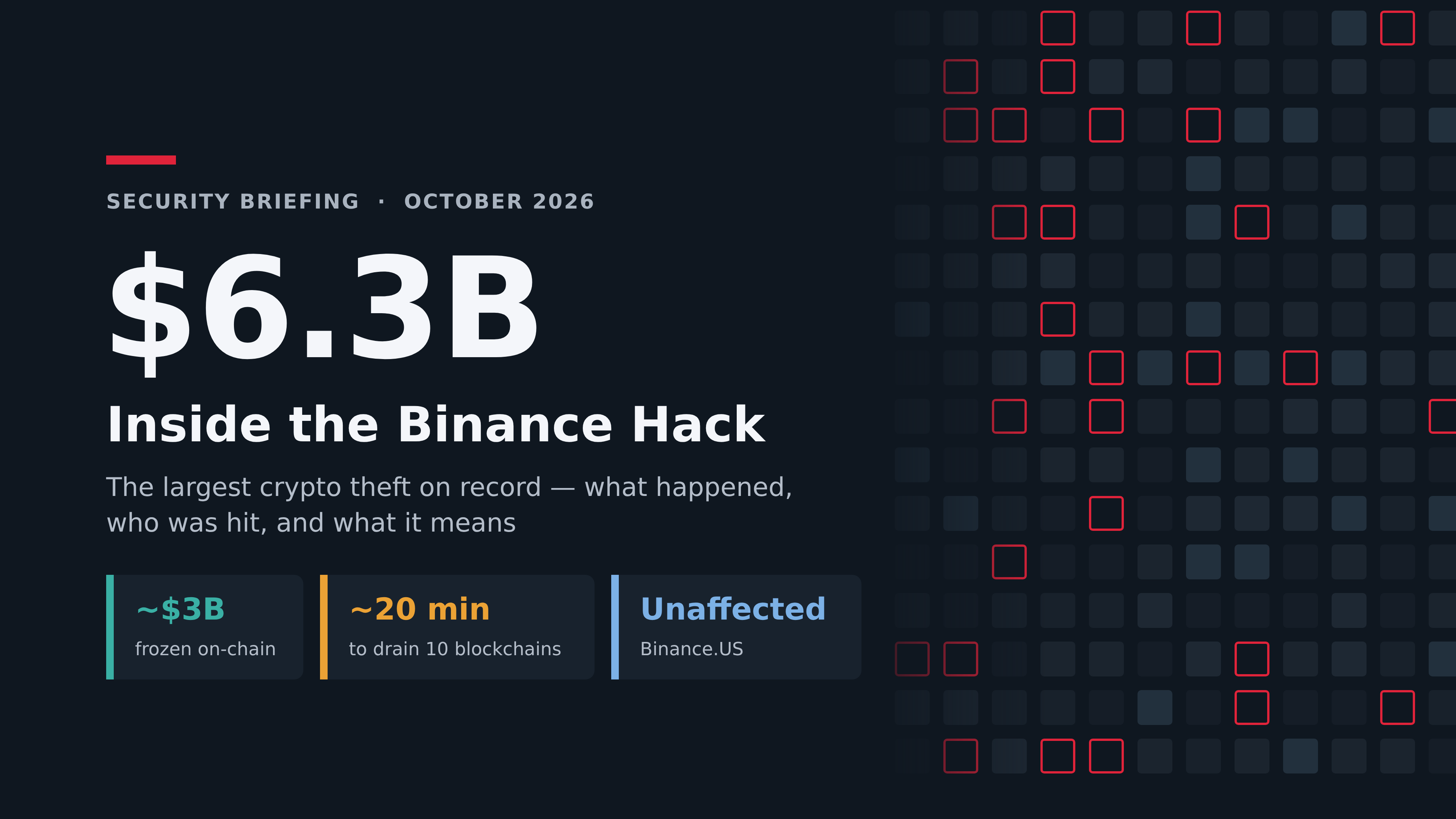
Infographic illustrating the $6.3 billion Binance hack in October 2026.

Figure 1. The $6.3 Billion Binance Hack Title Infographic. Jeremy Swenson. October 2026.

On Thursday night, the world’s largest cryptocurrency exchange suffered what is now the largest theft in the industry’s history. Roughly $6.3 billion in digital assets left Binance’s hot wallets in a matter of minutes, more than four times the $1.5 billion taken from the exchange Bybit in February 2025, the previous record.[1] What follows is what we know so far, what it means for customers, including users of Binance.US, and the lessons that security, risk, and finance leaders should take from it.

What Happened

On the evening of October 29, on-chain researchers began flagging unusually large outflows from Binance wallets. Within the hour, Binance co-founder Changpeng Zhao acknowledged publicly that the activity looked like a hack, and the exchange paused withdrawals across multiple networks.[2] The blockchain analytics firm TRM Labs estimates that approximately $6.36 billion was moved out of Binance wallets across ten blockchains, most of it within about twenty minutes.[3] Binance’s own estimate puts the total impact at about $6.3 billion, and the company has cautioned that the figure may rise as tracing continues.[4]
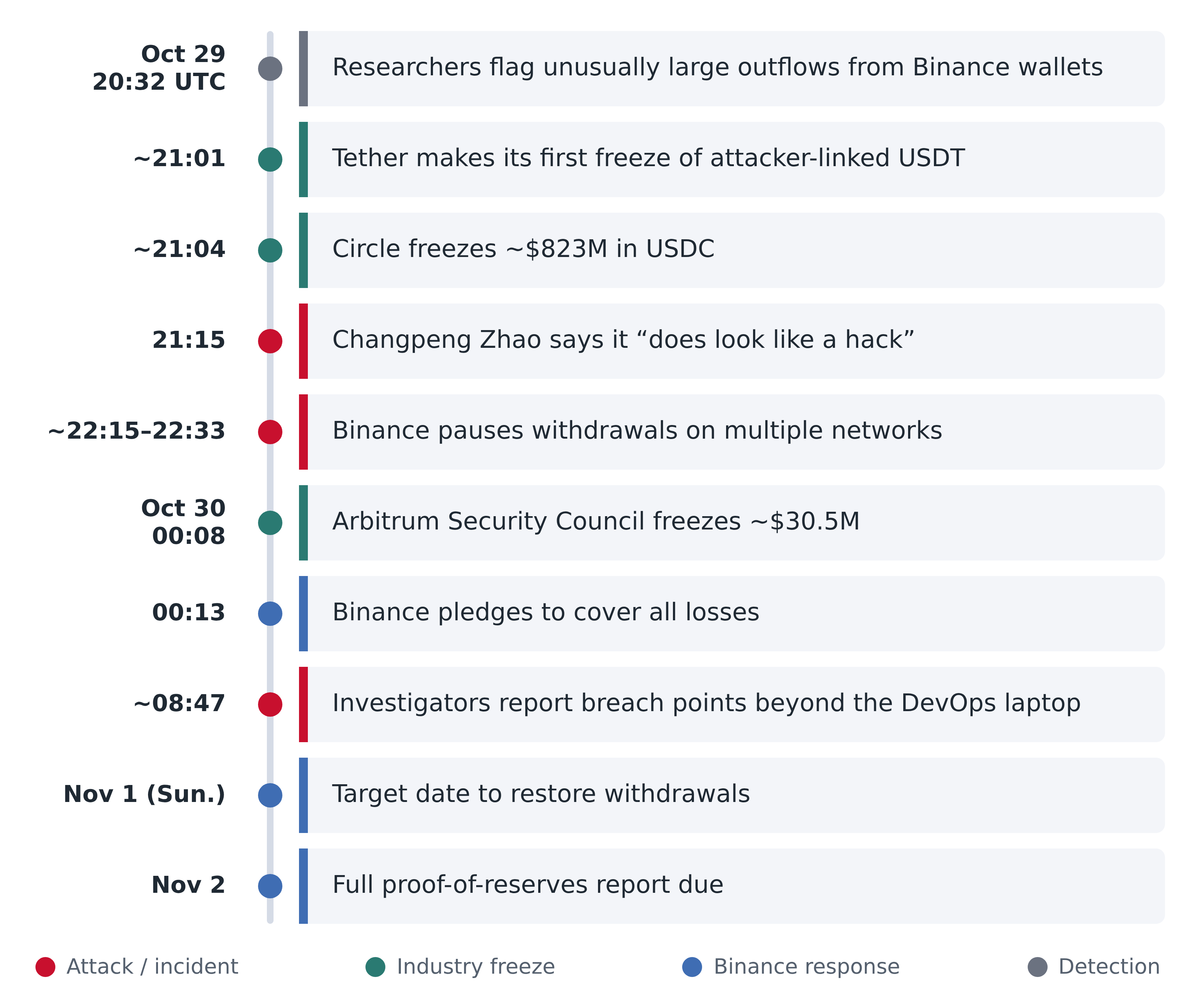
Timeline infographic depicting the Binance hack from October 29 through November 2, 2026. Events are presented in approximate Coordinated Universal Time (UTC), noting that reported times vary across sources.

Figure 2. Timeline of the Binance hack, October 29–November 2, 2026. Times are approximate and in Coordinated Universal Time (UTC); reported times differ across sources. Jeremy Swenson. Data from Crypto Times, HackenProof, Bloomingbit, and statements by Binance, Tether, Circle, and the Arbitrum Security Council.[5] October 2026.

How the Attackers Got In

Binance’s first explanation pointed to a single entry point: a compromised laptop belonging to a DevOps engineer, which reportedly allowed the attacker to reach a service container and submit unauthorized withdrawal transactions.[6] That picture has since grown more complicated. Co-CEO Richard Teng has said the breach was not a one-click event but a more complex, multistage attack, and Binance’s investigators have identified additional points of breach beyond the laptop.[7] Teng also stated that the team had found no evidence that any wallet private keys were leaked.[8] Teng has also said the attackers used a self-destruct mechanism that erased their tooling and traces as they went, which has made reconstructing the intrusion more difficult.[9]

Not every analysis aligns neatly with that account. The security firm Blockaid’s incident report indicates that eleven Binance hot-wallet keys signed the outgoing transfers, which raises the question of whether the attacker abused Binance’s signing infrastructure rather than stealing keys outright.[10] Binance has promised a full technical post-mortem once its investigation is complete, and that report should reconcile the competing accounts.[11]

Speed and Automation

The pace of the attack stands out as much as its size. In a research report released Friday, Chainalysis found that the attackers not only moved the funds quickly but also laundered the proceeds and destroyed evidence of their operation at an unprecedented speed, a pattern its researchers read as automation running through the entire heist.[12] Eric Jardine, head of research at Chainalysis, told Axios that the transactions came at a frequency and scale that ruled out any person approving them: “It had to have been done by a computer.”[13] Researchers at TRM Labs also found that the attackers began preparing for the operation only about 36 hours before it was launched.[14]

Who Is Behind It

Neither Binance nor the FBI has formally attributed the attack.[15] Two prominent analytics firms, however, point in the same direction. TRM Labs links the theft to a North Korean state-sponsored group, citing hallmarks of earlier operations attributed to that country, including transaction signatures obtained in advance.[16] Several blockchain investigation firms have tied the theft specifically to TraderTraitor, a unit linked to the North Korean government’s Lazarus Group collective and the same group that set the previous record with the $1.5 billion Bybit theft.[17] Elliptic likewise assesses North Korea as the likely culprit and reports that some of the stolen funds reached an address connected to the laundering of a suspected North Korean exploit of the exchange Bitget, though Elliptic notes that this establishes a shared laundering network rather than proving a single attacker.[18] According to a person familiar with the matter cited by Reuters, Binance is working with the FBI and the U.S. Secret Service.[19]

A Decade of North Korean Financial Theft

If the attribution holds, the Binance theft extends a record of state-directed financial crime that stretches back more than a decade. In 2016, North Korean hackers tried to steal nearly $1 billion from Bangladesh’s central bank and got away with $81 million; in 2017, the country was blamed for the WannaCry ransomware outbreak, which disrupted hundreds of thousands of computers in more than 150 countries.[20] Pyongyang has since shifted its focus toward crypto exchanges, partly because digital assets are easier to move and launder across borders, even though such attacks tend to leave a more visible trail on-chain.[21] According to Chainalysis’s Jardine, North Korean operators now take the bulk of the value stolen in any given year, effectively crowding out other threat actors.[22]

The AI Accelerant

Experts warn that the speed on display at Binance may offer a glimpse of how artificial intelligence could further amplify North Korea’s operations. Vijay Balasubramaniyan, chief executive and co-founder of Pindrop Security, said social engineering and automation have become hallmarks of the country’s recent cyberattacks. He added that advances in AI-generated video and audio have enabled North Korean operatives to greatly expand schemes that trick U.S. companies into hiring them for IT jobs.[23] Across Pindrop’s customer base, North Korean applicants accounted for roughly one in every 343 job applications last year; this year the figure is about one in 47. Balasubramaniyan attributes the jump less to any single tool than to the sheer number, low cost, and growing ecosystem of AI tools now available to attackers.[24]

The Industry’s Freeze Response

One of the most striking features of this episode is how quickly the rest of the industry moved. Because a large share of the stolen funds were stablecoins, their issuers were able to freeze them on-chain:[25]

  • Tether froze more than $1.56 billion in USDT linked to the incident.[26]
  • Circle froze more than $800 million in USDC, in coordination with law enforcement.[27]
  • Ripple froze roughly $200 million, and World Liberty Financial, working with the custodian BitGo, froze stablecoins and its own tokens.[28]
  • Arbitrum’s Security Council froze about $30.5 million on its network, and the lending protocol Aave froze its Avalanche markets.[29]

Elliptic reports that stablecoins accounted for about $3.46 billion of the stolen funds and that the attacker was slow to convert them, which gave issuers a window in which to act. The firm has independently verified about $2.84 billion of frozen funds on-chain, close to Binance’s estimate of roughly $3 billion.[30] Binance has not said what has become of the remaining $3.3 billion.[31] Jardine said investigators may still recover some of the unfrozen half if those funds pass through exchange infrastructure whose operators can move quickly enough to freeze them, though he cautioned that it is still early days.[32]
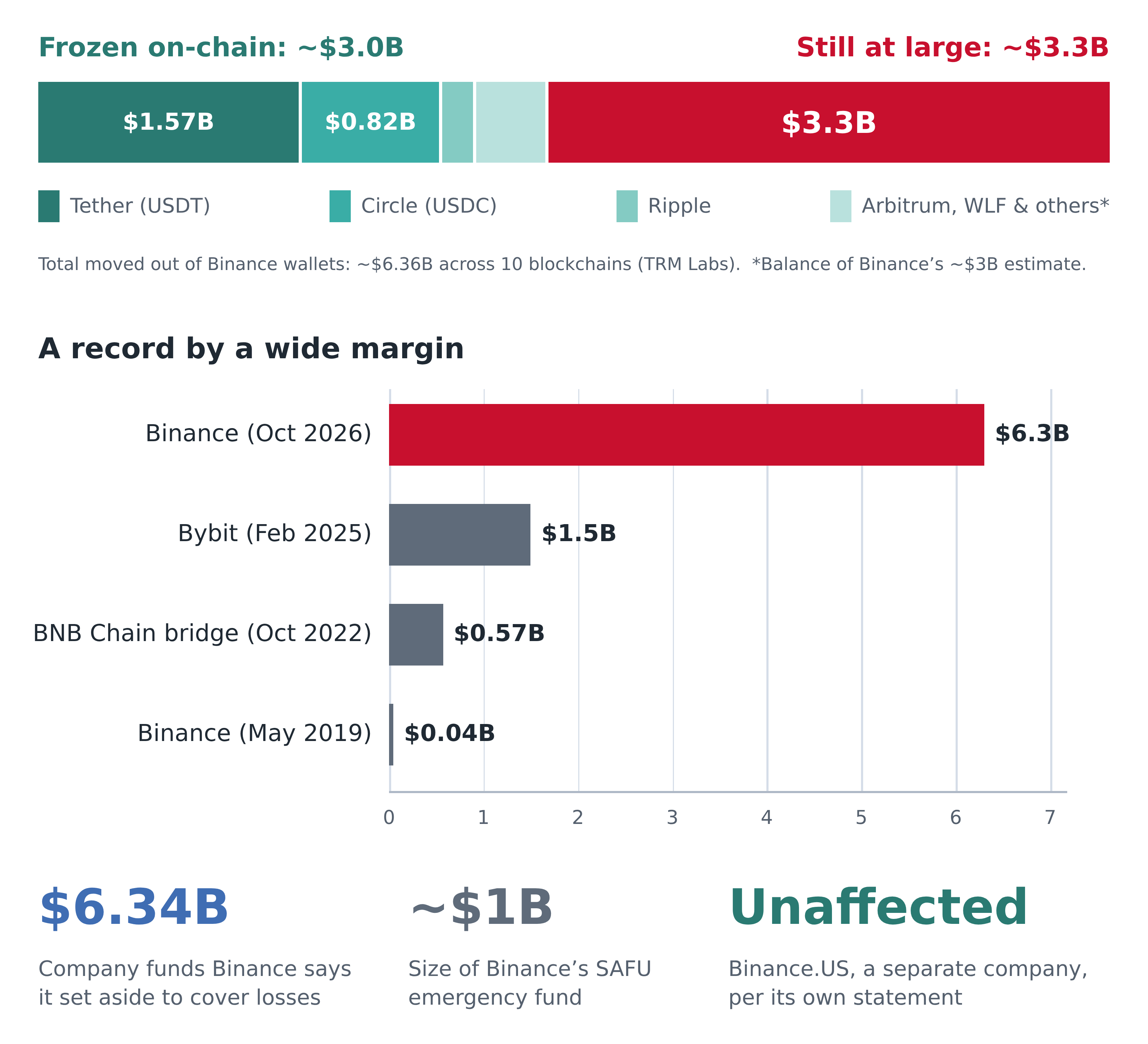
Infographic comparing the status and recovery of assets stolen in the Binance hack with losses from earlier major cryptocurrency exchange hacks, measured in billions of U.S. dollars. Shows reported asset freezes by issuers and Binance, noting that individual amounts may not total Binance’s estimated $3 billion in affected assets.

Figure 3. Status of the stolen assets and comparison with earlier major exchange hacks, in billions of U.S. dollars. Freeze amounts are as reported by issuers and Binance and do not sum precisely to Binance’s ~$3 billion estimate. Jeremy Swenson. Data from Binance, Tether, Circle, Reuters, Elliptic, TRM Labs (via CNBC), Al Jazeera, and Ynet News.[33] October 2026.

Were Customer Funds Stolen?

Binance maintains that customers will not lose money. Teng has said the incident was confined to the exchange’s own hot wallets and that customer assets are managed under a separate security system; Binance says it has secured more than $6.34 billion of company funds to cover the losses in full.[34] That sum is more than six times the size of Binance’s roughly $1 billion Secure Asset Fund for Users (SAFU), the emergency reserve created in 2018 for exactly this kind of event.[35] The company has not detailed where the additional funds came from, but it plans to publish a full proof-of-reserves report by November 2.[36]

In the near term, customers are feeling the effects through access rather than balances. Withdrawals remain suspended while Binance rebuilds its withdrawal system, and the company expects to restore them by Sunday, November 1.[37] Early messaging was also inconsistent: Binance insisted that user funds were completely safe while simultaneously pledging to cover all losses, a combination that understandably confused users.[38] Analysts at Fundstrat Global Advisors say the breach does not currently appear to pose a meaningful solvency risk to an exchange that reported about $162.8 billion in assets under custody and 335 million registered users as of its 2025 annual report.[39]

What About Binance.US?

Binance.US, which operates as a separate company, has said it was not affected, and Coinbase likewise reported no impact on its operations.[40] The one caveat concerns Americans who access the global Binance exchange in spite of its geographic restrictions, for example through a virtual private network; they are in the same withdrawal queue as every other global user.[41]

Market Impact

The hack struck an already fragile market. Bitcoin fell toward $77,000, ether dropped by nearly 6 percent, and Binance’s native BNB token slid by nearly 10 percent.[42] The market maker GSR reported that bid–ask spreads on spot bitcoin at Binance were about five times wider than normal early Friday, a sign of thin liquidity as traders pulled back.[43]

Six Takeaways for Leaders

1. The most privileged endpoints are the biggest attack surface. A single engineer’s laptop appears to have provided an early foothold into systems controlling billions of dollars. Developer and DevOps endpoints deserve the same scrutiny as production infrastructure.

2. Key security is not the same as signing security. Even if no private keys leaked, an attacker who can push transactions through a legitimate signing pipeline can do enormous damage. Authorization logic, withdrawal limits, and anomaly detection along the signing path matter as much as key custody.

3. Centralized controls cut both ways. The ability of Tether, Circle, and others to freeze roughly $3 billion is the main reason this was not a total loss. It is also a reminder that stablecoins carry issuer-level control: a feature in a crisis and a policy debate the rest of the time.

4. Counterparty risk is real, even at the top. If the world’s largest exchange can be breached, institutions and individuals alike should know where their assets sit, who holds the keys, and what happens contractually when something goes wrong.

5. Expect regulation to follow. Industry voices, including the head of Franklin Templeton’s crypto business, are already calling for stronger cybersecurity rules.[44] A theft of this scale gives policymakers fresh momentum on custody standards, proof-of-reserves requirements, and mandatory incident disclosure.

6. Defenses must operate at machine speed. An attack that drained billions in about twenty minutes and erased its own traces leaves no room for manual review. Automated withdrawal circuit breakers, real-time anomaly response, and preserved forensic logs are now baseline controls. With AI-enabled North Korean applicants flooding hiring pipelines, identity verification during recruiting also belongs inside the security perimeter.

The Bottom Line

Binance appears to have the balance sheet to absorb this loss, and a coordinated industry response froze nearly half of the stolen funds within hours. Yet the largest crypto theft in history occurred at the platform best resourced to prevent it. The forthcoming post-mortem will be one of the most important security documents the industry has produced, and it deserves close reading.

How is your organization thinking about custody and counterparty risk after this week? I would welcome your perspective in the comments.

About The Author

Jeremy A. Swenson is a disruptive-thinking security entrepreneur, futurist/researcher, and seasoned senior management technology risk and digital strategy consultant. His experience spans healthcare, retail, financial services, high technology, and government. He is a frequent speaker and published writer, and he also does some pro bono consulting in these areas. He holds a certificate in Media Technology Policy from Oxford University’s Media Policy Summer Institute, an MSST (Master of Science in Security Technologies) degree from the University of Minnesota’s Technological Leadership Institute (TLI), an MBA from Saint Mary’s University of Minnesota, and a BA in political science from the University of Wisconsin Eau Claire. He is an alum of the Federal Reserve Secure Payment Task Force, the Crystal, Robbinsdale, and New Hope Community Police Academy (MN), as well as the Minneapolis FBI Citizens Academy. You can follow him on LinkedIn and Twitter. You can contact him for speaking, media, or consulting engagements via his website here: https://jeremy-swenson.com/

Endnotes


[1]Ravie Lakshmanan, “Binance Suffers Security Breach Affecting $6.3 Billion in Assets, Nearly $3 Billion Frozen,” The Hacker News, October 30, 2026, accessed October 30, 2026, https://thehackernews.com/2026/10/binance-suffers-security-breach.html; “Binance Hit by Record $6.3 Billion Crypto Hack: ‘This Was a Complex Attack,’ Says Co-CEO,” Yahoo Finance, October 30, 2026, accessed October 30, 2026, https://finance.yahoo.com/markets/article/bitcoin-drops-to-76000-as-binance-hack-spooks-investors-tether-circle-freeze-assets-083406383.html.

[2]“Binance Hack: How CZ, Coinbase, Tether and 70+ Crypto Leaders Reacted to the $6.3B Theft,” Crypto Times, October 30, 2026, accessed October 30, 2026, https://www.cryptotimes.io/2026/10/30/binance-hack-how-cz-coinbase-tether-and-70-crypto-leaders-reacted-to-the-6-3b-theft/; “Binance Pauses Withdrawals as Hackers Suspected of Stealing Billions in Crypto,” TechCrunch, October 29, 2026, accessed October 30, 2026, https://techcrunch.com/2026/10/29/binance-pauses-withdrawals-as-hackers-suspected-of-stealing-billions-in-crypto/.

[3]“Binance’s $6.3 Billion Hack: What We Know and What Comes Next,” CNBC, October 30, 2026, accessed October 30, 2026, https://www.cnbc.com/2026/10/30/billions-in-crypto-frozen-in-binance-hack-heres-what-happens-next-.html.

[4]“Binance Targeted in $6.3 Billion Crypto Heist, the Largest Ever,” NBC News, October 29, 2026, updated October 29, 2026, accessed October 30, 2026, https://www.nbcnews.com/business/markets/binance-hack-tether-circle-stablecoins-rcna606445.

[5]Timeline compiled from “Binance Hack: How CZ, Coinbase, Tether and 70+ Crypto Leaders Reacted”; “Binance Hack Update: $6.3B Impact, $3B Frozen After DevOps Laptop Breach,” Crypto Times, October 30, 2026, accessed October 30, 2026, https://www.cryptotimes.io/2026/10/30/binance-hack-6-3b-impact-3b-frozen-after-devops-laptop-breach/; “Binance Hack: What We Know About the $6.3B Breach,” HackenProof (blog), October 30, 2026, accessed October 30, 2026, https://hackenproof.com/blog/binance-hack, which also reports the Arbitrum Security Council freeze; and “Binance CEO Says Full Proof-of-Reserves Report Due Nov. 2, Pledges Full Compensation for Hack Losses,” Bloomingbit, October 30, 2026, accessed October 30, 2026, https://en.bloomingbit.io/feed/news/123309. Binance statements as reported in Lakshmanan, “Binance Suffers Security Breach”; Tether’s as reported in “Binance Targeted in $6.3 Billion Crypto Heist”; and Circle’s as reported in “Binance Hit by $6.3 Billion Theft in What Could Be the Biggest Crypto Heist on Record,” Help Net Security, October 30, 2026, accessed October 30, 2026, https://www.helpnetsecurity.com/2026/10/30/binance-crypto-hack/.

[6]Lakshmanan, “Binance Suffers Security Breach.”

[7]Agence France-Presse, “Crypto Platform Binance Confirms ‘Complex’ $6.3 bn Hack,” Yahoo Finance, October 30, 2026, accessed October 30, 2026, https://finance.yahoo.com/markets/crypto/articles/crypto-platform-binance-confirms-major-013059975.html; “What We Know About the $6.3B Breach.”

[8]“Binance Hack: Teng Says No Private Key Leaked, and Blockaid Says Eleven Binance Keys Signed the Transfers,” FinanceFeeds, October 30, 2026, accessed October 30, 2026, https://financefeeds.com/binance-hack-eleven-keys-signed-no-leak/.

[9]Sam Sabin, “How North Korea Perfected the Crypto Heist,” Axios, October 31, 2026, accessed October 31, 2026, https://www.axios.com/2026/10/31/north-korea-hackers-binance-crypto.

[10]“Teng Says No Private Key Leaked.”

[11]“Binance Hit by $6.3 Billion Theft.”

[12]Sabin, “How North Korea Perfected the Crypto Heist.”

[13]Sabin, “How North Korea Perfected the Crypto Heist.”

[14]Sabin, “How North Korea Perfected the Crypto Heist.”

[15]“Binance Hack: What the $6.3 Billion Theft Means for US Crypto Users,” BreezyScroll, October 30, 2026, accessed October 30, 2026, https://www.breezyscroll.com/money/binance-hack-crypto-assets-frozen.

[16]“What We Know and What Comes Next.”

[17]Sabin, “How North Korea Perfected the Crypto Heist.”

[18]Elliptic, “The Largest Theft in History: North Korea Likely Behind the $6.4 Billion Binance Hack,” Elliptic Insights, October 30, 2026, accessed October 30, 2026, https://www.elliptic.co/insights/binance-largest-hack-in-history/.

[19]Reuters, “Hackers Steal $6.3 Billion from Binance in Record Heist Blamed on North Korea,” Yahoo Finance, October 30, 2026, accessed October 30, 2026, https://finance.yahoo.com/markets/crypto/articles/tether-circle-freeze-2-38-222607515.html.

[20]Sabin, “How North Korea Perfected the Crypto Heist.”

[21]Sabin, “How North Korea Perfected the Crypto Heist.”

[22]Sabin, “How North Korea Perfected the Crypto Heist.”

[23]Sabin, “How North Korea Perfected the Crypto Heist.”

[24]Sabin, “How North Korea Perfected the Crypto Heist.”

[25]“Binance Hit by $6.3 Billion Theft.”

[26]“Binance Targeted in $6.3 Billion Crypto Heist.”

[27]“Binance Hit by $6.3 Billion Theft.”

[28]Reuters, “Hackers Steal $6.3 Billion from Binance.”

[29]“What We Know About the $6.3B Breach.”

[30]Elliptic, “Largest Theft in History.”

[31]“Binance Says $6.3bn Stolen in Biggest Crypto Heist in History: What We Know,” Al Jazeera, October 30, 2026, accessed October 30, 2026, https://www.aljazeera.com/news/2026/10/30/binance-says-6-3bn-stolen-in-biggest-crypto-heist-in-history-what-we-know.

[32]Sabin, “How North Korea Perfected the Crypto Heist.”

[33]Total stolen and Binance’s frozen-funds estimate from Lakshmanan, “Binance Suffers Security Breach”; Tether freeze from “Binance Targeted in $6.3 Billion Crypto Heist”; Circle freeze from “Binance Hit by $6.3 Billion Theft”; Ripple freeze from Reuters, “Hackers Steal $6.3 Billion from Binance”; stablecoin and verified-frozen totals from Elliptic, “Largest Theft in History”; TRM Labs estimate from “What We Know and What Comes Next”; unaccounted-for remainder and earlier-hack comparison from “Binance Says $6.3bn Stolen”; and “Binance Reports $6.3 Billion Crypto Breach, Potentially the Biggest Hack in History,” Ynet News, October 30, 2026, accessed October 30, 2026, https://www.ynetnews.com/business/article/bjmb5f11tme.

[34]“Binance CEO Says Full Proof-of-Reserves Report Due Nov. 2.”

[35]“Binance Says $6.3bn Stolen.”

[36]Reuters, “Hackers Steal $6.3 Billion from Binance.” “Binance CEO Says Full Proof-of-Reserves Report Due Nov. 2.”

[37]“Binance CEO Says Full Proof-of-Reserves Report Due Nov. 2.”

[38]Agence France-Presse, “Binance Confirms ‘Complex’ $6.3 bn Hack.”

[39]“What We Know and What Comes Next.” Reuters, “Hackers Steal $6.3 Billion from Binance.”

[40]“Binance Reports $6.3 Billion Crypto Breach”; “Binance Hack Update.”

[41]“What the $6.3 Billion Theft Means for US Crypto Users.”

[42]“Live Updates: Bitcoin Falls to $77,000 as Binance Exploit Combines with Tech Woes,” CoinDesk, October 30, 2026, accessed October 30, 2026, https://www.coindesk.com/markets/2026/10/30/live-news-binance-hack-rattles-crypto-as-intel-plunges-and-ai-spending-fears-hit-tech; Agence France-Presse, “Binance Confirms ‘Complex’ $6.3 bn Hack.”

[43]Reuters, “Analysts React as Binance Freezes Assets after $6.3 Billion Security Breach,” Euronext Financial News, October 30, 2026, accessed October 30, 2026, https://live.euronext.com/en/financial-news/analysts-react-binance-freezes-assets-after-63-billion-security-breach.

[44]Chris Perkins, “Binance Hack Reveals Need for Stronger Cybersecurity Regulation,” interview, CNBC, video, October 30, 2026, accessed October 30, 2026, https://www.cnbc.com/video/2026/10/30/binance-hack-calls-for-stronger-cybersecurity-regulation-perkins.html.


What the rise, fall, and rapid rebirth of eXch tells us about the real shape of crypto crime in 2026

Every few months, a crypto exchange gets “shut down.” Headlines run. LinkedIn fills with hot takes. And then, quietly, the money keeps moving. That’s the pattern I want to walk through here—not as a hypothetical, but as a documented case, built on the work of the two firms that actually trace this money for a living: TRM Labs and Chainalysis.

Across my career in technology governance, cyber risk, enterprise transformation, and technology leadership, this particular case study has become one of the clearest illustrations of a lesson every risk leader eventually learns the hard way: shutting down a bad actor is not the same as dismantling the capability behind it. The organization goes away. The infrastructure, the liquidity, and the operators very often do not.

The Exchange That Wouldn’t Stay Dead:

eXch was a no-questions-asked crypto swap service. No identity verification, no meaningful compliance program—and it marketed that absence as a feature, branding itself a “privacy project” rather than what regulators would call it: a gap in the system, wide open and waiting to be used.

That gap became national news in February 2025, when North Korea’s Lazarus Group pulled off the largest crypto theft in history, stealing roughly $1.4 to $1.5 billion in Ethereum from the Bybit exchange.1 Bybit and independent investigators—including Elliptic, TRM Labs, and researcher ZachXBT—all pointed to the same off-ramp: eXch allegedly helped launder more than $90 million of the stolen funds.2

eXch’s owner, publicly known only as “Johann Roberts,” denied it, then partially admitted it, then blamed a slow compliance data feed. For what it’s worth, I went looking for a verified identity behind that name while researching this piece. I couldn’t find one. Treat it as an alias until proven otherwise.

In April 2025, eXch announced it was shutting down—citing, of all things, a DOJ whistleblower and a “transatlantic law enforcement operation.” Here’s the part almost nobody covered: it didn’t actually stop. TRM Labs found that eXch pulled its public-facing website but kept serving business partners through an API, with the same laundering fingerprints continuing right past its own announced shutdown date.3

This Isn’t One Bad Exchange—It’s a Lineage:

If eXch feels like an isolated case, look at what happened to Garantex, the Russian exchange first sanctioned in 2022 for laundering funds tied to darknet markets and ransomware groups like Conti and Hydra. Law enforcement finally seized its infrastructure in March 2025, after the platform had processed an estimated $96 billion in transactions since 2019, a substantial share of it tied to ransomware, darknet-market, and other criminal activity.4

What happened next is the whole point of this article. Garantex didn’t disappear. It became Grinex—same liquidity, same users, same money, new name. Chainalysis and TRM then traced the same pattern into ABCeX and its rebrand AEXBit, which share identical backend infrastructure and hot wallets with their predecessors; into the A7/A7A5 ruble-backed payment network, which has moved more than $93.3 billion in on-chain volume and counting; and into Heleket, a “new” service that received its opening liquidity directly from Garantex’s own wallets.5

TRM’s own assessment, stated plainly in its 2026 crypto crime report, is that this wave of rebrands is likely coordinated—a deliberate attempt to keep Russia’s crypto liquidity flowing while insulating the actual operators from further sanctions.6 For what it’s worth, Grinex itself went dark in April 2026 after a $13.7 million cyberattack it blamed, without evidence, on Western intelligence agencies.7 I’d bet money there’s already a successor standing by.

The Bigger Story Nobody’s Talking About Enough:

Here’s what I think most crypto-crime coverage still misses: individual rogue exchanges, however dramatic the headline, are no longer the main event.

Both TRM and Chainalysis now point to something structurally different—Chinese-language money laundering networks, or CMLNs. In 2025 alone, these networks moved an estimated $16.1 billion, roughly $44 million a day, across nearly 1,800 active wallets. That’s not a typo: Chainalysis measured CMLN growth at roughly 7,325 times the growth rate of illicit inflows to centralized exchanges since 2020.8

The anchor of this ecosystem is Huione Group, a Cambodia-based conglomerate that processed more than $98 billion in total crypto inflows between August 2021 and January 2025, over $4 billion of it confirmed illicit. In October 2025, the U.S. Treasury’s FinCEN designated Huione under Section 311 of the USA PATRIOT Act as a primary money laundering concern. Huione is also directly tied to Prince Group, the Cambodia-based criminal network behind a sprawling web of scam compounds across Southeast Asia.9

Why does this matter more than another exchange takedown? Because CMLNs aren’t one company you can seize. They’re a marketplace—fragmentation services, OTC desks, and “guarantee” platforms like Huione and Xinbi that connect buyers and sellers of laundering capacity, often without the platform operators ever directly touching the illicit funds themselves. Sanction one vendor, and the rest of the marketplace barely notices.10

Ransomware Isn’t Slowing Down—It’s Diversifying:

Data-leak-site-claimed ransomware incidents grew 50 percent year-over-year in 2025, reaching an all-time high even as enforcement activity intensified.11 The Ransomware-as-a-Service market has also fragmented, with some trackers counting as many as 85 active independent extortion groups—a more decentralized field that’s harder to monitor collectively, even as individual groups’ laundering patterns become easier to fingerprint on-chain.12

Separately, broader Chainalysis research on illicit crypto flows (not specific to ransomware) points to a shift in final-stage laundering toward exchanges with little to no know your customer (KYC) verification, with no-KYC exchange usage up 82 percent and usage of “guarantee” aggregators such as Tudou Danbao up 87 percent.13 Whether North Korean state actors rely on these no-KYC exchanges less than independent cybercriminals do—running a more specialized pipeline through Chinese money-laundering networks and bridge protocols instead—is a plausible pattern given DPRK’s well-documented use of dedicated laundering infrastructure. But it isn’t a claim I found directly confirmed in the sources reviewed for this piece, so I’m flagging it as a reasonable hypothesis rather than an established fact.

Enforcement has also started targeting the infrastructure layer itself, not just individual exchanges. In February 2025, the U.S., U.K., and Australia jointly sanctioned Zservers, a Russian bulletproof-hosting provider tied to ransomware operations including LockBit; Chainalysis data shows Zservers funneled at least $5.2 million through high-risk channels, including the sanctioned exchange Garantex.14 OFAC separately sanctioned Aeza Group, another Russian bulletproof host, in July 2025—though, notably, that action does not appear to have included the U.K. and Australia as co-sanctioning parties.15

What This Actually Means:

If you take one thing from this, let it be this: the “shut it down” model of enforcement works—temporarily. eXch kept running through its own back door. Garantex became Grinex became ABCeX became AEXBit. The harder, more consequential fight is against the marketplace model itself—the CMLNs, the guarantee platforms, and the hosting infrastructure underneath all of it—which doesn’t have one throat to choke.

The good news, and it’s a real one, is that blockchain transparency remains investigators’ structural advantage. The same on-chain fingerprinting—shared wallets, co-spending patterns, infrastructure overlap—that unmasked ABCeX as a Garantex clone will eventually do the same to whatever comes after Grinex, and whatever comes after that.

This case study reflects the kind of governance-under-adversarial-pressure challenge I spend a lot of time researching and writing about: how do we design governance, oversight, and risk management frameworks for ecosystems that are deliberately engineered to evade them? Answering that will take a coordinated, multi-layered response—end-to-end mapping of cryptocurrency transaction chains, stronger Know Your Customer and Anti-Money Laundering controls, deeper multinational cooperation among regulators and law enforcement, more rigorous misuse-case modeling to anticipate adversarial behavior, and broader, faster identification and blacklisting of the high-risk exchanges, wallets, and tokens that keep facilitating illicit finance long after their predecessors are supposedly gone.

Endnotes:

1. TRM Labs, “2026 Crypto Crime Report” (TRM Labs, 2026), https://www.trmlabs.com/reports-and-whitepapers/2026-crypto-crime-report.

2. Decrypt, The Block, and CryptoRank.io, contemporaneous news coverage of the Bybit hack and eXch’s role in laundering stolen funds, February–March 2025.

3. TRM Labs, “eXch Remains Active Despite Shutdown: How the Bybit Hack-Linked Exchange Continues to Enable Laundering of CSAM Funds” (TRM Labs Blog, May 2, 2025), https://www.trmlabs.com/resources/blog.

4. Chainalysis, “OFAC Sanctions Tracker: How Sanctions Impact Crypto Crime” (Chainalysis Blog), https://www.chainalysis.com/blog/ofac-sanctions/.

5. TRM Labs, “2026 Crypto Crime Report.”

6. TRM Labs, “2026 Crypto Crime Report.”

7. TRM Labs, “2026 Crypto Crime Report.”

8. Chainalysis, “The Chinese-Language Underground Crypto Money Laundering Ecosystem” (Chainalysis Blog, January 27, 2026), https://www.chainalysis.com/blog/2026-crypto-money-laundering/.

9. Chainalysis, “Crypto Sanctions: 2026 Crypto Crime Report” (Chainalysis Blog, 2026), https://www.chainalysis.com/blog/crypto-sanctions-2026/.

10. Chainalysis, “The Chinese-Language Underground Crypto Money Laundering Ecosystem.”

11. Chainalysis, “Crypto Ransomware: 2026 Crypto Crime Report” (Chainalysis Blog, March 4, 2026), https://www.chainalysis.com/blog/crypto-ransomware-2026/.

12. Chainalysis, “Crypto Ransomware: 2026 Crypto Crime Report.”

13. Chainalysis, “2025 Crypto Theft Reaches $3.4 Billion” (Chainalysis Blog, December 18, 2025), https://www.chainalysis.com/blog/crypto-hacking-stolen-funds-2026/.

14. Chainalysis, “OFAC Sanctions Tracker.”

15. Chainalysis, “OFAC Sanctions Tracker.”

Crypto, Conflict, and Capital Flight: What Iran’s On-Chain Shock Signals for Middle East Economics and U.S. Markets


In late February 2026, shortly after coordinated U.S.–Israeli airstrikes struck targets in Tehran, blockchain analytics firms observed an abrupt spike in cryptocurrency withdrawals from Iran’s largest digital asset exchange. Within minutes of the strikes, Nobitex reportedly experienced a roughly 700 percent surge in withdrawals, with millions of dollars in crypto leaving the platform in a compressed time window.¹ This episode, while modest in absolute global market terms, offers a revealing case study in how digital assets function during geopolitical stress—and what that may signal for Middle East economics and U.S. financial markets over the next year.

A Rapid Withdrawal Shock:

Reporting indicates that nearly $3 million exited Nobitex in a single hour following the strikes, with approximately $10 million leaving Iranian exchanges over several days.² Such flows are small relative to global crypto trading volumes but significant within the Iranian financial context, where capital controls, sanctions, and currency instability already shape economic behavior.

Iran’s domestic currency, the rial, has faced long-standing pressure from inflation, sanctions, and restricted access to global banking networks. In that environment, cryptocurrencies—particularly Bitcoin and dollar-denominated stablecoins—have increasingly served as alternative stores of value and channels for cross-border transfers.³ The surge in withdrawals appears consistent with crisis-driven capital preservation behavior rather than speculative trading alone.

Crypto as a Financial “Pressure Valve”:

The events underscore crypto’s evolving role as a decentralized financial “pressure valve” in sanctioned or conflict-affected economies. When traditional banking rails are constrained or politically vulnerable, digital assets offer relative portability and censorship resistance.¹

Internet blackouts and temporary exchange disruptions complicate interpretation. Outages can cluster transactions when connectivity resumes, making withdrawal spikes appear sharper than underlying demand alone would suggest.³ Nonetheless, the pattern aligns with prior episodes in emerging markets where digital assets gained traction during currency stress.

The lesson is not that crypto replaces sovereign financial systems, but that it increasingly supplements them under strain.

Economic Implications for the Middle East (Next 12 Months):

Looking forward, several dynamics are likely to shape regional economics:

1. Expanded Informal Dollarization via Digital Assets. Sanctioned or financially constrained economies may see broader retail and institutional adoption of dollar-linked stablecoins as parallel monetary tools.

2. Heightened Regulatory and Surveillance Pressure. As crypto flows intersect with sanctions regimes, U.S. and allied regulators are likely to intensify scrutiny of exchanges, custodians, and cross-border blockchain activity.¹

3. Persistent Capital Flight Incentives. Geopolitical volatility increases incentives for households and firms to diversify outside domestic banking systems.

4. Infrastructure Fragility Risks. Internet shutdowns and exchange outages remain structural vulnerabilities in crisis environments.³

Collectively, these forces suggest that digital asset adoption in parts of the Middle East will continue—not as ideological endorsement of crypto, but as pragmatic economic hedging.

What This Means for U.S. Markets:

For U.S. investors and policymakers, the implications extend beyond regional headlines.

Oil and Energy Sensitivity. Any escalation involving Iran carries oil supply risk implications. Even absent sustained disruption, perceived risk premiums can lift energy prices.

Safe-Haven Flows and Dollar Strength. Periods of geopolitical tension historically reinforce demand for U.S. Treasuries and dollar-denominated assets. Concurrently, Bitcoin and gold often experience volatility tied to risk sentiment shifts.⁴

Regulatory Spillover. If crypto is increasingly viewed as a sanctions-adjacent vector, U.S. enforcement posture may tighten, affecting exchanges and institutional investors.

Systemic Interconnectedness. Crypto is no longer a siloed asset class. It is embedded within global liquidity networks. Geopolitical events can trigger rapid on-chain responses that ripple into equities, commodities, and foreign exchange markets.

Forecast—A Converging Risk Landscape:

Over the next year, expect three converging trends:

  1. Greater integration between geopolitical risk modeling and digital asset analytics.
  2. Increased compliance burdens on global crypto infrastructure providers.
  3. Continued volatility transmission across oil, crypto, emerging market currencies, and U.S. equities during regional escalations.

The Iranian withdrawal spike may have involved only millions of dollars—but its significance lies in what it signals: digital capital now moves at the speed of conflict.

For U.S. markets, that means geopolitical shocks increasingly transmit through hybrid financial rails—traditional and decentralized alike. Outside of economic considerations, peace is desirable for the benefit of all.


Bibliography:

  1. Yahoo Finance. “Millions of Dollars in Crypto Left Iranian Exchanges After Airstrikes.” February 2026.
  2. Economic Times. “Why Did Iran’s Largest Crypto Exchange See a 700% Withdrawal Spike Minutes After US–Israel Airstrikes Hit Tehran?” February 2026.
  3. Bitget News. “Iranian Crypto Exchange Records Surge in Withdrawals Following Tehran Strikes.” February 2026.
  4. Forbes. “Iran War, an Oil Crisis, a Crypto Stress Test.” March 2026.

What If You Bought 10,000 Bitcoins on November 30, 2010?

Minneapolis—07/14/25

Fig. 1. Bitcoin Stock Image, 2025.

Investor enthusiasm for Bitcoin continues to grow as corporate treasuries ramp up their acquisitions and the U.S. Congress edges closer to passing pivotal cryptocurrency legislation. Starting on 07/14/25, the U.S. House of Representatives will begin reviewing a suite of crypto-related bills during what has been labeled “Crypto Week.” These proposed measures aim to establish a more transparent regulatory framework for digital assets—an initiative long championed by the crypto industry. The policy push has received backing from former President Donald Trump, who has positioned himself as a crypto-friendly leader and is involved in multiple blockchain-related ventures. Among the most closely watched proposals is the Genius Act, which could introduce federal oversight for stablecoins pegged to the U.S. dollar and potentially open the door for private companies to issue digital dollars.

However, on 11/30/10, Bitcoin was trading at roughly $0.23 per coin.(1) If you had invested $2,300 then, you could’ve acquired 10,000 BTC. At the time, that decision would’ve seemed obscure, laughable even, especially compared to buying gold, stocks, or real estate. The real estate market was down then due to the mortgage bubble-induced Great Recession.

But today, with Bitcoin priced at $121,000 per coin (2), that same purchase would now be worth an astonishing $1.21 billion. Your original $2,300 would have grown by over 52 million percent, delivering a profit of $1,209,997,700—yes, that is billions! That’s not just life-changing wealth—it’s generational. Billionaire status, from a sum that’s less than many people’s rent check.


The High-Risk Investment Nobody Believed In:

Despite the reward, a 2010 Bitcoin investment was far from low-risk. Investors at the time faced:

  • Technology Risk: You had to navigate early exchanges like Mt. Gox and use command-line wallets.
  • Security Risk: Wallet hacks and exchange thefts were rampant. There was no FDIC or insurance for crypto losses.(3)
  • Regulatory Uncertainty: Bitcoin was considered the currency of the dark web. Its legal future was murky at best.(4)
  • Volatility: There were frequent 70–90% drawdowns. Many early holders sold at $1, $10, or $100, fearing it would crash back to zero.

To hold 10,000 BTC from 2010 to 2025 required not just foresight—but ironclad conviction and secure digital hygiene.


Three People Who Made (and Kept) Their Bitcoin Fortunes:

1. Erik Finman

In 2011, a teenage Finman bought about 100 BTC with $1,000. By the time he was 18, he had become a millionaire. He parlayed his gains into building educational tech ventures and became a public face for Gen Z crypto success.(5)

2. Roger Ver

Known as “Bitcoin Jesus,” Ver was among the first to promote Bitcoin full-time. He invested heavily when it was under $1, and his early holdings are believed to number in the hundreds of thousands. Though later he championed Bitcoin Cash, his Bitcoin fortune is still substantial.(6)

3. Charlie Shrem

A co-founder of BitInstant, Shrem acquired thousands of Bitcoins in 2011, using them to build infrastructure for Bitcoin access. Though he served prison time due to regulatory issues, his stake made him a multimillionaire.(7)


Is There Another Bitcoin Out There?

It’s easy to dream that another asset might offer Bitcoin-like returns. But we should note:

  • Bitcoin was a first-mover. It’s the only digital asset to go from $0.01 to over $100,000 while maintaining broad global recognition.
  • Markets are now institutionalized. Regulators, hedge funds, and custodians watch the crypto space closely, making “wild west” gains harder to find.
  • Asymmetric bets still exist. AI startups, early-stage biotech, and deep-tech platforms might offer the next moonshot—but with similar volatility and failure risk.

Lessons from the Bitcoin Billionaires:

  1. Be Early—but Stay Invested Timing is only half the story. Holding through crashes (like in 2014, 2018, and 2022) was just as critical.
  2. Protect Your Holdings Many early holders lost everything due to poor key management. Cold wallets and secure backups are vital.
  3. Have Conviction Amid Doubt The biggest returns often come from believing before the crowd does—when the risk feels scariest.

Final Word: From $2,300 to $1.21 Billion:

Had you purchased 10,000 BTC for $2,300 on November 30, 2010, and held it securely for 15 years, you’d now be worth $1.21 billion. Few people made that choice, and even fewer had the resolve to hold. But this extreme example offers a timeless insight: Fortune doesn’t just favor the bold—it favors the bold who are patient, prepared, and just a little bit lucky. One thing is for sure: paper and coin currency are dead, too burdensome, and are declining in use over credit cards.


Footnotes:

  1. CoinMarketCap. (2023). Bitcoin Historical Data – November 2010. Retrieved from https://coinmarketcap.com
  2. Yahoo Finance. (2025, July 14). Bitcoin (BTC-USD) price. Retrieved from https://finance.yahoo.com
  3. Popper, N. (2015). Digital Gold: Bitcoin and the Inside Story of the Misfits and Millionaires Trying to Reinvent Money. Harper.
  4. Greenberg, A. (2014). This Machine Kills Secrets. Dutton.
  5. CNBC. (2017, Dec 14). Teen Bitcoin Millionaire Erik Finman. https://www.cnbc.com
  6. The Guardian. (2017, July 2). Bitcoin’s Evangelist: Roger Ver. https://www.theguardian.com
  7. Wired. (2014, Jan 27). Bitcoin’s First Felon: The Rise and Fall of Charlie Shrem. https://www.wired.com

About the Author:

Jeremy Swenson is a disruptive-thinking security entrepreneur, futurist/researcher, and senior management tech risk consultant. Over 17 years, he has held progressive roles at many banks, insurance companies, retailers, healthcare organizations, and even government entities. Organizations appreciate his talent for bridging gaps, uncovering hidden risk management solutions, and simultaneously enhancing processes. He is a frequent speaker, podcaster, and a published writer – CISO Magazine and the ISSA Journal, among others. He holds a certificate in Media Technology from Oxford University’s Media Policy Summer Institute, an MBA from Saint Mary’s University of MN, an MSST (Master of Science in Security Technologies) degree from the University of Minnesota, and a BA in political science from the University of Wisconsin Eau Claire. He is an alum of the Cyber Security Summit Think Tank, the Federal Reserve Secure Payment Task Force, the Crystal, Robbinsdale and New Hope Citizens Police Academy, and the Minneapolis FBI Citizens Academy. He also has certifications from Intel and the Department of Homeland Security.

Digital vs. Physical Heists: Does Crypto Theft Impact Cryptocurrency Value?

Fig. 1. Digital vs. Physical Financial Theft Graphic, Jeremy Swenson, 2025.

Minneapolis—

Cryptocurrencies have revolutionized the financial landscape, offering decentralized and borderless transactions. However, the rise of crypto fraud and theft poses significant challenges to the stability and perception of digital currencies. With large-scale hacks and scams frequently making headlines, the question arises: do these fraudulent activities ultimately raise or lower the value of cryptocurrencies? This article examines the immediate and long-term effects of crypto theft on digital asset valuation, comparing these incidents with traditional cash heists and analyzing market reactions, investor psychology, and regulatory responses.

High-Profile Crypto Thefts and Their Immediate Impact:

One of the most significant incidents in recent history is the Bybit exchange hack in February 2025, where approximately $1.5 billion worth of Ethereum was stolen during a routine transfer from a cold wallet to a warm wallet. The breach led to a temporary decline in Ethereum’s value and prompted over 350,000 withdrawal requests from concerned users. Bybit’s CEO, Ben Zhou, assured clients of the company’s solvency and commitment to reimbursing affected users, highlighting the exchange’s $20 billion in assets to cover the losses.[1] Yet this is hard to believe considering the firm’s newer status. This event underscores the immediate negative impact such breaches can have on cryptocurrency values and investor confidence.

Similarly, the 2016 Bitfinex hack resulted in the theft of 119,756 Bitcoins, causing a sharp decline in Bitcoin’s price by 20%. The exchange managed to recover and reimburse affected users over time, but the incident highlighted vulnerabilities in crypto security and the potential for significant market disruptions.[2] Other major breaches, such as the infamous Mt. Gox collapse in 2014 and the Ronin Network hack of 2022, further illustrate how large-scale thefts can shake the market.[3]

Digital Heists vs. Traditional Bank Robberies:

The magnitude of the Bybit crypto heist becomes more striking when compared to traditional bank robberies. Stealing $1.5 billion in cash presents substantial logistical challenges. For instance, $1 billion in $100 bills weighs approximately 10,000 kilograms (22,046 pounds) and would occupy significant physical space.[4] Transporting such a massive amount would require meticulous planning, heavy machinery, and considerable risk of detection.

In contrast, the largest cash robbery in U.S. history, the Dunbar Armored robbery in 1997, involved the theft of $18.9 million.[5] This amount, while substantial, pales in comparison to the $1.5 billion stolen digitally from Bybit. The largest known cash heist globally was the 2005 Banco Central burglary in Brazil, where thieves stole approximately $70 million by tunneling underground to access the vault.[6] Even this record-setting crime is dwarfed by the scale and ease of execution of digital heists, which require no physical transport or direct confrontation with law enforcement.

Statistical Trends in Crypto Fraud and Theft:

The prevalence of crypto-related fraud and theft has seen a marked increase over the years. In 2022, the FBI reported that Americans lost over $2.57 billion to cryptocurrency investment fraud, a staggering 183% increase from the previous year.[7] This figure represented more than two-thirds of all internet investment scam losses reported that year. By 2023, losses had escalated to over $5.6 billion, indicating a 45% surge from 2022.[8] These statistics reflect a growing trend of illicit activities within the crypto space, which can erode investor trust and negatively impact cryptocurrency values.

Long-Term Effects on Cryptocurrency Value:

While immediate reactions to fraud and theft often result in sharp declines in cryptocurrency values, the long-term effects can vary. In some cases, the market demonstrates resilience, with values rebounding as security measures are enhanced and regulatory frameworks are strengthened. For instance, despite the significant losses from various hacks and scams, the overall market capitalization of cryptocurrencies has continued to grow over the past decade.[9]

However, persistent incidents of fraud and theft can lead to increased volatility and deter potential investors, hindering mainstream adoption. The perception of cryptocurrencies as high-risk assets may be reinforced, leading to more cautious investment approaches and potentially suppressing value growth. Large institutional investors, who could provide market stability, may hesitate to enter the crypto space due to security concerns.[10]

Regulatory Responses and Market Confidence:

Regulatory bodies worldwide are becoming increasingly vigilant in addressing crypto-related fraud and theft. Enhanced regulations aim to protect investors and ensure the integrity of the financial system. While some argue that increased regulation may stifle innovation, others believe it is essential for building trust and stability in the crypto market.[11]

For example, the U.S. government’s recovery of funds from the Bitfinex hack and the subsequent legal actions against the perpetrators demonstrate a commitment to combating crypto-related crimes. Such actions can bolster investor confidence, potentially leading to a positive impact on cryptocurrency values over time.[12] Similarly, stricter Know Your Customer (KYC) and Anti-Money Laundering (AML) requirements for crypto exchanges have been implemented to deter illicit activities and restore trust in the industry.

Conclusion:

Crypto fraud and theft present significant challenges to the stability and perception of cryptocurrencies. While the immediate consequences often include sharp value declines and shaken investor confidence, the long-term impact hinges on the industry’s ability to strengthen security, implement effective regulations, and promote transparency. For crypto thieves and threat actors, the profitability of theft can incentivize further attacks, potentially driving up cryptocurrency values. The real question is: how much theft and insecurity can the system withstand before it collapses, or will its architects continue propping it up just long enough to cash out? As the crypto ecosystem evolves, addressing these vulnerabilities is essential for sustaining growth and maintaining public trust.

About the Author:

Jeremy Swenson is a disruptive-thinking security entrepreneur, futurist/researcher, and senior management tech risk consultant. Over 17 years, he has held progressive roles at many banks, insurance companies, retailers, healthcare organizations, and even government entities. Organizations appreciate his talent for bridging gaps, uncovering hidden risk management solutions, and simultaneously enhancing processes. He is a frequent speaker, podcaster, and a published writer – CISO Magazine and the ISSA Journal, among others. He holds a certificate in Media Technology from Oxford University’s Media Policy Summer Institute, an MBA from Saint Mary’s University of MN, an MSST (Master of Science in Security Technologies) degree from the University of Minnesota, and a BA in political science from the University of Wisconsin Eau Claire. He is an alum of the Cyber Security Summit Think Tank, the Federal Reserve Secure Payment Task Force, the Crystal, Robbinsdale and New Hope Citizens Police Academy, and the Minneapolis FBI Citizens Academy. He also has certifications from Intel and the Department of Homeland Security.

References:

  1. “Hackers steal $1.5bn from crypto exchange in ‘biggest digital heist ever,'” The Guardian, February 23, 2025.
  2. “Bitcoin Exchange Bitfinex Hacked, Loses $72 Million,” Reuters, August 3, 2016.
  3. “The Mt. Gox Bankruptcy and Its Lasting Impact on Crypto,” CoinDesk, March 2022.
  4. “Money Weight Calculator,” Good Calculators.
  5. “Dunbar Armored robbery,” Wikipedia.
  6. “The Biggest Bank Robbery in History,” Guinness World Records.
  7. “Fact Sheet: Crypto Harms by the Numbers,” Americans for Financial Reform, May 2024.
  8. “Americans lost $5.6 billion last year in cryptocurrency fraud scams,” AP News, September 2024.
  9. “Cryptocurrency Market Capitalization Hits New High Despite Scams,” Bloomberg, January 2025.
  10. “How Institutional Investors Approach Cryptocurrency,” Financial Times, November 2024.
  11. “How Global Regulators Are Cracking Down on Cryptocurrency Fraud,” Financial Times, December 2024.
  12. “US Recovers $3.6B Stolen in Bitfinex Hack, Arrests Two,” CNBC, February 8, 2022.

Digital Horizons: 8 Transformative Trends Reshaping AI, Cybersecurity, Strategy, and Crypto for a Smarter 2025

Fig. 1. Digital Horizons Infographic, Jeremy Swenson, 2025.

Minneapolis—

The rapid technological developments of 2024 have established a foundation for significant shifts in artificial intelligence (AI), cybersecurity, digital strategy, and cryptocurrency. Business executives, policy leaders, and tech enthusiasts must pay attention to these key learnings and trends as they navigate the opportunities and challenges of 2025 and beyond. Here are eight insights to keep in mind.

1. AI Alignment with Business Goals:

2024 underscored the importance of aligning AI initiatives with overarching business strategies. Companies that successfully integrated AI into their workflows—particularly in areas like customer service automation, predictive analytics, tech orchestration, and supply chain optimization—reported not only significant productivity gains but also enhanced customer satisfaction. For instance, AI-powered tools allowed firms to anticipate customer needs with remarkable accuracy, leading to a 35% improvement in retention rates. However, misalignment of AI projects often resulted in wasted resources, showcasing the need for thorough planning. To succeed in 2025, organizations must create cross-functional AI task forces and establish KPIs tailored to their unique business objectives.[1]

2. The Rise of Responsible AI:

As AI adoption grows, so does scrutiny over its ethical implications. 2024 saw regulatory frameworks such as the EU’s AI Act and similar policies in Asia gain traction, emphasizing transparency, accountability, and fairness in AI deployments. Companies that proactively implemented explainable AI models—capable of detailing how decisions are made—not only avoided legal risks but also gained consumer trust. Moreover, organizations adopting responsible AI practices observed better team morale, as employees felt more confident about using ethically sound tools. The NIST AI Risk Management Framework is a good start. Leaders in 2025 must view responsible AI as a strategic advantage, embedding ethical considerations into every stage of AI development.[2]

3. Cyber Resilience Becomes Non-Negotiable:

The escalation of sophisticated cyber threats—including AI-driven malware and deepfake fraud—led to a dramatic increase in cybersecurity investments. Many businesses adopted zero-trust models, ensuring that no user or device is trusted by default, even within corporate networks. Product owners must build products with a DevSecOps mindset and must think out misuse cases from many angles. Additionally, the integration of machine learning for anomaly detection enabled real-time identification of threats, reducing breach response times by over 50%. As the cost of cybercrime is projected to exceed $10 trillion globally by 2025, organizations must prioritize cyber resilience through advanced threat intelligence, employee training, and frequent vulnerability assessments. Cyber resilience is no longer a luxury but a fundamental pillar of operational stability.[3]

4. Quantum Readiness Emerges as a Critical Strategy:

Quantum computing made significant strides in 2024, with breakthroughs in error correction and hardware scalability bringing the technology closer to mainstream use. While practical quantum computers remain years away, their potential to break traditional encryption methods has already prompted a cybersecurity rethink. Forward-looking organizations have begun transitioning to quantum-safe cryptographic algorithms, ensuring that their sensitive data remains secure against future quantum attacks. Industries like finance and healthcare—where data sensitivity is paramount—are leading the charge. By adopting a proactive quantum readiness strategy, businesses can mitigate long-term risks and position themselves as leaders in a post-quantum era.[4]

5. The Blockchain Renaissance:

Blockchain technology continued to evolve beyond its cryptocurrency roots in 2024, finding innovative applications in sectors such as logistics, healthcare, and real estate. For example, blockchain’s immutable ledger capabilities enabled unprecedented transparency in supply chains, reducing fraud and enhancing consumer trust. Meanwhile, the tokenization of physical assets, such as real estate and fine art, democratized access to investment opportunities, attracting a broader range of participants. Organizations leveraging blockchain reported reduced operational costs and faster transaction times, proving that the technology’s value extends far beyond speculation. In 2025, businesses must explore blockchain’s potential as a tool for enhancing efficiency and fostering trust.[5]

6. Employee Upskilling for Digital Transformation:

The digital skills gap emerged as a critical bottleneck in 2024, prompting organizations to invest heavily in workforce development. Comprehensive upskilling programs focused on AI literacy, cybersecurity awareness, and digital strategy were launched across industries. Employees equipped with these skills demonstrated greater adaptability and productivity, enabling their organizations to better navigate technological disruptions. Additionally, companies that prioritized learning cultures saw higher retention rates, as employees valued the investment in their professional growth. As digital transformation accelerates, the ability to upskill and reskill the workforce will be a key differentiator for organizations aiming to remain competitive.[6]

7. Convergence of AI and IoT:

The integration of AI and the Internet of Things (IoT) reached new heights in 2024, driving advancements in smart factories, connected healthcare, and autonomous vehicles. AI-enabled IoT devices allowed businesses to predict equipment failures before they occurred, reducing downtime and maintenance costs by up to 20%. In healthcare, AI-powered wearable devices provided real-time insights into patient health, enabling early intervention and personalized treatment plans. The growing adoption of edge computing further enhanced the responsiveness of AI-IoT systems, enabling real-time decision-making at the device level. This convergence is set to redefine operational efficiency and customer experiences in 2025 and beyond.[7]

8. The Decentralized Finance (DeFi) Evolution:

Decentralized Finance (DeFi) continued to mature in 2024, overcoming early criticisms of security vulnerabilities and lack of regulation. Enhanced interoperability between DeFi platforms and traditional financial systems enabled seamless cross-border transactions, attracting institutional investors. Innovations such as decentralized insurance and automated compliance tools further bolstered confidence in the ecosystem. As traditional banks increasingly explore blockchain for settlement and lending services, the line between centralized and decentralized finance is beginning to blur. In 2025, DeFi’s scalability and innovation are poised to challenge the dominance of legacy financial institutions, creating new opportunities for both consumers and businesses.[8]

Looking Ahead:

The intersection of AI, cybersecurity, digital strategy, and cryptocurrency offers unprecedented opportunities for value creation. However, success will hinge on leaders’ ability to navigate complexity, embrace innovation, foster outstanding leadership, and prioritize ethical stewardship. As these trends continue to evolve, businesses must remain agile and forward-thinking.

About the Author:

Jeremy A. Swenson is a disruptive-thinking security entrepreneur, futurist/researcher, and seasoned senior management tech risk and digital strategy consultant. He is a frequent speaker, published writer, podcaster, and even does some pro bono consulting in these areas. He holds a certificate in Media Technology from Oxford University’s Media Policy Summer Institute, an MSST (Master of Science in Security Technologies) degree from the University of Minnesota’s Technological Leadership Institute, an MBA from Saint Mary’s University of Minnesota, and a BA in political science from the University of Wisconsin Eau Claire. He is an alum of the Federal Reserve Secure Payment Task Force, the Crystal, Robbinsdale, and New Hope Community Police Academy (MN), and the Minneapolis FBI Citizens Academy. You can follow him on LinkedIn and Twitter.


Footnotes:

  1. Smith, J. (2024). “AI’s Business Integration Challenges.” Tech Review.
  2. European Commission. (2024). “AI Act Regulatory Guidelines.” EU Tech Law Journal.
  3. Cybersecurity Ventures. (2024). “The Cost of Cybercrime: Annual Report.”
  4. Quantum Computing Report. (2024). “Quantum Progress and Cryptographic Implications.”
  5. Blockchain Association. (2024). “The Blockchain Beyond Crypto Study.”
  6. World Economic Forum. (2024). “The Future of Work: Digital Upskilling.”
  7. IoT Analytics. (2024). “The AI-IoT Convergence Report.”
  8. DeFi Pulse. (2024). “State of Decentralized Finance.”