What If You Bought 10,000 Bitcoins on November 30, 2010?

Minneapolis—07/14/25

Fig. 1. Bitcoin Stock Image, 2025.

Investor enthusiasm for Bitcoin continues to grow as corporate treasuries ramp up their acquisitions and the U.S. Congress edges closer to passing pivotal cryptocurrency legislation. Starting on 07/14/25, the U.S. House of Representatives will begin reviewing a suite of crypto-related bills during what has been labeled “Crypto Week.” These proposed measures aim to establish a more transparent regulatory framework for digital assets—an initiative long championed by the crypto industry. The policy push has received backing from former President Donald Trump, who has positioned himself as a crypto-friendly leader and is involved in multiple blockchain-related ventures. Among the most closely watched proposals is the Genius Act, which could introduce federal oversight for stablecoins pegged to the U.S. dollar and potentially open the door for private companies to issue digital dollars.

However, on 11/10/10, Bitcoin was trading at roughly $0.23 per coin.(1) If you had invested $2,300 then, you could’ve acquired 10,000 BTC. At the time, that decision would’ve seemed obscure, laughable even, especially compared to buying gold, stocks, or real estate. The real estate market was down then due to the mortgage bubble-induced Great Recession.

But today, with Bitcoin priced at $121,000 per coin (2), that same purchase would now be worth an astonishing $1.21 billion. Your original $2,300 would have grown by over 52 million percent, delivering a profit of $1,209,997,700—yes, that is billions! That’s not just life-changing wealth—it’s generational. Billionaire status, from a sum that’s less than many people’s rent check.


The High-Risk Investment Nobody Believed In:

Despite the reward, a 2010 Bitcoin investment was far from low-risk. Investors at the time faced:

  • Technology Risk: You had to navigate early exchanges like Mt. Gox and use command-line wallets.
  • Security Risk: Wallet hacks and exchange thefts were rampant. There was no FDIC or insurance for crypto losses.(3)
  • Regulatory Uncertainty: Bitcoin was considered the currency of the dark web. Its legal future was murky at best.(4)
  • Volatility: There were frequent 70–90% drawdowns. Many early holders sold at $1, $10, or $100, fearing it would crash back to zero.

To hold 10,000 BTC from 2010 to 2025 required not just foresight—but ironclad conviction and secure digital hygiene.


Three People Who Made (and Kept) Their Bitcoin Fortunes:

1. Erik Finman

In 2011, a teenage Finman bought about 100 BTC with $1,000. By the time he was 18, he had become a millionaire. He parlayed his gains into building educational tech ventures and became a public face for Gen Z crypto success.(5)

2. Roger Ver

Known as “Bitcoin Jesus,” Ver was among the first to promote Bitcoin full-time. He invested heavily when it was under $1, and his early holdings are believed to number in the hundreds of thousands. Though later he championed Bitcoin Cash, his Bitcoin fortune is still substantial.(6)

3. Charlie Shrem

A co-founder of BitInstant, Shrem acquired thousands of Bitcoins in 2011, using them to build infrastructure for Bitcoin access. Though he served prison time due to regulatory issues, his stake made him a multimillionaire.(7)


Is There Another Bitcoin Out There?

It’s easy to dream that another asset might offer Bitcoin-like returns. But we should note:

  • Bitcoin was a first-mover. It’s the only digital asset to go from $0.01 to over $100,000 while maintaining broad global recognition.
  • Markets are now institutionalized. Regulators, hedge funds, and custodians watch the crypto space closely, making “wild west” gains harder to find.
  • Asymmetric bets still exist. AI startups, early-stage biotech, and deep-tech platforms might offer the next moonshot—but with similar volatility and failure risk.

Lessons from the Bitcoin Billionaires:

  1. Be Early—but Stay Invested Timing is only half the story. Holding through crashes (like in 2014, 2018, and 2022) was just as critical.
  2. Protect Your Holdings Many early holders lost everything due to poor key management. Cold wallets and secure backups are vital.
  3. Have Conviction Amid Doubt The biggest returns often come from believing before the crowd does—when the risk feels scariest.

Final Word: From $2,300 to $1.21 Billion:

Had you purchased 10,000 BTC for $2,300 on November 30, 2010, and held it securely for 15 years, you’d now be worth $1.21 billion. Few people made that choice, and even fewer had the resolve to hold. But this extreme example offers a timeless insight: Fortune doesn’t just favor the bold—it favors the bold who are patient, prepared, and just a little bit lucky. One thing is for sure: paper and coin currency are dead, too burdensome, and are declining in use over credit cards.


Footnotes:

  1. CoinMarketCap. (2023). Bitcoin Historical Data – November 2010. Retrieved from https://coinmarketcap.com
  2. Yahoo Finance. (2025, July 14). Bitcoin (BTC-USD) price. Retrieved from https://finance.yahoo.com
  3. Popper, N. (2015). Digital Gold: Bitcoin and the Inside Story of the Misfits and Millionaires Trying to Reinvent Money. Harper.
  4. Greenberg, A. (2014). This Machine Kills Secrets. Dutton.
  5. CNBC. (2017, Dec 14). Teen Bitcoin Millionaire Erik Finman. https://www.cnbc.com
  6. The Guardian. (2017, July 2). Bitcoin’s Evangelist: Roger Ver. https://www.theguardian.com
  7. Wired. (2014, Jan 27). Bitcoin’s First Felon: The Rise and Fall of Charlie Shrem. https://www.wired.com

About the Author:

Jeremy Swenson is a disruptive-thinking security entrepreneur, futurist/researcher, and senior management tech risk consultant. Over 17 years, he has held progressive roles at many banks, insurance companies, retailers, healthcare organizations, and even government entities. Organizations appreciate his talent for bridging gaps, uncovering hidden risk management solutions, and simultaneously enhancing processes. He is a frequent speaker, podcaster, and a published writer – CISA Magazine and the ISSA Journal, among others. He holds a certificate in Media Technology from Oxford University’s Media Policy Summer Institute, an MBA from Saint Mary’s University of MN, an MSST (Master of Science in Security Technologies) degree from the University of Minnesota, and a BA in political science from the University of Wisconsin Eau Claire. He is an alum of the Cyber Security Summit Think Tank , the Federal Reserve Secure Payment Task Force, the Crystal, Robbinsdale and New Hope Citizens Police Academy, and the Minneapolis FBI Citizens Academy. He also has certifications from Intel and the Department of Homeland Security.

Titans of the Trade: Six Hedge Fund Visionaries

Fig. 1. Hedge Fund Infographic, Generic Rights Free, 2025.


Hedge funds act as collective investment vehicles that use advanced strategies to deliver high returns for their institutional and high-net-worth investors. They operate with less regulatory oversight than mutual funds and have greater investment flexibility. Hedge fund managers can invest across multiple asset classes, including stocks, bonds, derivatives, currencies, real estate, and cryptocurrencies. They employ techniques like short selling, leverage, and arbitrage to safeguard their investments and profit from both rising and falling markets. Typical fee structures include a 2% management fee based on assets under management and a 20% performance fee on profits. Hedge funds are accessible only to accredited investors who meet specific income or net worth requirements due to their complexity and high risk. Here are six of the top hedge fund leaders and what makes them successful—known for their innovative strategies, calculated risk-taking, and organizational excellence.


1. Bill Ackman

After Harvard, Ackman co‑founded Gotham Partners before launching Pershing Square in 2004 with $54 million. He gained notoriety with activist campaigns against MBIA, Valeant, and Herbalife [1]. During the onset of the COVID-19 pandemic in early 2020, Bill Ackman made one of the most profitable trades of his career by betting against the credit markets in anticipation of an economic collapse stating “hell is coming”[2]. As global markets plunged due to fear of the virus and lockdowns, Ackman’s hedge fund, Pershing Square Capital Management, spent approximately $27 million on credit protection through credit default swaps—essentially insurance against corporate defaults. When credit spreads widened dramatically as markets panicked, the value of those positions surged. In less than a month, Pershing Square turned that $27 million into $2.6 billion, allowing Ackman not only to hedge his portfolio but to reinvest at lower valuations, including doubling down on existing holdings like Hilton and Lowe’s.$1.25 billion by trading on inflation forecasts [2][3]. Despite steep losses involving Valeant and J.C. Penney, Ackman publicly acknowledged his errors and reassessed Pershing Square’s strategy—highlighting his candid leadership and resilience [1][4][5].

2. Ken Griffin

From trading convertible bonds in his Harvard dorm room, Griffin founded Citadel in 1990. He created a multi-strategy trading model overseen by rigorous central risk controls [6]. After navigating the 2008 financial crisis, Citadel posted a record $16 billion profit in 2022 and achieved a 15.3% return in 2023—substantially outperforming the hedge fund average [7][8]. Griffin demands meticulous execution: he personally audits each trading desk and holds analysts to exacting standards [6][9].

3. Kyle Bass

Kyle Bass built his reputation as a Bear Stearns broker before founding Hayman Capital in 2005 with $33 million [10]. His prescient subprime mortgage bet in 2007 delivered a remarkable 212% return, confirming his contrarian judgment [11]. Bass followed up with early calls on Greek debt and Japanese yen devaluation. Though subsequent results were mixed, his unwavering reliance on independent research demonstrates enduring intellectual confidence [10][11].

4. Israel “Izzy” Englander

Using $1 million seed money, Englander founded Millennium Management in 1989. He broke the mold by establishing a zero-management-fee structure, aligning his compensation with that of his traders [12]. Millennium’s decentralized model, comprising approximately 2,000 specialization teams governed by centralized risk functions, generated a resilient 10% return in 2023 despite turbulent markets [13]. Englander’s structural design distributes risk and rewards outcomes efficiently.

5. Steve Cohen

Cohen entered the business world at Gruntal & Co. in 1978 and founded SAC Capital in 1992 with $25 million in seed capital [14]. Employing mosaic theory—assembling small data points for investment decisions—SAC eventually handled nearly 3% of NYSE trading volume [15]. Even after a $1.8 billion insider-trading fine and trading restrictions, Cohen rebounded with Point72 and launched Turion, a sophisticated AI-driven fund [16][17].

6. David Tepper

Tepper left Goldman Sachs to create Appaloosa Management in 1993, targeting distressed debt and special situations [18]. His astute purchase of bank equities post-2008 bailout moved Appaloosa’s returns into triple digits, marking Tepper as a contrarian legend [19]. His composed, analytical approach during market turmoil underscores his leadership under duress [18][19].


Common Threads That Elevate Them

  1. Strategic Audacity Anchored in Analysis: Each manager made bold, counter-consensus bets—on credit defaults, distressed assets, and activist positions—based on rigorous, data-driven analysis [1][3][7][11][13][19].
  2. Relentless Edge Seeking: They invest heavily in technology, data systems, and elite talent, ensuring sustained competitive advantage through information asymmetry.
  3. Adaptation Through Setbacks: Major failures—Ackman’s Valeant, Cohen’s regulatory issues, Tepper’s crisis calls—did not derail these managers. Instead, they rebuilt stronger by learning from mistakes.
  4. Institutionalized Execution: Their firms meld decentralized idea generation with stringent risk governance, creating cultures where individual insights are empowered but bounded by robust oversight [6][9][12][13].

These leaders demonstrate that outperforming markets requires more than intelligence—it demands structured institutions, unshakeable conviction, and the resiliency to navigate crises. Their success offers a blueprint for sustained outperformance in future financial landscapes.


References

  1. Ackman, B. (2004). Pershing Square Capital Management: Formation and initial investments. Gotham Partners Archive.
  2. Ackman, B. (2020, March). “Hell is coming” and COVID‑19 credit default swap bets. Vanity Fair.
  3. Ackman, B. (2020). Inflation hedge performance: $1.25 billion gains. Pershing Square Quarterly Report, 1(2).
  4. Ackman, B. (2021). Public admissions regarding Valeant and J.C. Penney losses. Pershing Square disclosures.
  5. Pershing Square. (2022). Strategic recovery and firm recalibration reports.
  6. Citadel Risk Oversight Team. (n.d.). Trading desk structure and internal audits. Citadel Risk & Governance Reports.
  7. Griffin, K. (2022). Citadel’s record profit. The Wall Street Journal.
  8. Griffin, K. (2024). Citadel’s 2023 performance report: 15.3% return vs. 7.4% average. Citadel Annual Review.
  9. Reuters/Benzinga. (2023). Citadel audit and trading desk oversight features.
  10. Bass, K. (2005). Founding of Hayman Capital Management. Hayman Capital Press Release.
  11. Bass, K. (2007). Subprime mortgage collapse: A 212% return for Hayman. Hayman Investor Letter.
  12. Englander, I. (1989). Millennium Management founding and zero-fee structure. Millennium Quarterly.
  13. Millennium Management. (2024). 2023 performance: 10% return in challenging markets. Millennium Annual Report.
  14. Cohen, S. (1992). Founding of SAC Capital. SAC Capital Company Archive.
  15. Cohen, S. (2005). Mosaic theory and market share, up to 3% of NYSE. Trading Insights Journal.
  16. U.S. Securities and Exchange Commission. (2013). Insider-trading settlement and ban of SAC Capital. SEC Litigation Release.
  17. Point72 Asset Management. (2023). Launch of Turion AI quantitative fund. Point72 Press Release.
  18. Tepper, D. (1993). Founding of Appaloosa Management. Appaloosa Press Release.
  19. Tepper, D. (2009). Contrarian bank-bailout bets in 2008: Performance analysis. Appaloosa Manager Report.

Thought$ On The Future of Digital Curren¢y For A Better World

In the old days the gold standard was the way global economies secured their financial backing yet over time that got to be too costly to secure and too heavy to move. In all reality inflation and population growth far exceeded the amount of gold available for it to be widely used so nations moved away from the gold standard and adopted their own currencies and financial regulatory systems – for better or worse. Yet with growing curiosity around digital currency in conjunction with the decline of traditional cash usage I offer my commentary at an increasingly relevant time.

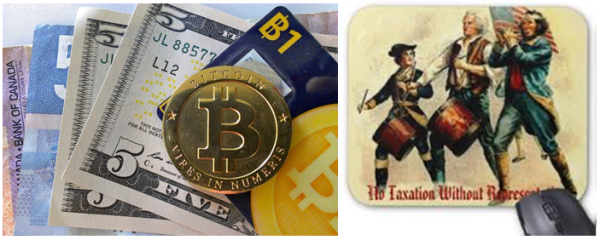
Figs. 1. and 2.
blog post small

Governments are wrong to assume all or most forms of digital currency are associated with illicit activity. We all know there have been bad actors out there in the digital currency space, and we know that some platforms like Silk Road have been attractive to them. Yet we must not forget that most bad actors use normal currency more often, and more importantly, the form of the currency is not as important as what the actor does with it.

Since we are at the beginning of the digital currency revolution it scares big governments who use traditional currencies to govern and collect taxes, and in some countries like Venezuela, Rwanda, Iraq, and Libya, they commit war crimes, financial fraud, and they steal from their citizens under the auspice of a legitimate financial system. In these countries, could a new more secure digital currency inspire a government revolution showing more transparency in currency movement and tax records sustaining democracy, human rights, and economic growth? The point here is that governments have abused their power to collect taxes and regulate financial services since the beginning of time. Didn’t the United States fight the Revolutionary War to stop excessive and unjust taxation from the British, and prior to the formation of the United States (July 4, 1776) the Thirteen Colonies had their own contradictory currencies, used the Spanish dollar, and counterfeiting was widespread by government and non-government people alike. Indeed governments should discourage immoral activity via legislation but not innovation in payment methodologies because lots of good can come from these new technologies. We as a world must think harder, longer, and we must inspire debate among global leaders for a better currency form in the future as paper cash is too darn simple and will soon grow more insecure due to better printer technologies observing the endless capabilities of the 3d printer.

Figs. 3. and 4.
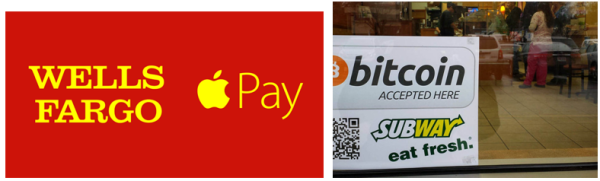
Bit Coin Apple Pay
Conservative Wells Fargo led the industry in a surprise joint effort with Apple for the iPhone Apple Pay application in Oct. of 2014, setting a new standard with a mobile digital currency that has great security. Wells Fargo’s move to Apple Pay is a step closer to a digital currency and it is gaining traction and according to Forbes.com 10 major banks have now signed up for it (http://www.forbes.com/sites/roberthof/2014/12/16/apple-pay-gets-more-bank-support-but-it-still-needs-a-lot-more-stores-to-succeed/). Yet like most new technologies it takes time for others to upgrade to it, and in this case that means retailers need new software and terminal equipment that will accept the mobile payment platform. Although this takes time and money, every new technology does, and over time I believe it will save retailers money and time. Imagine a busy retailer two years from now who has no ability to take mobile payments during a busy holiday rush, they will have to staff more people, suffer more human error via cash transactions and manually entered credit card transactions, risk employee theft of unmasked credit card numbers, and customers will leave feed up with how long it takes to be serviced. Conversely, imagine a busy retailer two years from now who has the ability to take mobile payments, they will staff less people, customers can check themselves out and the risk of human error is reduced while security has the potential to be better. Moreover, in a hyper competitive retail market this can bring prices down and service levels up to the benefit of the customer, the community, and the technology sector. This is where innovation is born and some Subway franchise owners have taken the lead as of Nov. 2013 (http://www.cnbc.com/id/101211284). Economic policy makers must not hide from this better future and should take note from the private sector.

Fig. 5. Subway entrepreneur using Bitcoin:

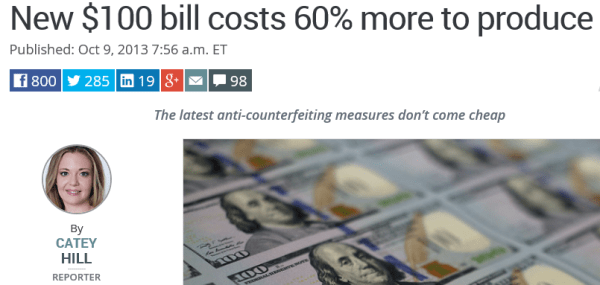
It is likely less costly to make and secure digital currency than it is to make and secure cash and coins. Every time the U.S. Mint releases a new version of its bigger bills it takes years to develop, billions to make, billions to secure, they have to burn and shred billions of old bills, and a credible 2013 Market Watch Report backs this up by saying, “the new hundred dollar bill costs 60% more to make than the prior version” (http://www.marketwatch.com/story/new-100-bill-costs-60-more-to-produce-2013-10-08). With this type of growth rate how can these costs be sustainable especially as the population grows and paper resources become sparser?

Fig. 6.

New 100 Bill

Conversely, we know that technology costs go down or stay even when balanced for inflation over time. We also know that RAM memory, CPU speed, CPU size, fiber optic cable connectivity, and data encryption have made exponential leaps in the last five years thus making the environment for digital currency ripe. After all, many governments including the U.S. claim to have cloud, server, metadata, and predictive analytic technologies that manage to monitor and track all the internet transactions in most of the world, and the private sector would agree with this. If technology is this good why then can’t we have digital currency?

The answer is that change takes time and government bureaucrats have insulated themselves with yes lobbyists who support the current status quo. Supporting the current status quo is big business after all there are secured vehicle companies, printing companies, risk management companies, and many other companies that make money off the current financial regulatory system; lots of jobs and money are at risk if the current model would change. A good example of this is what happened to the film based camera company Kodak when it failed to respond to digital, but with digital currency its worse because we are dealing with big government and elected leaders who are at best imperfect though at times well intentioned. Yes there are some true leaders out there like Congressman Steve Stockman (R-TX 36th District) who took Bitcoin donations on his campaign and introduced the Virtual Currency Tax Reform Act (http://www.forbes.com/sites/perianneboring/2014/04/08/breaking-rep-stockman-to-introduce-first-bitcoin-bill/) to get the dialogue on Capitol Hill started but the bill has not yet passed and more work and research needs to be done. We as business/tech people need to be a loud part of this research and discussion and then more elected leaders will support it.

Lastly, digital currency moves the world closer to a one world currency where foreign exchange risk is significantly reduced or eliminated. Thus tariffs and geopolitical economic sanctions will be easier to see, prevent, and private sector companies that do a lot of international trade can benefit from that. Are there too many currencies throughout the world and would one global currency be better? Well it would be better in that there would be fewer economic highs and fewer economic lows but it would be worse in that highly valued companies and individuals would be greatly devalued in the developed world and some in the U.S. would argue that violates the free market principles of the constitution and discourages private sector competition. Moreover, a one world currency would be impracticable to support and would violate state sovereignty across the world yet that didn’t stop China from advocating for it in 2009 and subsequent years according to this credible source (http://usa.chinadaily.com.cn/world/2014-01/29/content_17264069.htm).

In sum, I don’t think a one world currency is the answer as I do think it would violate free market principles. Yet I do think a leading digital currency is needed when it can have transparent transfer rates, a secure audit trail, and can enable some cross-border economic development to balance out the third world so they don’t have to go to loan sharks for their crop loans. Cheers to our digital future!

If you want to hire me to speak at your next event or consult for your company on these and related topics concerning financial services risk, process improvement, project management, and related areas please contact me.

Former FDIC Chair Shelia Bair Comments On Bank Bailouts, Peer-To-Peer Lending, And Tax Reform

On Tues, 04/08/14, former FDIC Chairperson Shelia Bair visited Minneapolis and offered commentary on the financial services industry, peer-to-peer lending, systemic risk, and the recent recession.  Bair is educated as an attorney and was Assistant Secretary for Financial Institutions at the Treasury Dept. and a professor at the University of Massachusetts Amherst before she moved over to Chair the FDIC from 2006 to 2011.  At the FDIC Bair helped the nation’s financial system out of an exacerbated recession and unprecedented bank run from 2007 to 2010 but not without ruffling a few feathers.

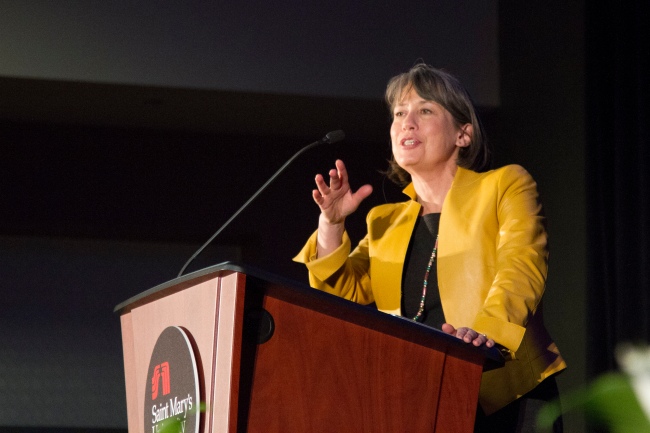
Addressing a sold out crowd including former Congressman Tim Penny and other elected officials, business people, students, and ethically minded community members, Bair had the honor of being the keynote speaker at Saint Mary’s University of MN’s publically broadcasted Hendrickson Forum on Ethical Leadership.  Bair opened her keynote by describing how unimpressed she was that when she arrived at the FDIC in 2006 the organization had little to no info on sub-prime lending and had to buy a database to conduct research on it.  This was in part due to the fact that sub-prime lenders were private and not a part of deposit institutions and thus slightly out of scope for the FDIC at that time.  Bair did not inherit a perfect FDIC, and it can be inferred that the FDIC should have been paying attention to sub-prime lending far sooner as it was directly related to many elements that affect deposit institutions including real estate, entrepreneurship, income and tax, and community redevelopment.

Image

Bair now free from the constraints of holding a Washington office spoke openly about how she felt hindered to speak to the human element of the financial crisis while at the FDIC.  She indicated that although she was a part of the team that brokered the historic bank bailouts (2008-2009), that she has some serious reservations about that, because it was “too generous and uneven” and “helped the banks far more than it helped homeowners and families”.  She also described regular disagreement with then Treasury Secretary Timothy Geithner and suggested he was too close to many of the bank executives who benefited from the bank bailouts.

She further described miscommunication and lack of collaboration as Geithner worked around her efforts at the FDIC, and the undertone of this was political disagreement over which agency should lead the recession resolution in terms of the banking industry.

At present, Bair supports the Dodd-Frank Act because it favors bankruptcy and a three-year claw back for executives over a bailout in the event of a bank failure.  Although Bair in the past has said she disagreed with Janet Yellen’s support to repeal the Glass-Steagall Act, she presently indicated she still supports the new Fed Chair and viewed her as a reliable Washington outsider.

Image

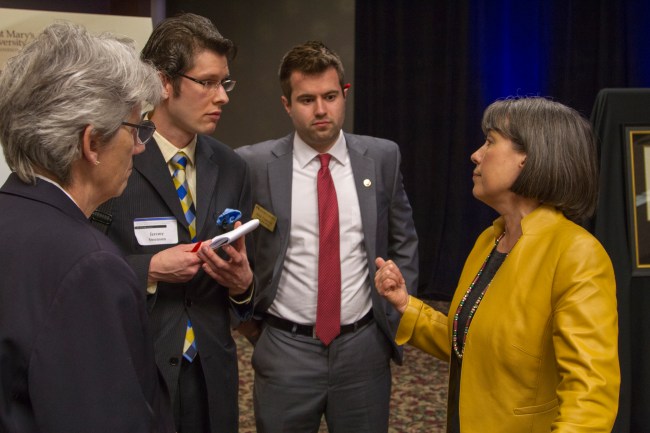
When I directly questioned Bair on the growth of peer-to-peer lending she seemed cautious about its long-term viability citing an unknown regulatory landscape and even recounted that peer-to-peer lender Prosper lost many investors during the worst months of the recession.  In discussion with Bair I observed that she, like many banks, is in a wait and see mode with peer-to peer-lending, but she did indicate that for customers consolidating higher interest rate debt it can be a good thing and that could in turn force banks to be more customer centric with better terms.

Yet I am more optimistic on peer-to-peer lending than Bair in partnership with many respected peer-to-peer investors including Google who invested $125 million in Lending Club and the former CEO of Citi Group, Vikram Pandit.  It is really telling when the former Citigroup CEO goes against his own industry in favor of a tech-heavy new lending model, but he is right because most customers no longer need the big bank branches and elaborate services that are fee heavy.  Moreover, peer-to-peer lenders offer attractive rates, diverse portfolio options, and low operational costs and that keeps investors and borrowers happy.  Just like online news slaughtered traditional print media, as soon as peer-to-peer lending gets more regulatory backing it will slaughter traditional fee-heavy banks if they don’t adapt to this new environment.

When commenting on federal sequestration Bair showed frustration and disagreement over the automatic spending cut approach and instead suggested that tax rates be reduced and restructured in a number of areas to encourage more employment, keep businesses in the U.S., and encourage business innovation which would in turn provide more income and employment thus bringing in a greater amount of taxable income to offset her proposed tax reduction.  This truly can be a helpful aspect of the budget deficit issue in that taxes in the U.S. are far too high and there are some needless loopholes that harm many and help few.  The 2.3% Medical Device Tax is an example of this as it encourages the many medical device companies in MN to move their operations outside the U.S. due to the high tax cost, and it adds to their cost of doing business thus reducing their ability to get favorable loans.

Lastly, as an advocate for consumer protection and creative thinking I asked Bair if she had any insight on what the massive Target data breach might mean for the banking and related industries — where an estimated 10-15% of the 40 million affected cards have encountered some type of fraud — and she reminded me that the banks are taking the losses before the retailer does.  Although she offered no specifics other than suggesting that debit cards are more relevant, she shared my concern that data security is a growing factor in financial regulation yet I was then reminded that Bair is more of a politician and economist than a technologist.  Yet from an economic policy standpoint if the nation encounters more data breaches like this it could drive the cost of goods up thus forcing more costly and secure card payment products perhaps with biometrics on them.

Photos by Rick Busch.

Written by Jeremy Swenson (c)