
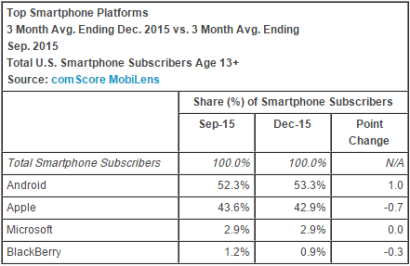
There is no doubt that Microsoft is a tech super power in this game of smart phone wars, but Google’s Android and Apple’s iOS have challenged them to date. As per Fig. 1. Microsoft’s phone OS (operating system) market share has stayed about steady at about 2.9%. Blackberry on the other hand has so little market share they are hardly worth mentioning since their mobile phone OS market share has dropped to .09% at the end of 2015 (Fig 1.). Although different phone OS market research reports have slight up or down variations, the point is that Microsoft and Blackberry are hugely losing the Smart Phone Wars.
Fig. 1.
 Last time Cassem and I commentated on this situation was August of last year when Microsoft was high on the release of Windows 10, arguably their best operating system in a decade but not without risk. In our last piece we valued many aspects of Microsoft’s products including the Cloud, SharePoint, and Windows 10 for business users, but we only began to address the full story. Yet our prior conclusion that Microsoft as a company is undervalued is unchanged because they have so many successful products including Server, Exchange, Visual Studio, System Center, Dynamics, and SharePoint, in spite of their phones weaknesses.
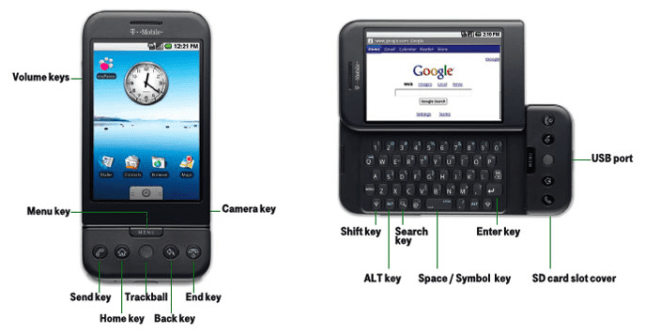
In this post we will specifically explore why Microsoft is losing the smart phone war and what can be done about it so they can win. First of all, Microsoft was late to the game in October 2010 with the release of the Windows Phone 7. Google was early with the T-Mobile G released in October 2008. (Fig. 2.). Apple was the first with the iPhone 1 released in June 2007. Microsoft’s late entrance in conjunction with their delay to take phone apps seriously has proven to push app makers to the dominate platforms, Android and iOS.
Mobile applications are increasingly addictive for phone users and since the Windows platform has so few that means most mobile gamers, media streamers, and multitaskers will avoid the Windows Phone in the immediate future. Most corporate mobile phone contracts favor the iPhone and those contracts will take years to be undone to the detriment of Microsoft.
Fig. 2.
 With 53.3% (Fig. 1.) of the phone OS market share there are a few things that Android got right. The integration of Google Calendar is easy, useful, and free. Conversely, on a Windows phone, the integration of Microsoft Outlook is awkward, overly optimized for a traditional PC, and it’s not free for the full version. As an owner of many Android phones I can see how the many OS updates have proved to make the platform much better with more efficiency and less bugs, especially on the Lollipop release of Android.
Apple comes in second with 42.9% of the mobile OS market share (Fig. 1) because they have gotten a lot of things right. Apple’s OS works well together and is recognized as artful by the majority of the creative community — their early integration of iTunes and the iPod into the iPhone made it a big hit. Also, you can use the iPhone with Apple TV, an iMac, iCloud, the Apple Watch, and Airport Time Capsule, to name a few. ITunes has been a force to deal with but has started to lose market share in recent years as streaming services and other digital music services have come on board, specifically Pandora and Google Play. Android users will say iPhones are overly simplistic, but to those users, that is a benefit. There are a lot more settings options in Android, but Apple fans feel they don’t need all those features. This is one ongoing battle between iOS and Android.
Security varies greatly in each of the platforms. Apple has a very secure and closed off OS and network and they rarely share info with other tech companies. Apple’s app network is also massive and thus they have experience with a lot of different architectural frameworks and they are good at approving and declining apps based on security. Unlike Apple, Android has had some issues with fake apps designed to compromise security that were available for download in the app store. Additionally, in recent weeks Apple has taken a respected but partially controversial stance to protect its user’s privacy in the wake of what many argue is an overreaching government. (In Debate Over Apple-FBI Dispute, Gates And Zuckerberg Don’t Agree). This is a public debate that needs to continue and unfortunately as of now, Microsoft has given a more a-political and lukewarm response to this debate – though Microsoft founder Bill Gates disagrees with full privacy coverage arguments.
Windows 10 appears to be a pretty solid platform that builds off of some security benefits of Microsoft’s enterprise systems. Windows 10’s Credential Guard protects corporate identities by isolating them in a hardware-based virtual environment. Device Guard depends on Windows 10’s virtualization-based security to allow only trusted applications to run on devices — letting the service use signatures defined by your enterprise-controlled policy (Tech Net Device Guard Overview). In our mind, Microsoft needed to do this to help leverage its legacy network of enterprises that could upgrade to the new Windows 10 OS in the most secure way including Server, Exchange, Visual Studio, System Center, Dynamics, and SharePoint.
Moving on, iPad and Android based tablet customers have been frustrated with the slow speed and low power and functionality of these devices for a long time. In response to this Microsoft has been an innovator and leader with the design and release of the Microsoft Surface. The Surface redefines what a tablet can be. It brings full computer power, something that had not been done on a tablet in the past. As the Surface improved up to its latest iteration, the Pro 4, it proved to validate the clever Windows 10 OS. As of January 28th 2016 Surface sales are up 29% from last year (2015) (Microsoft Q2 2016 Earnings Report) which suggests that with the right improvements they could also get considerable gains in the phone market.
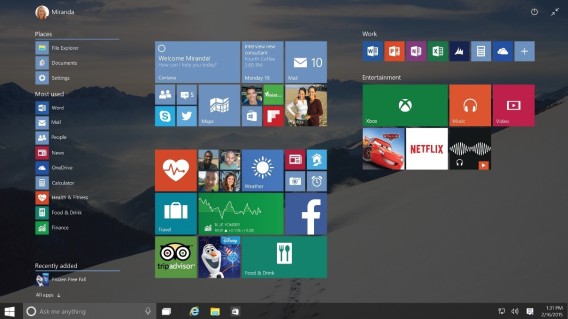
Why would someone change to a Windows Phone? First off, there are a lot of users out there that are familiar with Windows in general. “For example, Skype has been downloaded more than 900 million times on iOS and Android devices, Microsoft CEO Satya Nadella said during a recent earnings call” (Microsoft Q2 2016 Earnings Report). The only problem in most people’s minds is that they use their phone differently than they use their PC. Microsoft has to convince these people that there are similarities, cross-usage benefits, and that the user experience is better or good. From a user experience standpoint, Windows Hello is a great feature that provides for facial recognition log in and Cortana is the virtual assistant that is controlled by voice recognition (Fig. 3.). Positively, Office Mobile comes with all Windows 10 phones and that includes a great iteration of PowerPoint with a fun and easy to use interface (see video below). Moreover, all Windows 10 phones can connect to Blue Tooth keyboards, mice, and dual monitors. Granted, the mobile version doesn’t have a desktop built in like the PC version does but it has something better for the mobile environment, Continuum. Continuum turns your phone into a big-screen projector and a big-time productivity tool when you have the Microsoft Display Dock as described in the video below.
Fig. 3.
The new Windows 10 is a much more connected OS than previous OSs. It seems that part of Microsoft’s strategy is connecting the new OS with their cloud business over time. The Windows 10 Phone gives a lot of connected apps that show new emails, current weather, and news just by glancing at the home screen. In the iPhone, the icons will rarely show updates. The only iPhone app that comes with the phone that shows updates is the calendar app. This is an idea that is built into Windows 10 giving people the convenience of not actually having to open the app to get the information they are quickly looking for. If they want more information, they can open the app and go from there. Lastly, the criticism of Nokia as a phone company is exaggerated. It is a good thing for a hardware and software company like Microsoft to own a phone maker and although not all Lumia models have been hits they have a positive trajectory. This trajectory is due to enhancements including a great camera, crystal clear screen, a removable battery, Windows Hello, Office Mobile, and most of all its ability to transform into a desktop computer via Continuum.
Jeremy Swenson and Mike Cassem are two seasoned, Intel certified, retail technology marketing and training representatives on assignment at Best Buy for clients including Intel, Trend Micro, Adobe, and others. Swenson doubles as a Sr. business analyst and project management consultant while Cassem doubles as a Marketer and Sales Consultant. Tweet to them @jer_Swenson and @micassem.


 Windows 10 also introduces a function that allows you to utilize multiple desktops not just screen extensions, and this is a lot like Mission Control from Apple OS X. This will be a big benefit for business users, creative users, students, and people who do a lot of multitasking. The hot key shortcut to open a virtual desktop is: Windows key + Ctrl +D. Windows 10 also adds something new for gamers and graphics focused users, direct X12, which is a Microsoft proprietary graphics card decoder that communicates with and optimizes the many different graphics chips on thousands of computer models. It is the industry standard and that is why it’s used on the hugely popular X-Box. Windows 7 and 8.1 will not get access to direct X12 so graphics will be better on Windows 10. A creative person could even game in one desktop while they work in another assuming they have the RAM and CPU power needed for those specific applications – this is pretty cool. Another interesting visual add is the Windows Snap feature which allows you to split your screen into two, three or four separate areas and the hotkey shortcuts for this are:
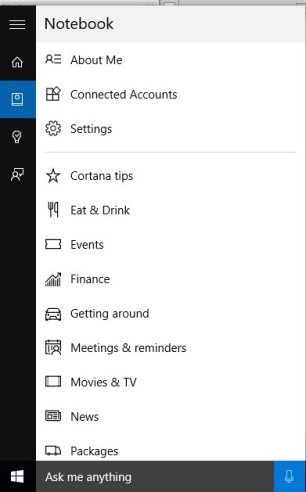 After upgrading to Window’s 10, we weren’t sure if we would use Cortana, but the more we use it the more we like it. In playing around with Cortana, you can provide feedback with screenshots that go right back to the teams at Microsoft. To prepare for the 10 release Microsoft was using an estimated five million external testers known as “insiders” to get this type of bug feedback. This impressive number is a considerable increase from prior releases. Cortana is easy to locate in the bottom left of the screen next to the start menu. We find that if the user types a question in the search bar it will add tips and give you interesting facts each and every day, if you let it. Cortana starts out giving you information on the weather, finance, and sports but you can customize this under notebook settings (Fig. 3). Cortana is very intuitive and can track things for you. If you’re receiving a package, it will tell you the progress or details of that package. Say you’re picking someone up at the airport, Cortana will tell you if the flight is on time.

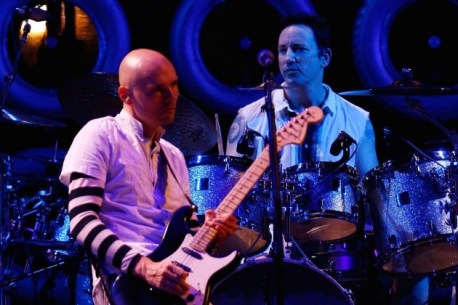
 This entrepreneurial effort is only likely to gain momentum and it shows that Chamberlin’s creativity is beyond music. In terms of the Smashing Pumpkins it shows that Billy Corgan is likely to tap Chamberlin’s business sense to help remake and remarket the Smashing Pumpkins since the band has been mostly a revolving door over the last 6 years. It will be much harder for Corgan to lose Chamberlin this time around as he has the ability to cross market the band’s shows via his company, even if it’s still in development mode. Corgan and Chamberlin truly could be at the beginning of a new music business nirvana but let’s hope egos and miscommunication do not get in the way of a reunion that has a history and talent that is worth much more than a small summer tour.

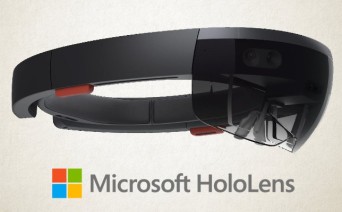 1) We knew there would come another well-positioned company who makes a pair of smart glasses like Google Glass and that it will derive more competition and innovation. Microsoft raised their hand right away with their HoloLens glasses which are hologram based, slightly “gamified”, and seemingly better than Google Glass largely because they tied it in with known Windows functionality (broader offerings). See a video of this cool new technology here:
 There is no doubt that mobile will continue to grow and will be used on smaller devices like watches, ear buds, pacemakers, and contact lenses. Web design has shifted so fast to mobile that sometimes good web design and user experience is forgotten about for non-mobile users or business users who on average spend much more time on those same sites than mobile users. Thus a better balance of the two design types is needed, and an app is a separate project all together yet still needed. I also think Microsoft will take more mobile market share away from Android and Apple since they have learned a lot from their Windows 8 release and are quickly working to release Windows 10 as a better touch based mobility optimized O.S. that many are excited to try.
 1) Stakeholder Management: Attain clear support from the executive stakeholders from the beginning of the project and schedule regular check-in meetings with them ahead of time as they tend to be very busy and are often pulled in many directions. Set the tone that their participation is needed and that they will need to approve change requests which is not uncommon. You should also use clever people skills and empathetic listening skills as you interview the many high-level stakeholders in the early part of the project so as to diffuse conflict and get consensus on disagreements about scope, business goals, order, and to find out who will be the thorn in your back as the sooner you know that the better. Also, accept that stakeholders will be different and they may not even directly work for your company which is ok as those ones tend to offer specialized expertise and are often very creative.
 3) Quality Management: Having worked on many complex projects in highly regulated industries over the last 5 years I have noticed a shift towards agile methodologies vs. waterfall. From my perspective this is really about quality and timely flexibility. Aligning the project tasks in small pieces allows you to test the results independently and faster, and if the results are bad that’s a good thing because it’s just one piece of the project and you can learn from it – getting an early warning. Yet to get better quality out of an error you need to have documented what went into the error from beginning to end and you need intelligent consensus. On SDLC projects there will be many small errors which then raise questions about other systems and how they relate to the business rules. Yet with good process flows, screen shots, and JAD sessions with key people, you can ensure that these errors are nothing more than normal bumps in the road. Every project has its bumps but the real test is having above average quality on budget and on time at the projects end thus creating a reusable plan others can learn and be inspired from.
 4) Risk Management: In this new era where almost everything is in the cloud and hackers are targeting large and mid-sized companies to steal and sell their data, every risk analysis document/plan should take into consideration data security, customer privacy, access controls from the project team, and there should be an independent audit plan – often out of scope of the project and done by a different group for checks and balances. No project has no data so data is always a part of a project, sometimes more and sometimes less. Question number one is who should have access to the data and at what point? In today’s environment you should embrace a need to know policy and you should document that to reduce risks. You should also imagine a worst case scenario and be prepared for it and run this by the executive project sponsors, and/or risk officer if your company has one.

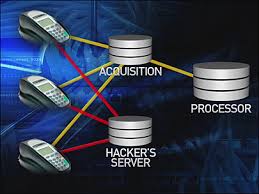
 The general consensus is that a HVAC contractor for Target, Fazio Mechanical Services, who had access to Target’s networks got their own networks hacked via an e-mail phishing attack, normally an elementary attack method; yet that attack installed malware that then got onto Target’s network and installed more malware that copied personal data from Target’s payment processing terminals when it was in the “working memory area” or “cache” of the software/system – that is before it gets encrypted to be sent to the bank to be authorized. This is part of the reason why it was not detected so fast and yes these hackers were smart.
 Yet Target did not take this alert seriously but why? Fear of change, ego, poor leadership, and too much bureaucracy got in the way of the costly software’s effectiveness. At the time of the breach FireEye was a new software tool for Target’s technology group and what I know about new technology is that people delay embracing and learning new systems of out of fear that those systems will be buggy or not as good as the old ones. I understand this very well having worked part time in the P.C. dept. at Best Buy for more than 3.7 years representing Intel and related software makers Microsoft, Symantec, Trend Micro, and Adobe. When Windows 8 came out all kinds of people were doubting it not because it was bad but because it was more work to get to know, and if they saw something really different about it, they were inclined to think it was a bug when in fact it was a useful design feature they didn’t yet understand. The same bias can be applied to Apple computers. People falsely think that they are immune from viruses because Apple designs them that way. What a joke. Apple computers are only as secure as their understanding of the latest virus. Yes it is true the Apple operating system is not targeted as much for viruses but it is also not used as much and it is hardly used by large companies and governments.

 Although Prince is no lawyer, he has hired some great ones over the years, L. Londell Mcmillan – the famous entertainment lawyer and owner of the Source R&B Magazine, and Clive Davis – the Harvard Law educated record mogul, chart-topping producer, and long time record company CEO at Sony, Arista, and J records. Prince’s legal and business maneuvers have helped him win a legal case against his estranged half-sister, got him out of an unfavorable contract with Warner Bros in 1996 to redefine his brand under a new name thus renewing interest in his art, allowed him an open record deal at Arista Records in 1999, and in 2004 his business team came up with the idea to sell his album with each concert ticket sold for his large worldwide Musicology arena tour thus bringing his album sales numbers to the top of the Sound Scan charts in an unprecedented move. Yet Prince like the King / Elvis has lost a few battles, mostly due to his poor management style and huge ego. In one case a European court ordered him to pay $2.95 million dollars to a European concert promoted he stiffed — for good or bad reasons – Prince is indeed battle-tested. Yet presently he has renegotiated a new contract with Warner Bros to re-master and remarket Purple Rain and many of his best albums of years ago and for the most part, he gets the rights to the masters which is unheard of for most artists. Purple Rain helped broaden free speech in music for today, brought about “explicit lyrics” stickers, and encouraged multiculturalism in a band that has mass appeal.

 Abstract Forward Consulting