
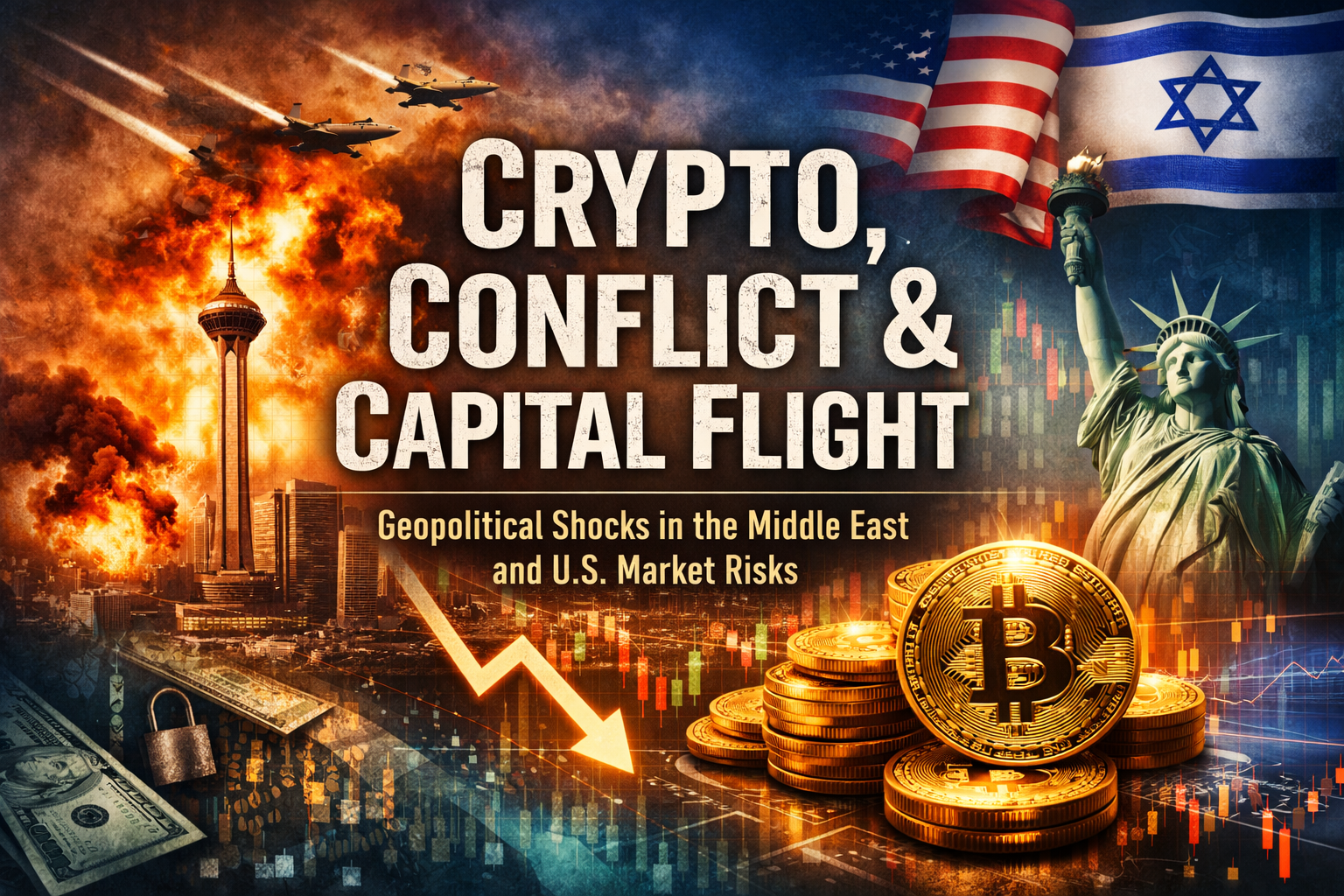
In late February 2026, shortly after coordinated U.S.–Israeli airstrikes struck targets in Tehran, blockchain analytics firms observed an abrupt spike in cryptocurrency withdrawals from Iran’s largest digital asset exchange. Within minutes of the strikes, Nobitex reportedly experienced a roughly 700 percent surge in withdrawals, with millions of dollars in crypto leaving the platform in a compressed time window.¹ This episode, while modest in absolute global market terms, offers a revealing case study in how digital assets function during geopolitical stress—and what that may signal for Middle East economics and U.S. financial markets over the next year.
A Rapid Withdrawal Shock:
Reporting indicates that nearly $3 million exited Nobitex in a single hour following the strikes, with approximately $10 million leaving Iranian exchanges over several days.² Such flows are small relative to global crypto trading volumes but significant within the Iranian financial context, where capital controls, sanctions, and currency instability already shape economic behavior.
Iran’s domestic currency, the rial, has faced long-standing pressure from inflation, sanctions, and restricted access to global banking networks. In that environment, cryptocurrencies—particularly Bitcoin and dollar-denominated stablecoins—have increasingly served as alternative stores of value and channels for cross-border transfers.³ The surge in withdrawals appears consistent with crisis-driven capital preservation behavior rather than speculative trading alone.
Crypto as a Financial “Pressure Valve”:
The events underscore crypto’s evolving role as a decentralized financial “pressure valve” in sanctioned or conflict-affected economies. When traditional banking rails are constrained or politically vulnerable, digital assets offer relative portability and censorship resistance.¹
Internet blackouts and temporary exchange disruptions complicate interpretation. Outages can cluster transactions when connectivity resumes, making withdrawal spikes appear sharper than underlying demand alone would suggest.³ Nonetheless, the pattern aligns with prior episodes in emerging markets where digital assets gained traction during currency stress.
The lesson is not that crypto replaces sovereign financial systems, but that it increasingly supplements them under strain.
Economic Implications for the Middle East (Next 12 Months):
Looking forward, several dynamics are likely to shape regional economics:
1. Expanded Informal Dollarization via Digital Assets. Sanctioned or financially constrained economies may see broader retail and institutional adoption of dollar-linked stablecoins as parallel monetary tools.
2. Heightened Regulatory and Surveillance Pressure. As crypto flows intersect with sanctions regimes, U.S. and allied regulators are likely to intensify scrutiny of exchanges, custodians, and cross-border blockchain activity.¹
3. Persistent Capital Flight Incentives. Geopolitical volatility increases incentives for households and firms to diversify outside domestic banking systems.
4. Infrastructure Fragility Risks. Internet shutdowns and exchange outages remain structural vulnerabilities in crisis environments.³
Collectively, these forces suggest that digital asset adoption in parts of the Middle East will continue—not as ideological endorsement of crypto, but as pragmatic economic hedging.
What This Means for U.S. Markets:
For U.S. investors and policymakers, the implications extend beyond regional headlines.
Oil and Energy Sensitivity. Any escalation involving Iran carries oil supply risk implications. Even absent sustained disruption, perceived risk premiums can lift energy prices.
Safe-Haven Flows and Dollar Strength. Periods of geopolitical tension historically reinforce demand for U.S. Treasuries and dollar-denominated assets. Concurrently, Bitcoin and gold often experience volatility tied to risk sentiment shifts.⁴
Regulatory Spillover. If crypto is increasingly viewed as a sanctions-adjacent vector, U.S. enforcement posture may tighten, affecting exchanges and institutional investors.
Systemic Interconnectedness. Crypto is no longer a siloed asset class. It is embedded within global liquidity networks. Geopolitical events can trigger rapid on-chain responses that ripple into equities, commodities, and foreign exchange markets.
Forecast—A Converging Risk Landscape:
Over the next year, expect three converging trends:
- Greater integration between geopolitical risk modeling and digital asset analytics.
- Increased compliance burdens on global crypto infrastructure providers.
- Continued volatility transmission across oil, crypto, emerging market currencies, and U.S. equities during regional escalations.
The Iranian withdrawal spike may have involved only millions of dollars—but its significance lies in what it signals: digital capital now moves at the speed of conflict.
For U.S. markets, that means geopolitical shocks increasingly transmit through hybrid financial rails—traditional and decentralized alike. Outside of economic considerations, peace is desirable for the benefit of all.
Bibliography:
- Yahoo Finance. “Millions of Dollars in Crypto Left Iranian Exchanges After Airstrikes.” February 2026.
- Economic Times. “Why Did Iran’s Largest Crypto Exchange See a 700% Withdrawal Spike Minutes After US–Israel Airstrikes Hit Tehran?” February 2026.
- Bitget News. “Iranian Crypto Exchange Records Surge in Withdrawals Following Tehran Strikes.” February 2026.
- Forbes. “Iran War, an Oil Crisis, a Crypto Stress Test.” March 2026.
 Abstract Forward Consulting